Immediate Response Rodent Control
in Long Beach, California
Rats and mice don't wait. Neither do we. PestPunt dispatches licensed rodent control technicians across Long Beach — from Downtown to Belmont Shore, Bixby Knolls to Naples Island — with same-day availability and a treatment plan tailored to your property and neighborhood.



Why Long Beach Has a Persistent Rodent Problem — and Why Fast Action Is Critical
Long Beach is one of Southern California's most densely populated coastal cities, and its geography, climate, and urban layout create near-ideal conditions for rat and mouse activity year-round. Understanding the local dynamics is the first step to controlling them.
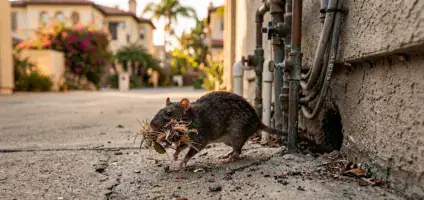
The city's proximity to the Port of Los Angeles and Port of Long Beach — among the busiest cargo ports in the world — means Norway rats (Rattus norvegicus) have been establishing populations in the harbor district and surrounding neighborhoods for generations. These rats are burrowers. You'll find their tunnel networks running beneath the older residential blocks of North Long Beach, under the landscaping in Bixby Knolls, and along the drainage channels throughout the Westside.
Roof rats (Rattus rattus), by contrast, thrive in the mature tree canopy that lines streets in California Heights and Los Altos. These agile climbers move along utility lines, drop into attic vents, and establish nests in insulation before most homeowners notice any activity. Long Beach's Mediterranean climate — mild winters with average lows around 48°F and warm, dry summers — means rodent breeding continues across most of the calendar year. There is no reliable "cold season" that naturally suppresses populations.
The canal and waterway network in Naples Island provides ideal cover and food access for both species. Waterfront restaurant waste near Belmont Shore's 2nd Street corridor creates persistent food-source concentrations that sustain large populations even when individual properties are treated in isolation. Downtown Long Beach's mixed-use development — older commercial buildings adjacent to residential conversions — creates structural gaps that rodents exploit between neighboring properties.
The window between noticing the first sign of rodent activity and calling a professional is where infestations accelerate most rapidly. A single breeding pair of Norway rats can produce 20–40 offspring in under six months under favorable conditions. In Long Beach's climate, conditions are almost always favorable. Every day without an effective intervention program is a day the infestation deepens.


Harbor-Adjacent Pressure
Norway rat populations established near the Port of Long Beach create constant reinfestation pressure on residential areas within a 3-mile radius of the harbor district.
Aging Housing Stock
Craftsman bungalows, post-war stucco homes, and older apartment complexes in California Heights, Central Area, and Lakewood Village develop natural entry points as siding, vents, and foundations age.
Year-Round Breeding
Long Beach's mild climate removes the seasonal population suppression that colder regions experience. Rodents breed in virtually every month of the year across all ten neighborhoods we serve.
Urban Food Availability
Dense restaurant corridors in Belmont Shore and Downtown, improperly stored compost and trash in residential areas, and citrus trees throughout Los Altos provide sustained food sources that support large populations.
Signs of a Mouse or Rat Infestation in a Long Beach Home
Rodents are nocturnal and deliberately avoid detection. By the time most homeowners identify the problem visually, the infestation is already well-established. These are the early warning indicators to look for in your Long Beach property.
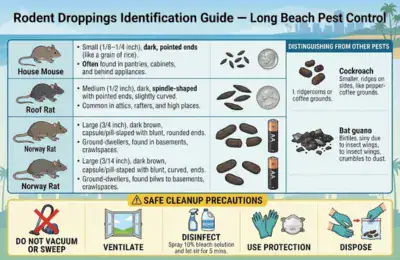
- Dark droppings near food storage, under sinks, in kitchen cabinets, or along wall edges — Norway rat droppings are capsule-shaped and about 3/4 inch long
- Gnaw marks on structural wood, electrical wiring, PVC plumbing, and food packaging — fresh gnaw marks appear lighter in color
- Grease smear marks along baseboards, pipes, and wall edges where rodents travel repeatedly, leaving oil from their fur
- Shredded nesting material — insulation, paper, fabric, or plant matter — found in attic spaces, wall cavities, or behind appliances
- Scratching or rustling sounds at night in walls, ceilings, or under floors, particularly in older Long Beach homes with accessible crawl spaces
- Runways and burrow holes in garden beds, near foundations, or alongside fences — particularly common in Bixby Knolls and California Heights properties with mature landscaping
- Pet behavioral changes — cats or dogs showing interest in walls, under appliances, or in areas where they normally do not investigate
- Damaged fruit or vegetables in home gardens, with characteristic gnaw patterns on citrus, tomatoes, and avocados — a common sign in Los Altos properties
- Unexplained electrical failures in older wiring — rodents chew through wire insulation and are a documented cause of residential electrical fires in Los Angeles County
- Ammonia-like odor in enclosed spaces such as pantries, crawl spaces, or garages — indicating accumulated urine from an active rodent colony
Rat or Mouse? How to Tell Which Rodent Is in Your Long Beach Home
Misidentifying a juvenile rat as a mouse is one of the most common — and most costly — mistakes a homeowner can make. The wrong identification leads to the wrong trap size, the wrong bait placement, and a DIY treatment that fails within days while the real infestation keeps growing.
| Characteristic | Norway Rat | Roof Rat | House Mouse |
|---|---|---|---|
| Body Length | 7–9.5 inches, stocky build | 6–8 inches, slender build | 2.5–3.5 inches |
| Tail vs. Body | Tail shorter than body | Tail longer than body | Tail roughly equal to body |
| Droppings | Capsule-shaped, ~3/4 inch | Spindle-shaped, ~1/2 inch | Rod-shaped, ~1/8–1/4 inch |
| Preferred Location | Burrows, foundations, crawl spaces | Attics, trees, roof lines | Wall voids, cabinets, garages |
| Common Long Beach Areas | North Long Beach, Westside, Naples Island | California Heights, Bixby Knolls, Los Altos | All neighborhoods, especially older homes |
Health Risks From Rats and Mice — and How to Reduce Them
According to the CDC, rats and mice spread more than 35 diseases worldwide, either directly through droppings, urine, and bites, or indirectly through fleas and ticks that have fed on infected rodents. Long Beach's mild, humid coastal climate keeps rodents — and these risks — active nearly year-round.
- Hantavirus — spread by breathing in dust contaminated with deer mouse droppings or urine. The California Department of Public Health continues to track hantavirus activity statewide.
- Leptospirosis — carried in rat urine and spread through contact with contaminated water or soil, a relevant risk near Naples Island's canals and Belmont Shore's waterfront properties.
- Salmonellosis and rat-bite fever — rodents track bacteria across food-prep surfaces as they travel, and bites or scratches from live or dead rodents can transmit rat-bite fever directly.
- Asthma and allergy flare-ups — airborne dander and dried droppings are a documented trigger, particularly for children and household members with existing respiratory sensitivities.
- Secondary parasites — fleas, ticks, and mites frequently accompany an active rodent population and can spread their own infections independent of the rodents themselves.
- Contaminated insulation and wiring — beyond the fire risk of chewed wiring, urine-soaked attic insulation can continue to pose a respiratory risk long after the rodents themselves are gone.
The CDC's official guidance for safe rodent clean-up is Seal Up, Trap Up, Clean Up: never dry-sweep or vacuum droppings, since disturbing them can release airborne particles. Thoroughly wet the area with a bleach solution or an EPA-registered disinfectant first. See the CDC's full rodent clean-up guidance for step-by-step instructions.
Prevention Steps You Can Take Now
Store food and pet food in sealed containers
Cardboard and thin plastic packaging are not a barrier to rats or mice.
Keep trash and compost tightly covered
Especially in Belmont Shore and Downtown's dense restaurant corridors.
Trim tree branches away from the roofline
Roof rats use overhanging limbs as a bridge into attics in California Heights and Los Altos.
Fix leaking pipes and standing water
Rodents need daily water access, and irrigation leaks are a common draw.
Seal gaps a pencil could fit through
Around vents, utility lines, and foundation weep holes — mice need only about a quarter-inch opening.
Call a professional at the first sign of activity
DIY sanitation reduces new pressure but will not resolve an infestation already established inside the structure.
Our Immediate Response Rodent Control Process in Long Beach
Effective rodent control is not a single treatment — it is a structured process. PestPunt's technicians follow a field-verified protocol developed specifically for Southern California's rodent species, housing types, and regulatory environment.
Same-Day Emergency Inspection
Upon receiving your call, we schedule an inspection as quickly as the same day across all Long Beach service areas. Our technician conducts a complete interior and exterior assessment — examining attic spaces, crawl spaces, garage perimeters, and yard areas. We document all active signs, identify rodent species (Norway rat, roof rat, or house mouse), and map probable entry points specific to your property's construction type.
Detailed Treatment Plan and Transparent Estimate
We provide a written treatment plan and cost estimate before any work begins. No pressure, no hidden charges. The plan outlines the specific methods selected — whether trapping, tamper-resistant bait stations, exclusion work, or a combination — and explains why each method is appropriate for your property and neighborhood. For properties in Naples or Belmont Shore near waterways, we apply California DPR guidelines strictly to avoid rodenticide contamination of sensitive habitats.
Active Infestation Treatment
Technicians deploy a combination of snap traps, glue boards (where appropriate), and tamper-resistant bait stations in locations that maximize contact with rodent travel routes while minimizing non-target exposure. For clients requesting humane rodent trapping in Long Beach, we use live-capture traps with appropriate follow-up relocation protocols. All bait products used are EPA-registered and California DPR-approved.
Structural Exclusion and Entry Point Sealing
Trapping without exclusion is a temporary fix. Our technicians seal identified entry points using materials appropriate to your property — galvanized steel mesh, copper wool, caulk, and hardware cloth. Common entry points in Long Beach housing include roof vent screens, garage door gaps, foundation weep holes in older stucco construction, and pipe penetrations through exterior walls. This is the step that prevents reinfestation.
Follow-Up Inspection and Monitoring
We schedule a follow-up visit to assess treatment effectiveness, remove any expired bait or trap contents, and check exclusion work for integrity. For ongoing monitoring programs — recommended for commercial properties, multi-unit apartments, and properties with persistent pressure from neighboring structures — we establish a regular service schedule with detailed reports after each visit.
Rodent Control Across All Long Beach Neighborhoods
PestPunt provides professional pest control in Long Beach across all major residential and commercial districts. Each neighborhood presents distinct rodent pressure characteristics — our technicians understand the specific conditions in each area.
Downtown Long Beach presents a high-density commercial and mixed-use environment. Older commercial buildings along Pine Avenue and Broadway corridors have complex structural gaps between neighboring properties, and restaurant waste concentrations sustain large rat populations in alley networks. Our exterminator services in Downtown focus on commercial-grade exclusion and ongoing monitoring programs.
Belmont Shore and the surrounding Second Street area see persistent Norway rat pressure linked to waterfront restaurant density. Canal-adjacent properties on the Alamitos Bay side experience burrowing activity beneath seawalls and dock structures. Roof rat activity increases seasonally as summer heat drives rodents toward the cool interior of coastal homes.
Bixby Knolls and California Heights are characterized by mature residential tree canopy — ideal roof rat habitat. Older Craftsman and Spanish colonial homes in these neighborhoods have roof vents, soffit gaps, and chimney access points that are frequently underprotected. Our rat exterminator service in these areas includes thorough upper-structure inspection and wildlife-exclusion-grade sealing.
Naples Island's waterway perimeter makes it one of the more challenging rodent control environments in Long Beach. Burrowing beneath decorative canal landscaping is common, and island geography means reinfestation pressure comes from multiple vectors. We develop specific baiting and exclusion programs for Naples properties that account for the proximity to water and the City of Long Beach's environmental sensitivity guidelines.
North Long Beach's mix of post-war residential housing, light industrial areas, and older commercial strips creates high Norway rat pressure. Properties near the Los Angeles River corridor are subject to ongoing reinfestation from riverine rodent populations. We emphasize structural exclusion in North Long Beach treatments because perimeter sealing is the only reliable long-term solution in these high-pressure zones.
Los Altos and Lakewood Village are predominantly residential neighborhoods where house mouse activity is frequently reported alongside roof rat issues tied to abundant fruit tree growth. We provide residential rodent control in these areas with a focus on exclusion, sanitation guidance, and attic remediation where nesting has occurred.
DIY Rodent Control vs. Professional Exterminator in Long Beach: What Actually Works
Hardware stores in Long Beach carry a range of consumer rodent control products. Understanding their limitations — and when professional intervention becomes necessary — helps you make a faster, more cost-effective decision.
| Factor | DIY Consumer Products | PestPunt Professional Service |
|---|---|---|
| Species Identification | ✗ Generic products, no species targeting | ✓ Norway rat, roof rat, and house mouse-specific protocols |
| Entry Point Sealing | ✗ Consumer products don't address entry points | ✓ Full structural exclusion — the only permanent solution |
| Bait Station Safety | ✗ Many consumer baits are accessible to children, pets, and wildlife | ✓ Tamper-resistant, lockable stations; EPA and CA DPR-compliant |
| Infestation Scale Assessment | ✗ No way to assess full scope without professional inspection | ✓ Complete property assessment including hidden areas |
| Reinfestation Prevention | ✗ Addresses individuals, not the population or access routes | ✓ Exclusion work prevents new rodents from entering |
| Regulatory Compliance | ✗ Many second-generation anticoagulants restricted to licensed operators in CA | ✓ All treatments comply with California DPR regulations |
| Attic and Crawl Space Access | ✗ Limited consumer access and no remediation | ✓ Full attic inspection, trapping, and contamination assessment |
| Follow-Up and Monitoring | ✗ No structured follow-up | ✓ Scheduled return visits with documented reporting |
| Dead Rodent Removal & Odor Control | ✗ No access to wall voids or attic cavities | ✓ Locate, remove, sanitize, and deodorize contaminated areas |
Consumer rodent products have a role in low-level, isolated mouse activity — a single mouse in a garage, for example. But for confirmed rat infestations, multi-room activity, signs of nesting in structural cavities, or any situation involving a business or multi-unit residential property, professional rodent control services deliver faster resolution and prevent the structural damage and health risks that compound over time.
The cost of professional rodent removal in Long Beach is almost always lower than the cumulative cost of repeated DIY attempts, wiring damage repair, attic insulation replacement, or — in the worst cases — remediation after a rodent-caused electrical fire. Contact PestPunt for a transparent estimate before making any treatment decision.
Commercial Rodent Control for Long Beach Businesses
A rodent sighting on your commercial premises is not just a pest problem — it is a liability, a health code issue, and a reputational risk. PestPunt provides professional pest control services for businesses across Long Beach, including restaurants, retail spaces, offices, apartment buildings, and warehouses.
Long Beach's restaurant and food service sector — concentrated in Belmont Shore, Downtown, and Pine Avenue — operates under Los Angeles County Environmental Health inspection requirements that specifically address pest activity. A single rodent sighting during an inspection can result in a closure notice. We work with restaurant operators to establish ongoing monitoring programs that meet and exceed LA County health code expectations.
For apartment and multi-unit residential buildings, we provide apartment exterminator services that address individual units, common areas, and the structural perimeter — because unit-by-unit treatment without building-level exclusion simply displaces the problem from one apartment to another.
Commercial clients receive written service reports after every visit, which support documentation requirements for health inspections, insurance purposes, and property management records.
Dead Rodent Removal, Odor Elimination & Attic Decontamination
Removing live rodents solves only part of the problem. A dead rat decomposing inside a wall void or attic produces a strong odor and a genuine contamination concern — and accumulated droppings and urine from a resolved infestation still need to be cleaned up safely.
PestPunt technicians locate and remove deceased rodents from wall cavities, attics, and crawl spaces, then sanitize and deodorize the affected area. For properties with a history of nesting — common in the older Craftsman and Spanish colonial attics found in Bixby Knolls and California Heights — we also assess whether contaminated insulation should be removed and replaced, since droppings- and urine-soaked insulation can continue to pose a respiratory risk long after the rodents themselves are gone.
Following CDC guidance for safe rodent clean-up, technicians wear appropriate protective equipment, avoid dry-sweeping or vacuuming droppings, and thoroughly wet contaminated areas with a disinfectant solution before removal. This step matters for health, not just for smell — dried rodent droppings and urine can release airborne particles when disturbed.
Frequently Asked Questions — Rodent Control in Long Beach
These are the questions Long Beach residents and business owners ask us most often.
What are the signs of a mouse infestation in a house?
How do I get rid of rats in my Long Beach home or backyard quickly?
How much does professional rodent removal cost in Long Beach?
Are there safe rodent bait products available in Long Beach stores, and can I use them myself?
Do you offer humane rodent trapping in Long Beach?
What are the best rodent control services in Long Beach?
Which Long Beach neighborhoods do you cover for rodent control?
How can I find affordable rodent exterminators near me in Long Beach?
Does homeowners insurance cover rat or rodent damage in California?
What attracts rats and mice to homes in Long Beach?
How can I tell if I have rats or mice?
What diseases can rats and mice spread to my family and pets?
Do you remove dead rodents and clean up contamination?
Official Rodent Control & Pest Guidance Resources
These authoritative sources provide additional guidance on rodent identification, safe removal methods, and California-specific pest control regulations.
- UC IPM — Rats Pest Note (University of California) — Comprehensive identification, biology, and integrated pest management guidance for Norway rats and roof rats in California.
- California Department of Pesticide Regulation — Licensing & Enforcement — Verify pest control operator licensing and understand California's pesticide use regulations for rodent control.
- City of Long Beach — Environmental Health: Pests & Vectors — Official Long Beach municipal guidance on pest reporting, vector control, and resident resources for rodent issues.
- UC IPM — House Mouse Pest Note (University of California) — Identification, biology, and non-chemical control options for house mouse infestations in California residential properties.
- CDC — How to Clean Up After Rodents — Official guidance on safely cleaning droppings, urine, and nesting material to avoid airborne disease exposure.
- California Department of Public Health — Hantavirus Information — Statewide guidance on hantavirus risk, symptoms, and prevention linked to rodent exposure in California homes.
More from PestPunt
Visit our PestPunt home page to learn about our full range of pest control services across California, or explore our service area sitemap to find resources for your specific city or neighborhood.