Roof Rat Droppings: Identification Guide (California)
A field guide to spotting, sizing, and telling apart roof rat droppings, Norway rat droppings, and mouse droppings — plus the health risks and safe cleanup steps every California homeowner should know before touching anything.
Roof Rat Droppings at a Glance
Identifying roof rat droppings is the first step in pest control. Unlike other rodents, roof rat droppings have specific characteristics that make them easily recognizable.
- Roof rat droppings size: ~12-15mm (about 0.5 inches) long.
- Shape: Spindle- or banana-shaped, pointed at one or both ends.
- Color: Dark brown to black when fresh; fades to gray as it dries.
- Common location: Attics, rafters, wall voids, upper cabinets — elevated areas.
- Also called: Black rat droppings, fruit rat droppings, palm rat droppings, roof rat scat.
- Compared to Norway rat droppings: Norway rat droppings are larger (18-20mm), capsule-shaped, blunt on both ends, and usually found at ground level.
Finding small, dark pellets tucked behind a box in your attic or along a garage shelf is rarely a coincidence — it's usually the first physical evidence of a rodent problem. Across California, the two most common culprits are the roof rat and the Norway rat, and the droppings each one leaves behind are different enough in size, shape, and location that you can often identify the species before you ever see the animal itself.
This guide walks through exactly what roof rat droppings look like, how roof rat droppings size compares to Norway rat droppings, why the pellets are sometimes labeled black rat droppings, fruit rat droppings, or palm rat droppings, and what the health risks are once you've found them. We'll also cover the CDC-based safe cleanup process, since disturbing dry rodent feces incorrectly is the single biggest exposure risk in the entire process.
Roof Rats, Black Rats, Fruit Rats, Palm Rats: One Species, Many Names
Before comparing droppings, it helps to clear up a common point of confusion. The roof rat (Rattus rattus) goes by several regional nicknames across California, and homeowners often assume they're dealing with a different animal when the terminology changes.
- Black rat: A direct reference to the roof rat's typically dark brown-to-black coat, so black rat droppings and roof rat droppings are identical.
- Fruit rat: Roof rats are agile climbers that raid citrus, avocado, and stone-fruit trees common in California yards and orchards, hollowing out the fruit and leaving droppings on branches and at the base of trees — hence fruit rat droppings.
- Palm rat: In warmer coastal and Southern California neighborhoods, roof rats frequently nest in the dense crowns of untrimmed palm trees, earning the nickname palm rat and, by extension, palm rat droppings.
- Ship rat: An older name referencing the species' historical spread via cargo ships, still used in some pest-control literature.
Regardless of which nickname you encounter, the droppings themselves share the same size, shape, and color profile described throughout this guide. This matters for identification because California properties, especially those with citrus trees, palms, dense landscaping, or older attics, are prime roof rat habitat statewide.
Roof Rat Droppings Size: How Big Is Roof Rat Poop?
Roof rat droppings size is one of the fastest ways to separate this species from its larger cousin. A typical roof rat poop size runs about 12-15mm, or roughly half an inch, in length, with a diameter closer to 4-6mm. Compared side by side with other rodent droppings, roof rat feces sit in the middle of the pack: distinctly larger and thicker than mouse droppings, but noticeably slimmer and shorter than Norway rat droppings.
Shape and Texture
The defining trait of roof rat droppings is the pointed, tapered end. Many pest professionals describe the shape as spindle-like or banana-like, with a gentle curve and one or both tips coming to a distinct point rather than a rounded blunt edge. This tapering is the single most reliable visual cue when roof rat feces are mixed in with debris, insulation, or dust in an attic.
Color: Fresh vs. Old Roof Rat Scat
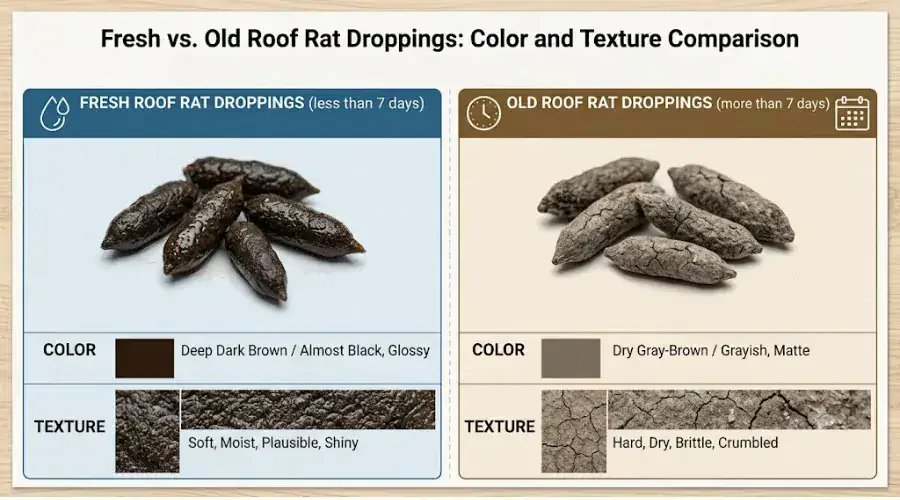
Color and texture tell you how recently the roof rat scat was deposited, which is critical for judging whether an infestation is active:
- Fresh (0-3 days): Dark brown to near-black, glossy or slightly moist-looking, and soft enough to leave a mark if pressed with a gloved finger.
- Aging (a few days to two weeks): Color dulls to a matte brown-gray as moisture evaporates.
- Old (weeks or more): Chalky gray to off-white, dry, brittle, and prone to crumbling into dust when disturbed — this is also the stage where airborne exposure risk increases if the material is swept or vacuumed.
Roof Rat Droppings vs. Norway Rat Droppings: Full Comparison
Correct species identification changes everything about a control plan — bait placement, trap height, and entry-point sealing are all different for roof rats versus Norway rats. Droppings are usually the fastest way to tell them apart when you haven't spotted the animal itself.
| Feature | Roof Rat Droppings | Norway Rat Droppings |
|---|---|---|
| Norway rat droppings size vs. roof rat | ~12-15mm long | ~18-20mm long (Norway rat droppings size is roughly a third larger) |
| Shape | Spindle/banana-shaped, tapered, pointed ends | Capsule-shaped, blunt and rounded ends |
| Thickness | Slimmer, ~4-6mm diameter | Thicker, ~6-8mm diameter |
| Typical location | Attics, rafters, wall voids, upper shelves, tree crowns | Basements, crawl spaces, foundations, garages, near ground-level burrows |
| Grease/rub marks nearby | On rafters, pipes, and elevated beams | Along baseboards, 1-3 inches above floor level |
In practice, a single norway rat dropping looks and feels noticeably heavier and blunter than a roof rat pellet — closer in profile to an olive pit than a grain shape. If you're finding norway rat droppings mixed with roof rat droppings in the same structure, it usually means the two species are using different levels of the building, which does happen in parts of California where both are present.
Roof Rat Droppings vs. Mouse Droppings and Other Rodent Waste
Size is the fastest sorting tool once you rule out the two rat species against each other. House mouse droppings run only 4-8mm long, roughly a quarter the length of roof rat feces, and resemble dark grains of rice rather than a spindle. Squirrel droppings are cylindrical with a slight twist at the midpoint and are usually found outdoors or in attic entry points rather than deep inside wall cavities. Confusing any of these with roof rat droppings leads directly to the wrong control strategy — bait, trap placement, and exclusion work all depend on knowing exactly which rodent you're up against.
Where Roof Rat Droppings Show Up in California Homes
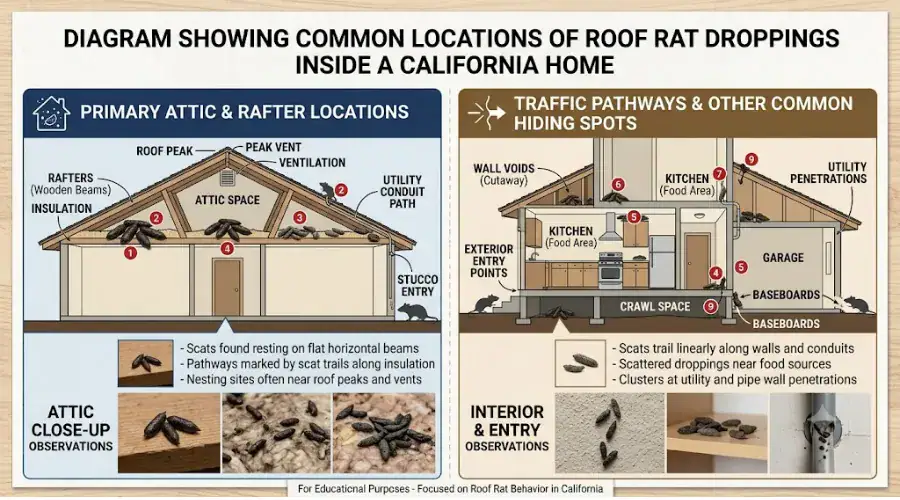
Because roof rats are exceptional climbers and rarely burrow, their droppings concentrate above ground level rather than at the foundation. In California properties, the most common discovery points are:
- Attics and insulation: The single most common site for roof rat scat, often along the perimeter where the roofline meets the eaves.
- Rafters and exposed beams: Roof rats travel along horizontal surfaces, leaving droppings and grease marks together.
- Wall voids near the roofline: Especially in older homes with gaps around vents or eaves.
- Garage shelving and stored boxes: Elevated storage areas mimic the tree-canopy habitat roof rats prefer outdoors.
- Palm trees, citrus trees, and dense landscaping: Outdoor palm rat droppings and fruit rat droppings often appear at the base of trees or in the crown itself.
- False ceilings and HVAC chases: Enclosed, elevated, and rarely disturbed — ideal nesting conditions.
If you're finding droppings closer to the ground, in a basement, crawl space, or along kitchen baseboards, that pattern is more consistent with Norway rat droppings than roof rat activity.
Are Roof Rat Droppings Dangerous? Health Risks Explained
The short answer to "are roof rat droppings dangerous" is yes. The risk isn't from simply seeing the pellets — it's from what happens when dry droppings are swept, vacuumed, or otherwise stirred into the air.
Hantavirus
According to the CDC's overview of hantavirus, people are most commonly exposed by breathing in contaminated air after dried rodent urine, droppings, or nesting material has been disturbed and turned into airborne dust. Hantavirus pulmonary syndrome is rare but can be severe, which is why the cleanup method described below matters as much as the cleanup itself.
Salmonellosis
Roof rat feces can carry Salmonella bacteria, which contaminate stored food, countertops, and pantry items that come into contact with droppings or the surfaces rats have traveled across.
Leptospirosis
Leptospira bacteria, shed in rodent urine and sometimes present on or near droppings, can cause flu-like illness in humans, typically through contact with contaminated water, soil, or damp surfaces.
Allergens and Asthma Triggers
Beyond specific diseases, dried rodent droppings and urine proteins are recognized allergens that can trigger or worsen asthma symptoms, particularly in enclosed attic or crawl space environments with poor ventilation.
How to Safely Clean Up Roof Rat Droppings
The CDC's core guidance is consistent across every version of its rodent cleanup recommendations: never dry-sweep or vacuum rodent droppings. Doing so is the primary way dust containing hantavirus becomes airborne. Instead, follow a "wet cleaning" method:
- Ventilate first. Open doors and windows and leave the space for at least 30 minutes before starting any cleanup.
- Wear protection. Rubber, latex, or vinyl gloves at minimum; a properly fitted respirator is strongly recommended for attic-scale cleanups.
- Wet everything before touching it. Spray droppings, urine stains, and nesting material thoroughly with a bleach solution (roughly 1 part bleach to 10 parts water) or an EPA-registered disinfectant, and let it sit for at least 5 minutes.
- Wipe, don't sweep. Use paper towels or a rag to pick up the wet material, then dispose of it in a sealed plastic bag, placed inside a second sealed bag.
- Disinfect surfaces. Mop or wipe down the surrounding area with the same bleach solution or disinfectant.
- Wash up. Remove gloves, then wash hands thoroughly with soap and water.
This sequence is drawn directly from CDC hantavirus prevention guidance. For light, isolated droppings this process is manageable for a homeowner with the right precautions. For attic-scale accumulations, nesting material, or repeated finds over time, a dispatched professional rodent droppings clean-up service is the safer route, since crews arrive with respiratory protection and can also identify how the rats got in.
Signs Beyond Droppings That Confirm a Roof Rat Infestation
Droppings rarely show up alone. Other indicators that typically accompany roof rat scat include:
- Gnaw marks on wood, wiring, or PVC pipe, usually at elevated points
- Grease or rub marks along rafters, pipes, and beams from repeated travel
- Scratching or scurrying sounds in the ceiling or attic, especially at night
- Shredded insulation, paper, or fabric used for nesting material
- Gnawed or hollowed fruit left hanging on citrus or fruit trees
- A persistent musky odor in enclosed attic spaces
When to Call a Professional
Confirming the species from droppings is a strong first step, but eliminating a roof rat problem also means finding and sealing entry points, choosing the correct elevated bait or trap placement, and safely removing contaminated material. A statewide fast, same-day rat control dispatch can confirm the species on-site, and if mice turn out to be part of the picture too, a same-day rodent removal service covers that scenario as well. Getting the identification right the first time avoids wasted weeks on a control plan built for the wrong species.
Found Roof Rat Droppings on Your California Property?
Our field representatives are dispatched directly to your location statewide — no office visit required. Call 24/7 for on-site identification and rodent droppings clean-up.
Call (888) 217-6759Frequently Asked Questions About Roof Rat Droppings
Roof rat droppings size averages 12-15mm (about 1/2 inch) long, spindle-shaped with one or both ends pinched to a point. Roof rat poop size is noticeably smaller and slimmer than Norway rat droppings, which run closer to 3/4 inch with blunt, rounded ends.
Roof rat droppings are slender and banana- or spindle-shaped with pointed tips, while Norway rat droppings are thicker, capsule-shaped, and blunt on both ends. Norway rat droppings size typically runs 18-20mm long, roughly a third larger than roof rat droppings.
Yes. Roof rat droppings are dangerous because dried, airborne particles can carry hantavirus, and the feces itself can harbor salmonella and Leptospira bacteria that cause leptospirosis. Disturbing dry droppings without precautions is the primary exposure risk.
Yes. "Black rat" is simply another common name for the roof rat (Rattus rattus), so black rat droppings and roof rat droppings describe the exact same pellet: slim, dark, and pointed at the ends.
There is no biological difference. "Fruit rat" is a nickname for the roof rat, earned from its habit of raiding citrus, avocado, and other fruit trees, so fruit rat droppings are identical in size and shape to standard roof rat droppings.
Yes. "Palm rat" is a regional nickname for the roof rat, used because the species frequently nests in palm tree crowns common across Southern California landscaping. Palm rat droppings match standard roof rat droppings in size, shape, and color.
Fresh roof rat feces are dark, moist-looking, and slightly soft to the touch with a matte-to-shiny black finish. Old droppings dry out, turn gray or chalky, and crumble or crack when gently pressed, indicating the activity may be days or weeks old.
Roof rat scat concentrates in elevated areas because the species is an agile climber: attics, insulation, rafters, false ceilings, wall voids near the roofline, garage shelving, and stacked storage boxes are the most common discovery points.
A single Norway rat dropping looks like a thick, dark capsule or cylinder with two blunt, rounded ends, roughly the size and shape of a large grain of rice or a small olive pit, and is usually found at ground level.
A single rat, roof or Norway, can produce roughly 20-50 droppings in a 24-hour period, which is why even a modest infestation can leave a surprising volume of scat concentrated along travel paths within days.
Small, isolated amounts can be wet-cleaned with precautions, but heavy accumulations in attics or wall voids are safer left to a dispatched rodent clean-up crew with proper respiratory protection, given the hantavirus exposure risk from disturbed dust.
Avoid sweeping or vacuuming the area, ventilate the space if possible, keep children and pets out, and schedule an on-site inspection to confirm the species, locate entry points, and plan safe removal and exclusion.
Fresh, soft droppings indicate an active or very recent infestation, while dry, crumbling, faded droppings alone may point to past activity. Either way, droppings confirm rats have accessed the structure and an inspection is warranted.
Sources & Further Reading
PestPunt — California Statewide Rodent Service
- PestPunt
- Service Area (California Statewide): Providing 100% on-site mobile services directly to your property.
- As a Service Area Business (SAB), we do not have physical office visits. Our local expert field representatives are dispatched directly to your location.
- 24/7 Dispatch Phone: (888) 217-6759
- Email: [email protected]
Connect with a Professional Rodent Specialist in California
Whether you need to identify roof rat droppings, confirm a Norway rat infestation, or schedule a safe cleanup, our team is ready to assist. Call (888) 217-6759 for a free consultation and on-site dispatch.
Information on this page is based on established public health and pest‑control guidelines. It is provided for educational purposes and is not a substitute for a professional on‑site evaluation or direct medical advice. If you suspect an acute health concern related to rodent exposure, consult a registered healthcare provider immediately.