How Many Mice Live in One Nest? A Field Guide to Colony Size and Growth
A single mouse nest inside a home, barn, or vehicle rarely holds just one animal. Based on field inspections across California properties, an active house mouse nest typically supports 12 to 24 related mice at any given time.
What "One Nest" Actually Means Inside a Structure
Direct Answer: A single active house mouse (Mus musculus) nest typically supports 12 to 24 related mice at any given time — a mix of a dominant breeding female, her current litter, and several near-mature offspring that haven't yet moved out to build a nest of their own. The number shifts constantly because mice breed on a continuous cycle rather than a seasonal one.
A mouse nest is not a single, fixed den the way a bird's nest is. It's a soft, round mass of shredded material — typically four to six inches across, built from paper, insulation, fabric, cardboard, and dried plant matter — that serves as a nursery and a resting site for one extended family group. Unlike solitary rodents, house mice are colonial: a dominant male holds a territory, and multiple related females share nesting duties and, in some cases, even nurse each other's pups communally.
That colonial structure is the reason nest counts run higher than most homeowners expect. You are rarely dealing with "a mouse." You are dealing with a small, actively reproducing family unit that treats your wall void, attic insulation, or garage storage box as a permanent nursery.
The Population Math: How Two Mice Become Dozens, Fast
The dozen-to-two-dozen range isn't an estimate pulled from thin air — it's a direct result of house mouse reproductive biology, which is unusually fast even among rodents.
Breeding Timeline
- Gestation: 19 to 21 days
- Litter size: 5 to 12 pups, with 6 to 8 being typical
- Time to sexual maturity: 6 weeks
- Breeding frequency: A female can conceive again within 48 hours of giving birth and can produce 5 to 10 litters per year
| Time Elapsed | Estimated Population | Nest Behavior |
|---|---|---|
| Day 1 | 2 mice | Pair establishes nest site |
| 3 weeks | 8–10 mice | First litter born |
| 6–8 weeks | 10–14 mice | First litter reaches maturity; second litter arrives |
| 3 months | 18–30 mice | Overcrowding begins; satellite nests form nearby |
| 6 months | 40+ mice across multiple nests | Colony spans several nesting sites in one structure |
Two things keep any single nest capped around 24 mice rather than growing indefinitely: available space and food competition. Once a nest gets crowded, mice don't keep stacking into the same six-inch ball — they split off. That's the mechanism behind the next section.
Why Nest Population Varies by Season and Site
Indoor vs. Outdoor Nests
Outdoor nests — under woodpiles, in dense ground cover, or inside sheds — tend to run smaller and turn over faster because weather, predators, and food scarcity all limit growth. Indoor nests inside insulated wall cavities or attics face none of those pressures. A wall void behind a kitchen appliance, for example, offers stable temperature, darkness, and proximity to food, which is exactly why indoor nests routinely reach the higher end of the 24-mouse range while outdoor nests rarely exceed 10 to 12.
Rural and Agricultural Properties
On barns, garages, and outbuildings across California's agricultural regions, we routinely find nest populations pushing past the typical range — sometimes 30 or more individuals in a single hay bale or insulated equipment panel — because grain storage removes the food-scarcity limit that normally caps colony size. If your property backs onto a field, orchard, or feed storage area, treat the upper end of every estimate in this article as your baseline, not your ceiling.
Seasonal Pressure
House mice don't hibernate and breed year-round indoors, but outdoor populations funnel inside as temperatures drop in fall, which is why nest sizes inside structures often jump noticeably between September and December — not because mice breed faster in cold weather, but because an entire outdoor colony relocates indoors at once.
Field Signs That Indicate More Mice Than You Think
Because nests are almost always hidden — inside walls, under insulation, behind stored boxes — you're rarely counting mice directly. You're reading evidence. Here's what actually separates a two-mouse problem from a twenty-mouse nest, based on inspection patterns we see across service calls.
- Dropping volume, not just presence: A single adult mouse produces 50 to 75 droppings per day. If you're clearing a noticeable pile every 24 hours in the same spot, you're looking at multiple animals, not one.
- Multiple grease trails at different heights: Mice rub oil and dirt from their fur along the same travel path repeatedly. One consistent smear at one height usually means one regular traveler. Two or three overlapping smears at slightly different heights along the same baseboard usually means multiple animals of different sizes — adults and juveniles — using the same route.
- Overlapping activity times: One mouse foraging shows up as intermittent noise. A nest of a dozen or more shows up as near-constant, low-level activity, because individual mice leave the nest to forage roughly 20 to 40 times per day, and with more mice in the nest, those foraging windows overlap almost continuously after dark.
- Distinct scratching sources: Standing still and listening at night — genuinely one of the most reliable low-tech field techniques — often reveals scratching from two or three separate points along one wall run rather than a single source moving back and forth. That pattern almost always indicates more than one nest chamber, not one especially active mouse.
- Gnaw marks of varying size: Juvenile mice have proportionally smaller incisors and leave finer gnaw marks than adults. Finding both coarse and fine gnaw damage in the same area is a strong indicator that a nest contains multiple age groups — meaning breeding has already occurred at least once on-site.
Field note: The single most underused indicator is smell. A nest supporting more than a dozen mice produces a distinct, persistent ammonia-like odor from concentrated urine that a one- or two-mouse presence almost never generates. If you can smell mice before you can find droppings, you're very likely past the small-population stage already.
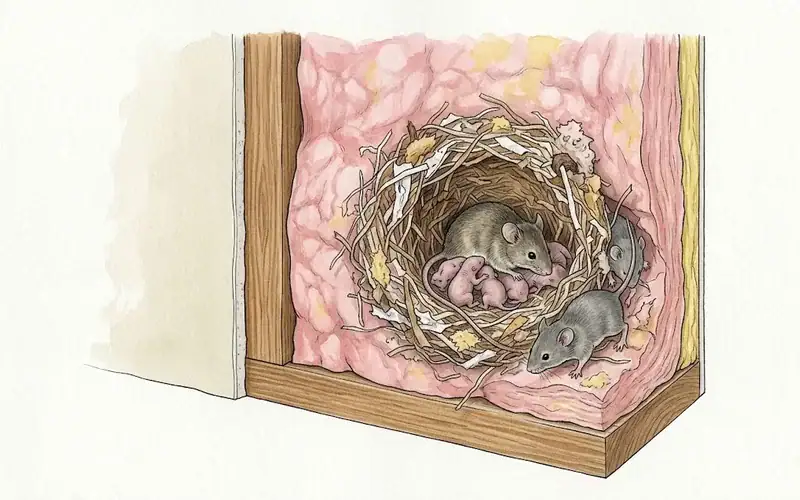
How One Nest Becomes Several Nests Through a Building
Overcrowding is the trigger for expansion, not tolerance for it. Once a nest reaches somewhere around 8 to 10 individuals, subordinate mice — usually younger males and some females — get pushed to the edges of the group and eventually leave to establish satellite nests. Those satellite sites are almost never far away; house mice rarely range more than 10 to 30 feet from a stable food source, so a second and third nest typically appear within the same wall run, the same attic section, or an adjoining room.
This is the practical reason a "one mouse, one hole" mental model fails so often. By the time evidence is obvious enough to notice — droppings in a cabinet, a smell in a closet, scratching in a wall — the original nest has frequently already spawned one or two additional nests nearby, meaning the true population in the structure is higher than any single nest's count would suggest.
What a Mouse Nest Looks Like and Where They're Built
Recognizing the nest itself — not just the mice — helps you locate a population before it grows. House mouse nests are loosely woven, round or ball-shaped, and built from whatever soft material is closest at hand.
Common Nesting Materials
- Shredded paper, cardboard, and packaging
- Fiberglass insulation and foam
- Fabric, carpet fibers, and mattress or pillow batting
- Dried grass, straw, and leaf litter (in outdoor or garage nests)
- Plastic sheeting and drywall paper facing
Where Nests Turn Up Most Often
- Wall voids near kitchens and bathrooms (moisture and food proximity)
- Attic insulation, particularly near roof penetrations
- Behind and under major kitchen appliances
- Garage storage boxes and vehicle engine compartments
- Crawl spaces and subfloor cavities
- Stacked firewood, hay bales, and outbuildings on rural properties
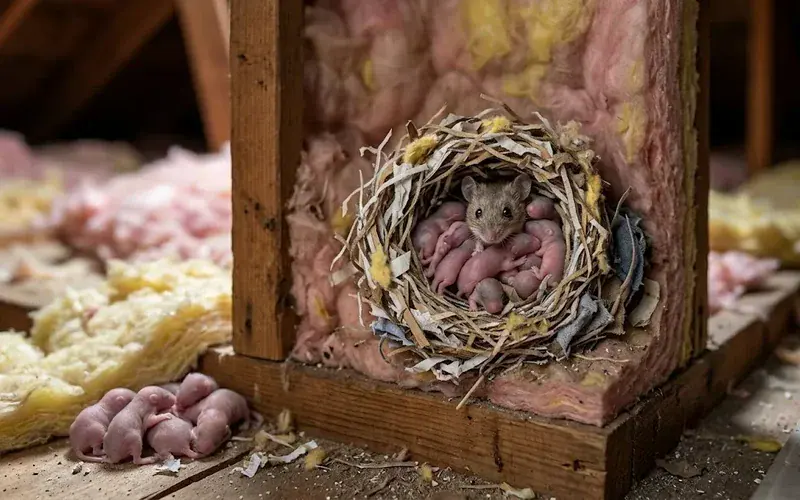
Nest Size and Health Risk Scale Together
The number of mice in a nest isn't just a curiosity — it directly predicts exposure risk. Every mouse in an active nest contributes daily to the accumulation of urine, droppings, and shed dander in that space. According to the CDC's guidance on hantavirus, exposure most often occurs when dried rodent urine or droppings are disturbed and inhaled, which makes nest size a meaningful factor: a cavity supporting two dozen mice generates dramatically more contaminated material than one supporting two or three.
This is also why disturbing a nest without protection is a genuinely bad idea, regardless of how small it looks from the outside. A compact, six-inch nest can still be the seasonal home of more mice than its size suggests, and the risk comes from what's inside and underneath it, not its visible dimensions.
Don't Misjudge the Nest — Confirm the Species First
Population estimates only hold up if you're actually looking at a house mouse nest and not a young rat's, since juvenile rats are frequently mistaken for adult mice — which skews both species identification and population math. A juvenile Norway rat can weigh close to what an adult mouse weighs, but rat colonies structure and grow differently than mouse colonies, and treating one as the other leads to under-treating the actual problem. If you're unsure which species you're dealing with before estimating numbers, our house mouse vs. baby rat comparison walks through the specific physical markers — tail-to-body ratio, head shape, and foot size — that make identification reliable in the field.
DIY Monitoring vs. Calling a Professional
Basic monitoring — tracking dropping accumulation, checking for grease trails, and listening for activity at night — is something any property owner can do accurately with a flashlight and a few days of observation. Where DIY approaches consistently fall short is population control once a nest exceeds roughly 8 to 10 mice, because at that density, trapping addresses individual mice while the breeding pair simply produces a replacement litter within three to four weeks.
A property-wide inspection identifies not just the primary nest, but the satellite nests that have likely already formed, along with the entry points sustaining the whole colony — the piece that store-bought traps and bait stations don't solve on their own.
| Situation | Recommended Approach |
|---|---|
| Single mouse sighting, no droppings found | Monitor for 48–72 hours; set basic traps near sighting point |
| Consistent droppings in one area, one grease trail | DIY trapping usually sufficient if addressed within 1–2 weeks |
| Droppings in multiple rooms, nighttime scratching from more than one point | Likely an established nest of 10+ mice; professional inspection recommended |
| Persistent odor, visible nesting material, multiple gnaw-mark sizes | Multi-nest colony likely present; full property inspection needed |
Mouse Nest Population & Behavior
A single active nest typically houses 12 to 24 mice — a dominant breeding female, her current litter, and several near-mature offspring that haven't dispersed yet.
Yes. Once a nest passes roughly 8 to 10 mice, crowding pushes younger mice to build satellite nests within 10 to 30 feet, so one entry point often leads to a cluster of nests rather than a single site.
A breeding pair can produce a new litter roughly every 25 to 40 days, with pups reaching maturity in about 6 weeks — meaning a cleared site can rebuild a population of a dozen or more within two to three months if entry points aren't sealed.
Yes. Nest size correlates directly with the volume of droppings and urine in a structure, both linked to hantavirus exposure, so a nest of two dozen mice presents meaningfully higher risk than one with two or three.
Track daily dropping accumulation, look for grease rub-marks at multiple heights along one path, and listen for scratching from more than one point along a wall — each is a reliable sign of more than a single mouse.
California Mobile Rodent Services
Stop the Infestation Before It Multiplies
Understanding nest population dynamics is the first step. Taking action is the second. Contact our team at (888) 217-6759 to schedule a full property assessment and get a tailored plan to eliminate mice and keep them from returning.