How to Clean Up After a Mouse Infestation in California: A Step-by-Step Safety Guide
Finding mouse droppings in your kitchen, garage, or attic is more than an inconvenience. In California, wild deer mice can leave behind urine and feces capable of carrying Sin Nombre hantavirus. Cleaning the wrong way—by sweeping or vacuuming dry waste—can increase your exposure risk. This guide gives you the exact, CDC-aligned process for safely decontaminating a mouse-infested space and knowing when to call a professional.
Finding mouse droppings in your kitchen, garage, or attic is more than an inconvenience. In California, wild deer mice can leave behind urine, feces, and nesting material capable of carrying Sin Nombre hantavirus—a respiratory illness the California Department of Public Health tracks across mountain, foothill, and rural-adjacent counties. Common house mice that infest urban and suburban homes carry a much lower hantavirus risk, but any rodent waste can still spread bacteria (including Salmonella), allergens, and other pathogens.
Cleaning up mouse droppings the wrong way—by sweeping or vacuuming dry waste—can actually increase your exposure risk by aerosolizing particles into the air you breathe. This guide walks you through the exact, science-backed process for safely decontaminating a mouse-infested space, room by room and surface by surface, so you can protect your household and know precisely when it’s time to call a licensed professional.
Why Rodent Decontamination Matters in California
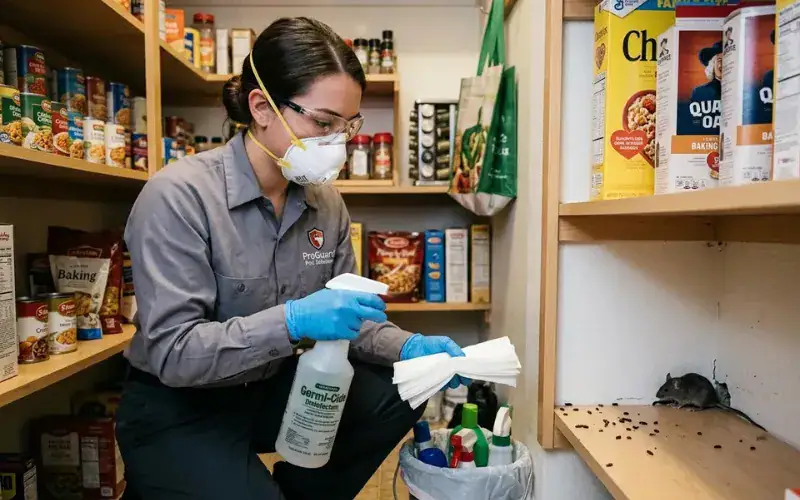
Mouse droppings aren’t just unsightly—they’re a documented public health concern. According to the CDC, hantaviruses spread to people primarily through contact with infected rodents and their urine, droppings, and saliva, and most often through breathing in air contaminated with dried rodent waste that has been disturbed. CDC’s hantavirus overview notes that hantavirus pulmonary syndrome (HPS) is a severe, sometimes fatal, lung disease, and that early symptoms often mimic the flu, which can delay diagnosis and treatment.
In California, the virus of concern is Sin Nombre virus, carried by wild deer mice (Peromyscus maniculatus). CDPH reports roughly a few cases per year statewide, with most historical exposures linked to mountain and foothill regions (including the well-known 2012 Yosemite cluster). Visual evidence of rodent activity has been found at a majority of investigated case sites. House mice that commonly infest Bay Area and Los Angeles homes carry a much lower hantavirus risk, but any home near open space, agricultural land, hillsides, or older construction with attic or crawl-space access should treat rodent droppings with full precaution.
Beyond hantavirus, mouse infestations also leave behind:
- Salmonella and other bacteria on countertops, pantry shelves, and food packaging contaminated by droppings.
- Allergens from dried urine and dander that can worsen asthma and respiratory sensitivity, especially in children.
- Structural damage from gnawing on wiring, insulation, and wood framing, which can create fire hazards.
- Persistent odor from urine-soaked insulation, drywall, and carpet padding that lingers long after mice are gone.
- Need for professional rodent decontamination when nested areas are deeply embedded in structural voids.
Before You Start: Safety Precautions & Protective Gear
To safely clean a mouse infestation, ventilate the space for 30 minutes, put on rubber gloves and an N95 mask (for enclosed or heavily soiled areas), then wet all droppings and urine with disinfectant before wiping them up. Never sweep or vacuum dry waste. This sequence—ventilate, wet, then wipe—is the foundation of CDC and CDPH rodent cleanup guidance and should not be skipped, even for what looks like a minor dropping or two.
Recommended protective equipment
- Gloves: Rubber, latex, or nitrile, worn for the entire cleanup and disinfected before removal.
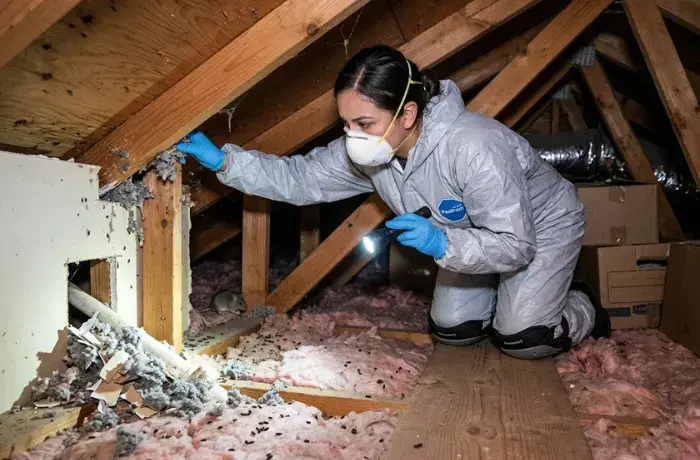
- Respiratory protection: An N95 respirator at minimum for attics, crawl spaces, vehicles, or heavier contamination; a half-mask air-purifying respirator with a HEPA filter for large infestations.
- Eye protection: Unvented safety goggles, particularly in enclosed spaces like attics, sheds, and vehicles.
- Disposable coveralls: Recommended for attic, crawl space, or heavy-infestation cleanups to avoid carrying contamination into the rest of the home.
Step-by-Step Guide: How to Clean Up Mouse Droppings and Urine
Once the space has been ventilated and you’re wearing gloves (and a mask if needed), follow this sequence for any hard surface, countertop, floor, or shelf affected by a mouse infestation. This process aligns with current CDC guidance for cleaning up after rodents.
Spray and saturate
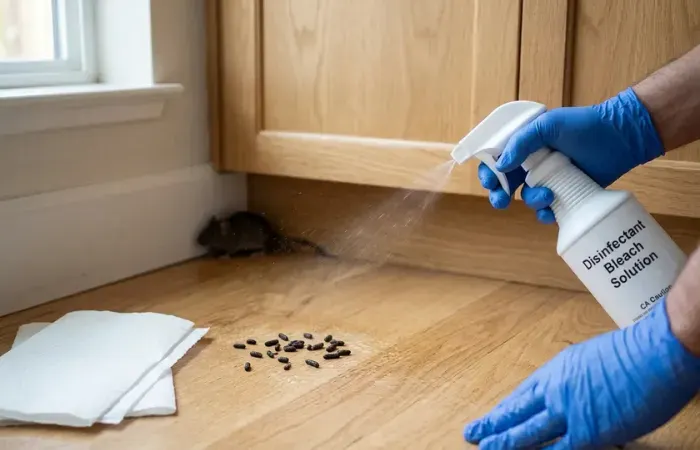
Spray all droppings, urine spots, and nesting material with an EPA-registered disinfectant or a fresh 10% bleach solution (1 part bleach to 9 parts water, or 1.5 cups bleach per gallon of water) until visibly wet. Don’t skip dry-looking, old droppings; they remain a risk even months later.
Let it soak
Allow the disinfectant to sit for at least 5 minutes (or the contact time on the product label; 10 minutes for heavier contamination) so it can fully inactivate pathogens before you disturb the material.
Wipe, never sweep
Use paper towels or a disposable cloth to wipe up the wet waste. Place used materials directly into a sealed plastic bag as you go.
Sanitize the surrounding area
Mop floors, wipe countertops, cabinets, and drawers with disinfectant, extending several feet beyond the visibly contaminated zone.
Double-bag and dispose
Seal the waste-filled bag, place it inside a second bag, seal that one too, and discard it in an outdoor trash bin with a secure lid.
Disinfect gloves, then wash hands
Spray your gloved hands with disinfectant before removing the gloves, then wash your hands thoroughly with soap and water for at least 20 seconds.
Rodent Droppings Cleanup by Surface and Location
Different materials absorb contamination differently. Here’s how to handle the most common places Californian homeowners find mouse droppings.
How to clean mouse droppings from carpet
If only a few droppings are present, lift them with a damp paper towel or a sticky lint roller rather than a vacuum. Dispose of the waste in a double-sealed bag, then shampoo the carpet with a commercial-grade disinfectant or use professional steam extraction. For carpet that has absorbed urine over a long period, padding replacement may be necessary to fully eliminate odor and risk.
How to clean mouse droppings off hardwood and tile floors
Gently lift droppings with a damp paper towel, then disinfect the area with a cleaner safe for the specific flooring finish. Always check the product label; some disinfectants can discolor sealed hardwood.
Mouse droppings in cupboards, pantries, and kitchen cabinets
Remove every item from the affected shelf. Discard any food packaging that shows chew marks, holes, or visible contamination, even if the food inside looks untouched. Wipe shelves, corners, and cracks with soap and disinfectant—mice often nest in the gaps behind cabinetry.
Mouse droppings on clothing, bedding, or linens
Pick up droppings with a damp paper towel and discard in a sealed bag. Wash the affected items in hot water with detergent on the highest heat setting the fabric allows. For colorfast concerns, test a small area first.
Mouse droppings in the garage, attic, or crawl space
These enclosed, poorly ventilated spaces carry the highest exposure risk because contaminated dust has nowhere to disperse. Ventilate for a full 30 minutes before entry, wear a HEPA-filtered respirator, and strongly consider professional help—garages and attics often have multiple hidden entry points that require sealing in addition to cleanup.
Mouse droppings in a vehicle
Open both the hood and the trunk along with all doors and let the vehicle air out for at least 20–30 minutes before working inside it. Disinfect the dashboard, seats, floor mats, and any visible nesting material the same way you would a room: spray, soak, wipe. If nesting material is found in the air intake system, replace the filter after removing the material.
| Location | Primary Risk | Recommended Approach |
|---|---|---|
| Kitchen / Pantry | Salmonella, contaminated food | Discard chewed food, disinfect shelving, check cracks |
| Carpeted rooms | Trapped urine odor, allergens | Damp pickup, commercial steam clean or shampoo |
| Attic / Crawl space | Highest airborne exposure risk | Full PPE, 30-min ventilation, consider professional cleanup |
| Garage | Multiple entry points, nesting | Clean, then seal gaps and vents |
| Vehicle | Confined-space air contamination | Open hood/trunk, air out 20–30 minutes before cleaning |
How to Safely Dispose of Dead Mice and Heavy Droppings
Spray the dead rodent, its nest, and the surrounding area thoroughly with disinfectant or a 10% bleach solution and let it soak for at least five minutes. Using gloves, place the rodent and any nesting material into a plastic bag, then double-bag it by placing that bag into a second one and sealing it tightly. Dispose of it in a covered outdoor trash receptacle.
If you plan to reuse a snap trap, submerge the trap (with the rodent still in it) in disinfectant for five minutes while wearing gloves, then release the rodent into a bag and rinse the trap thoroughly before reuse.
If you discover a heavy infestation—piles of droppings, multiple nests, or several dead rodents—treat the area as a higher-risk biohazard scenario and strongly consider bringing in a licensed rodent removal team rather than handling it solo.
Eliminating Mouse Urine Odor for Good
Bleach disinfects effectively, but it doesn’t fully break down the organic compounds responsible for lingering mouse urine odor. For complete odor elimination:
- Use an enzyme-based cleaner designed specifically to digest organic waste rather than just masking the smell.
- Apply generously to every affected hard surface and allow it to air-dry completely rather than wiping it away early.
- Re-treat porous materials like unsealed wood, concrete, or grout, since odor compounds can soak in deeper than a single application reaches.
- Replace heavily soiled materials such as attic insulation, drywall, or carpet padding if odor persists after repeated treatment; some materials simply can’t be fully restored.
Choosing the Right Disinfectant for Rodent Decontamination
Hantavirus is an enveloped virus, meaning its outer membrane is relatively vulnerable to common disinfecting chemistries when used correctly. Effective options include a fresh 10% household bleach solution and any EPA-registered disinfectant labeled for use against enveloped viruses, including many quaternary ammonium and hydrogen-peroxide-based products.
Always check the registration number on the product label and follow the listed dilution ratio and contact time exactly; under-dosing or wiping too early significantly reduces effectiveness. The CDC specifically recommends mixing 1.5 cups of household bleach in 1 gallon of water (or 1 part bleach to 9 parts water) and making the solution fresh before each use.
Common Mouse Cleanup Mistakes That Increase Health Risk
- Vacuuming droppings with a standard vacuum. Without a HEPA filter, vacuums can exhaust contaminated particles directly back into the air.
- Cleaning before ventilating. Entering and disturbing a closed-up space immediately can expose you to airborne contaminants that haven’t had time to settle or disperse.
- Reusing cleaning cloths or sponges. Cross-contamination spreads waste to surfaces that were never affected.
- Wiping before the disinfectant has soaked in. Cutting the contact time short reduces the product’s ability to neutralize pathogens.
- Skipping PPE for “just a few droppings.” Exposure risk isn’t strictly proportional to the visible quantity of waste; a small amount of dried urine can aerosolize just as easily as a larger pile.
After Cleanup: Preventing Mice From Coming Back
Cleaning up the mess is only half the job. Without sealing entry points and removing attractants, the same gaps that let mice in once will let new mice in again within weeks. Rodent-proofing your home properly is crucial.
- Seal gaps and holes around pipes, vents, doors, and foundation cracks; mice can squeeze through openings as small as a dime (about ¼ inch).
- Store food in airtight, rodent-proof containers and keep pet food off the floor overnight.
- Keep trash cans tightly covered and store them away from exterior walls when possible.
- Declutter attics, garages, and storage areas where mice like to nest undisturbed.
- Trim vegetation and clear debris near the foundation—especially important for homes near open space or hillside terrain common across the Bay Area and Southern California.
When to Call a Professional Rodent Cleanup Company in California
DIY cleaning is reasonable for a handful of droppings on a kitchen counter. It stops being reasonable the moment you’re dealing with an attic full of nesting material, a crawl space you can’t safely ventilate, recurring infestations, or any sign of a heavy rodent population. At that point, the airborne exposure risk and the labor involved both increase sharply, and professional-grade equipment—including HEPA vacuums, commercial disinfectants, and proper respiratory protection—becomes the safer and faster path. A trained technician will also locate and seal the entry points that DIY cleanup alone can’t fix, so the problem doesn’t simply return in a month.
PestPunt provides full-service rodent infestation cleanup, decontamination, and exclusion across California, with 24/7 emergency rodent removal in San Francisco and rapid response throughout the wider Bay Area and Los Angeles. Whether you need a one-time biohazard cleanup after an active infestation or an ongoing rodent prevention plan, our technicians are equipped to handle light residential cleanups and heavy commercial-grade contamination alike.
Frequently Asked Questions
Never sweep or vacuum dry mouse droppings. Ventilate the room for 30 minutes, put on gloves and a mask, then spray the droppings with a disinfectant or a 10% bleach solution until thoroughly wet. Let it soak for at least five minutes, wipe up with paper towels, and double-bag the waste before disposal.
Leave the area immediately and ventilate it for at least an hour before returning. Avoid touching your face, disinfect the vacuum or broom afterward, and wash your hands and clothing. Monitor for flu-like symptoms over the following weeks and contact a doctor if breathing difficulty develops, mentioning the rodent exposure.
Yes. Dried droppings and urine residue can release infectious particles into the air the moment they’re disturbed, regardless of how long ago the infestation occurred. Always wet down old rodent waste with disinfectant before disposing of it, just as you would with fresh droppings.
Mix one part household bleach with nine parts water (or 1.5 cups bleach per gallon of water) to create a 10% solution. Spray it fresh each time you clean, since diluted bleach loses potency quickly once mixed, and let it sit on contaminated surfaces for at least five minutes before wiping.
Ventilate the space for a minimum of 30 minutes with doors and windows open before entering to begin cleanup. For heavily infested attics, sheds, or vehicles closed up for an extended period, longer ventilation is safer.
Both can carry pathogens and should be treated with the same disinfection process. Urine tends to soak into porous materials like carpet, wood, and insulation more deeply than droppings, which is why lingering odor and contamination are often harder to fully eliminate from urine-soaked areas.
Light contamination, like a handful of droppings in one kitchen cabinet, is typically manageable with proper PPE and disinfection. Heavier infestations involving attics, crawl spaces, multiple rooms, or repeated rodent activity are safer and more thoroughly handled by a licensed rodent cleanup professional with commercial-grade equipment.
The main hantavirus risk in California comes from wild deer mice (Peromyscus maniculatus), which carry Sin Nombre virus. Common house mice that infest urban and suburban homes carry a much lower hantavirus risk, but any rodent waste should still be cleaned with the same wet-disinfection method because of bacteria, allergens, and other pathogens.
Get a Same-Day Rodent Cleanup Inspection in California
If you’re hearing scratching in walls at night, finding droppings in kitchen cabinets, or seeing rub marks along baseboards — you have an active infestation that won’t resolve without professional intervention. Call (888) 217-6759 today for a same-day inspection.
Mouse infestation cleanup is one of those household tasks where the right technique matters more than effort. Wetting contaminated surfaces before disturbing them, ventilating enclosed spaces, and wearing proper protective gear will keep most residential cleanups safe and manageable. For heavier infestations—or any home in a California region with documented hantavirus activity—professional decontamination removes the guesswork and the risk. Browse PestPunt’s full site directory of California pest control guides for more region-specific rodent prevention resources, or reach out directly for a same-day inspection.
Information on this page is drawn from public health guidance published by the Centers for Disease Control and Prevention and the California Department of Public Health. It is provided for general educational purposes and is not a substitute for medical advice. If you suspect hantavirus exposure or develop respiratory symptoms after a rodent cleanup, contact a healthcare provider immediately.