Rodent Pest Control Treatment & Removal Services in San Francisco
San Francisco's dense Victorian housing, aging sewer infrastructure, and year-round mild climate create some of California's highest urban rodent pressure. PestPunt delivers licensed, science-backed rat removal, mouse extermination, and full-perimeter rodent exclusion across the Bay Area — with treatments fully compliant with California's AB 1788 rodenticide rules.


Why San Francisco Has a Rodent Problem That Doesn't Fix Itself
San Francisco's rodent challenge is structural, geographic, and climatic — and it intensifies every year the city grows denser. Unlike cities with hard winters that suppress rodent reproduction cycles, San Francisco's average low temperature never drops below 45°F, meaning roof rats (Rattus rattus) and Norway rats (Rattus norvegicus) breed continuously without a seasonal die-off. According to the San Francisco Department of Public Health (SFDPH), rodent complaints have tracked upward with the city's construction boom, as ground disturbance from new developments displaces established colonies into adjacent residential blocks.
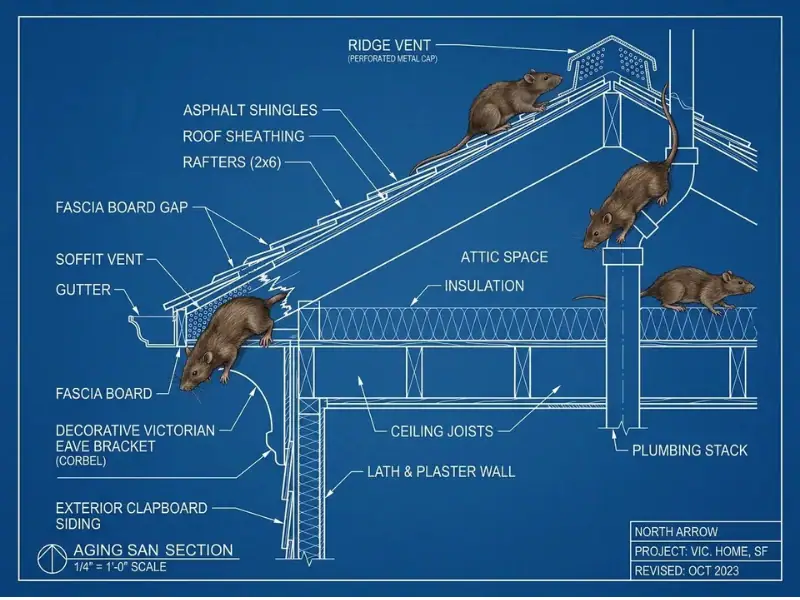
The city's 19th and early 20th-century housing stock compounds the problem. The 58,000+ Victorian and Edwardian structures in neighborhoods like the Castro, Mission, Noe Valley, and Haight-Ashbury were not built to modern pest-exclusion standards. Open soffits, wood-lath wall cavities, and rubble stone foundations give roof rats multiple unobstructed access highways into living spaces. A gap of just ½ inch (12mm) — the diameter of a dime — is sufficient for a juvenile roof rat to enter a structure.
Below, we break down every species, entry vector, treatment approach, and compliance requirement specific to San Francisco and the surrounding Bay Area cities PestPunt serves. This is the field knowledge that separates a permanent solution from a repeat callback.
Bay Area Rodent Species: What You're Actually Dealing With
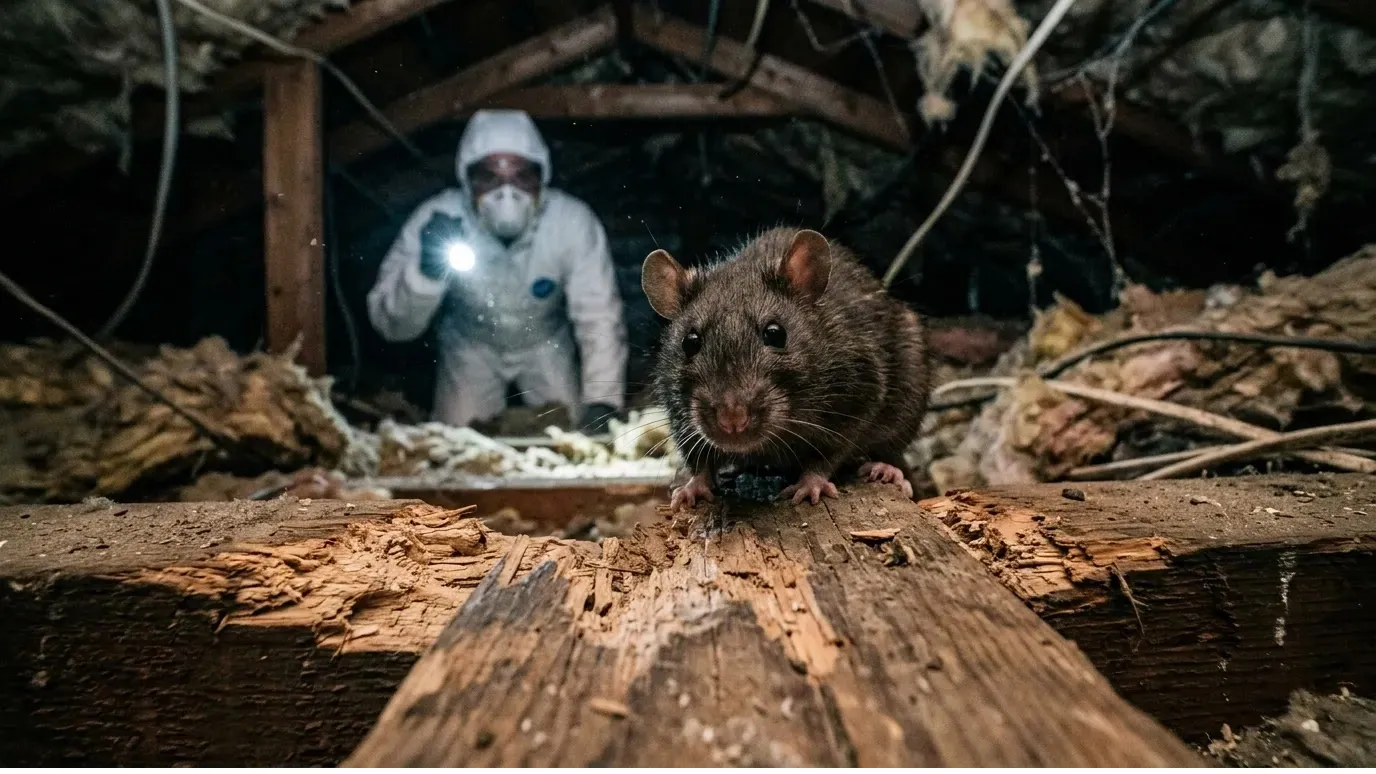
Effective rodent pest control services begin with accurate species identification. Misidentifying a roof rat infestation as a Norway rat problem — or vice versa — leads to wrong trap placement, wrong bait strategy, and zero results. Here's what PestPunt technicians consistently find across San Francisco and the Bay Area:
| Species | Size / Weight | Primary Habitat in SF | Droppings | Peak Activity Season |
|---|---|---|---|---|
| Roof Rat (Rattus rattus) | 150–250g; 6–8" body | Attics, ceiling voids, wall cavities; trees adjacent to rooflines in the Sunset, Castro, Richmond District | Banana-shaped, 12–13mm, pointed ends | Year-round; slight uptick Sept–Nov as fruiting trees (figs, persimmons) finish |
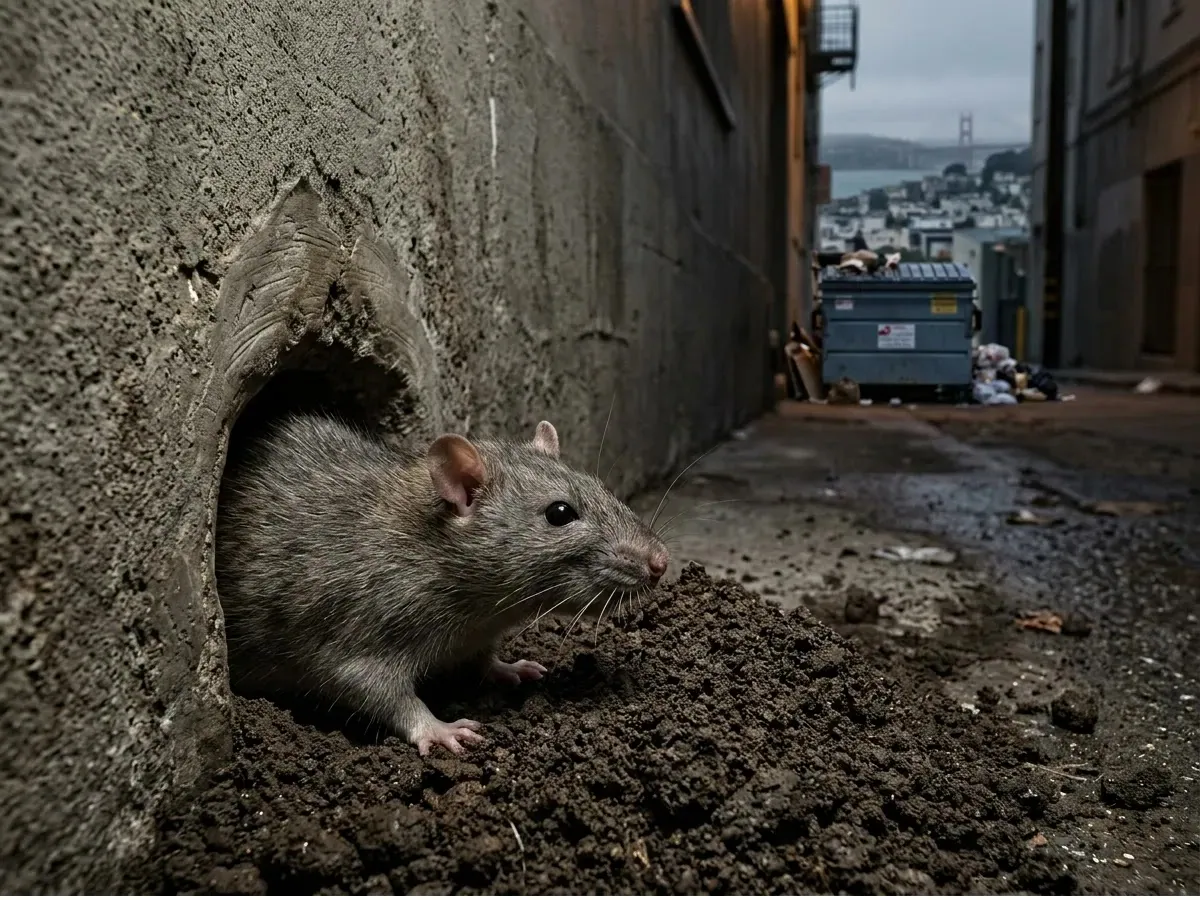
| Norway Rat (Rattus norvegicus) | 280–500g; 8–10" body | Storm drains, sewer lines, alley waste corridors (SoMa, Chinatown, Tenderloin), basement-level commercial kitchens | Capsule-shaped, 18–20mm, blunt ends | Year-round; colonial structures disturbed by construction may show sudden spikes |
| House Mouse (Mus musculus) | 12–25g; 2.5–3.5" body | Interior wall voids, kitchen cabinets, utility rooms across all neighborhoods; especially prevalent in multi-unit residential buildings | Rice-grain shaped, 3–6mm | Peaks Oct–Feb as outdoor temperatures cool (even SF's mild winters push mice indoors) |
| Deer Mouse (Peromyscus maniculatus) | 15–35g; 2.5–4" body | Rare in urban SF core; present in East Bay hills (Oakland hills, Berkeley hills, Tilden Regional Park perimeter), Marin fringe | Pointed ends, 3–6mm — visually similar to house mouse | All seasons; most concerning due to hantavirus risk in brushy, rural-adjacent properties |
The Roof Rat Problem Specific to San Francisco
San Francisco's dominant rodent is the roof rat — and this matters enormously for treatment design. Roof rats are arboreal by nature: they navigate through tree canopy, travel along fence lines, and access structures from above. The city's mature street tree program (over 125,000 street trees, many with branches within 3 feet of rooflines) creates an unbroken aerial highway network that pest control programs treating only at ground level will consistently miss.
This is why PestPunt's roof rat protocol in San Francisco focuses on roofline and attic access point mapping before any trapping begins. Snap traps placed along attic beam runs, with a secondary exclusion sweep of soffits, ridge vents, and plumbing stack penetrations, outperforms ground bait station programs for this species by a significant margin.
Why These 12 Bay Area Cities Face Elevated Rodent Pressure
Each city PestPunt serves has distinct risk drivers. Understanding them is what separates generic exterminator for rodents work from a solution that actually holds:
San Francisco
The convergence of dense Victorian housing, an extensive sewer system dating to the 1850s, year-round outdoor dining on the restaurant corridors of Valencia Street, the Embarcadero, and North Beach, and a municipal composting program that — when bins are overfilled — creates accessible food sources, makes SF one of the highest-pressure rodent environments on the West Coast. The SFDPH Vector Control Program identifies the Tenderloin, SoMa, and Mission as the highest-density complaint zones by block.
Oakland & Berkeley
Oakland's substantial 1920s–1940s Craftsman bungalow stock in the Temescal, Fruitvale, and Rockridge neighborhoods has the same open-soffit vulnerability as SF Victorians. The Eastshore freeway corridor and the Port of Oakland represent two of the highest-concentration Norway rat zones in Northern California — established via international shipping vectors. Berkeley's restaurant-dense Telegraph Avenue and Shattuck Avenue corridors mirror SF's downtown rodent pressure, while properties bordering the Berkeley Hills and Tilden Regional Park face additional deer mouse risk.
San Jose & Santa Clara
Silicon Valley's rapid construction activity continuously displaces established Norway rat colonies from disturbed ground into adjacent older residential neighborhoods. San Jose's large Vietnamese, Filipino, and Mexican community food markets — particularly along Story Road, East Santa Clara Street, and in the Berryessa district — create sustained rodent food availability that keeps colony sizes large. Santa Clara's commercial/industrial mix along El Camino Real means restaurant-adjacent rodent programs require commercial-grade monitoring systems.
Vallejo, Richmond & Concord
Industrial waterfronts in Richmond and Vallejo (Mare Island area) harbor some of the largest Norway rat populations in the region, sustained by waterfront waste and legacy food-processing infrastructure. Concord's BART station surroundings and the Concord Pavilion area see seasonal population spikes during summer events. Properties near Suisun Marsh in the Vallejo fringe can harbor native woodrats, which are legally distinct from invasive pest species and require different handling protocols under California Fish & Game code.
Daly City, San Mateo & Hayward
Daly City's hillside tract homes from the 1950s often have subfloor crawlspace access gaps that were never sealed to modern standards. San Mateo's proximity to the San Francisco Bay wetland margins creates a Norway rat movement corridor into residential streets closest to Bay Farm Island. Hayward's dense multi-family residential stock along Mission Boulevard has some of the highest house mouse complaint rates in Alameda County, driven by connected building utility chases.
Sunnyvale
Sunnyvale's large tech campus food service operations — with their cafeteria loading docks, compost waste, and landscaped green buffers — create textbook rodent attractant conditions. Municipalities with 24-hour food service operations and landscaped campus perimeters consistently generate the most complex commercial rodent programs PestPunt manages.
Our Rodent Pest Control Services in San Francisco & the Bay Area
PestPunt's exterminator for rats service is not a single visit with a bait block. It's a staged protocol built around the biology of the target species, the architecture of your property, and the legal constraints of California pest regulation. Every engagement follows this structure:
Comprehensive Inspection & Species Confirmation
Our technician conducts a full interior and exterior inspection — attic, crawlspace, basement, roofline, and perimeter — to confirm species, quantify population pressure, identify all active entry points, and assess harborage conditions. All findings are documented with photographs.
Snap Trap Deployment & Interior Treatment
For roof rats, multi-catch and snap traps are placed along attic beam runs, inside wall voids via inspection port, and along active runways identified by rub marks. For Norway rats, trap placement prioritizes sub-slab burrow entries and alley-facing perimeter locations. All traps are documented, mapped, and checked on a defined schedule.
Structural Exclusion (Rodent-Proofing)
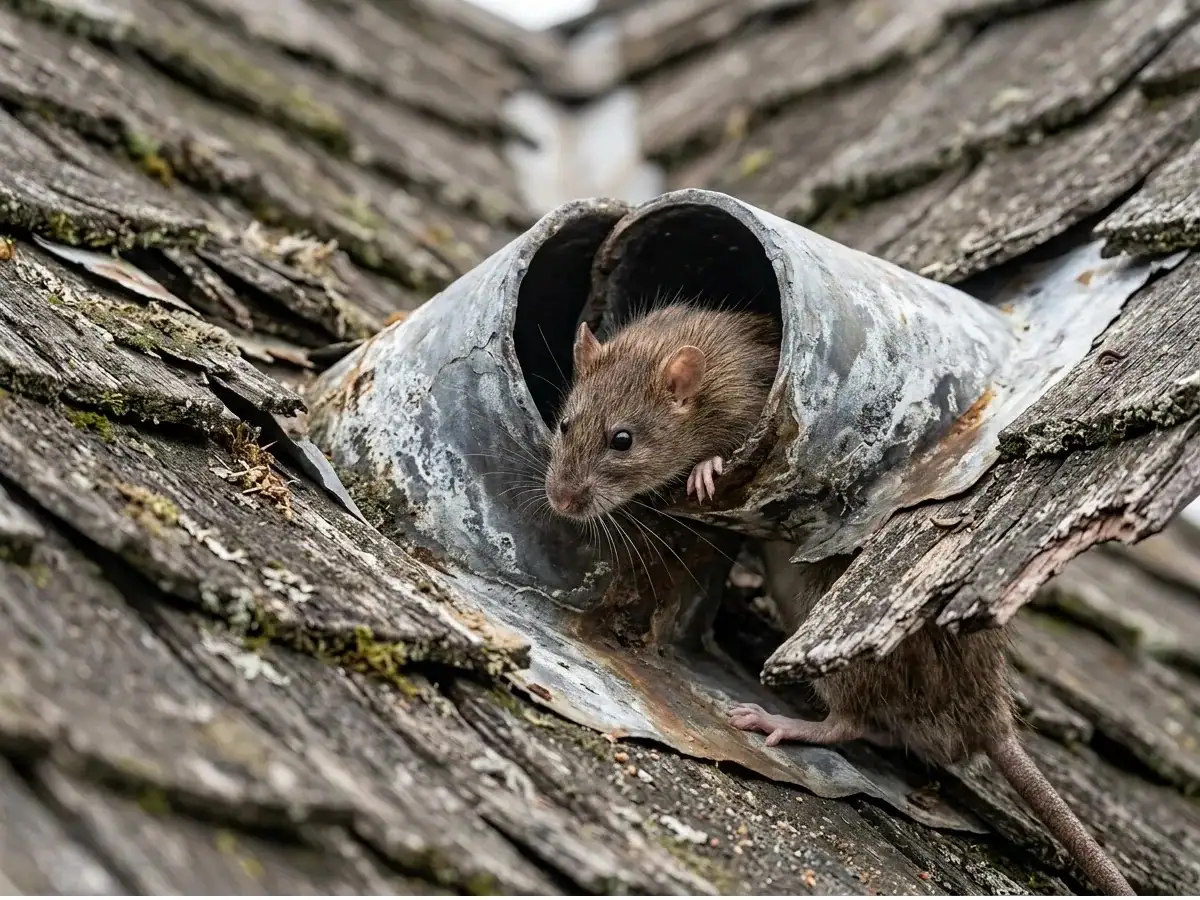
Every active and potential entry point identified in the inspection is sealed using appropriate materials: copper mesh and expanding foam for gaps under ½ inch; hardware cloth (18-gauge galvanized, ¼-inch mesh) for open soffits and ridge vents; cement mortar for foundation cracks; sheet metal flashing around utility penetrations. This step is what prevents re-infestation after population reduction.
Sanitation & Harborage Reduction Assessment
Rodent colonies persist because of food, water, and shelter availability. PestPunt provides a written harborage reduction report — overgrown landscaping, unsecured compost bins, exterior woodpile locations, bird feeder positions — that reduces re-colonization risk between service visits.
Follow-Up Monitoring & Population Verification
A follow-up visit at 7–14 days post-treatment checks trap counts, resets stations, and confirms population decline trajectory. For commercial accounts, monthly monitoring programs provide ongoing documentation for health department inspections.
Attic Remediation & Insulation Replacement (if required)
Active roof rat infestations in attics contaminate blown-in insulation with urine, droppings, and nesting material. Contaminated insulation loses R-value and poses a disease transmission risk. PestPunt coordinates complete attic clean-out and re-insulation for properties requiring remediation post-exclusion.
Rat Removal Service
Species-specific rat removal service for both roof rats and Norway rats. Snap-trap programs with complete carcass removal and trap sanitation between visits.
Mouse Extermination
House mouse control for residential apartments, multi-unit buildings, and commercial kitchen environments. Glue board alternatives available for accounts with ventilation constraints.
Full Exclusion (Rodent-Proofing)
Structural sealing of all entry points using permanent materials — the only method that delivers long-term results without indefinite trap maintenance.
Commercial Rodent Programs
Monthly monitoring contracts for restaurants, food retail, warehouses, and healthcare facilities. Documentation packages formatted for SF Department of Public Health inspections.
24/7 Emergency Removal
Urgent pest and rat control response for live rodent sightings in critical environments. Available around the clock across SF and the Bay Area. Learn more →
Attic & Crawlspace Remediation
Complete contaminated insulation removal, HEPA-filtered vacuuming of droppings, antimicrobial treatment, and fresh insulation installation post-exclusion.
AB 1788 & California Rodenticide Compliance — What Every Bay Area Client Needs to Know
California's Proposition 12 campaign and the resulting Assembly Bill 1788, enacted in 2021 and maintained through 2026, significantly restricts the use of second-generation anticoagulant rodenticides (SGARs) — including brodifacoum, bromadiolone, difethialone, and difenacoum — in non-agricultural urban settings across California. The reason: SGARs bioaccumulate through the food chain, and the California Department of Fish and Wildlife documented fatal secondary poisoning in golden eagles, mountain lions, and bobcats across the Sierra Nevada and Bay Area foothills. Detailed toxicology and wildlife impact data is published by the CDFW Wildlife Investigations Lab.
Structural Pest Control Board (SPCB) Licensing
In California, anyone performing rodent exclusion work on a structure (sealing entry points) must hold a Branch 2 (General Pest) or Branch 3 license issued by the California Structural Pest Control Board (SPCB). This is separate from CDPR pesticide licensing. Always request the technician's SPCB license number and verify it at the SPCB online lookup before work begins. Visit the PestPunt homepage to review our full licensing and service credentials.
Rodent-Borne Disease Risk in San Francisco & the Bay Area
The health dimension of a rodent infestation is not hypothetical. The CDC maintains a comprehensive list of rodent-associated diseases, several of which have documented Bay Area transmission history:
What Happens During a PestPunt Rodent Control Visit
Clients in San Francisco, Oakland, San Jose, and the broader Bay Area frequently ask what distinguishes a professional exterminator for rodents visit from a DIY trap-and-bait approach. The answer is systematic. Here's exactly what a PestPunt service visit looks like:
Before We Arrive
- Clear access to attic hatch, under-sink cabinets, and garage/utility areas if accessible.
- Note any specific locations where you've seen activity, heard sounds, or found droppings — the time of day matters (roof rats are most active 30 minutes after sunset and before sunrise).
- Secure pets in a separate room during the inspection and treatment phases.
- If you have an active bird feeder, suspend feeding 7 days prior — spilled seed is a primary secondary food source sustaining rodent colonies.
During the Visit
- Full interior and exterior inspection: 60–90 minutes for a standard single-family home, longer for multi-unit or commercial properties.
- Technician photographs all entry points, active runways (grease marks), and nesting sites before and after treatment.
- Trap placement map provided to client — you'll know exactly where every device is and how to identify it.
- Written report delivered same-day covering species confirmed, entry points found, treatment deployed, and follow-up schedule.
After the Visit
- Do not move or disturb snap traps — placed along specific runways based on behavioral observation, not random placement.
- Report any new activity, sounds, or odors immediately — early re-population signals can indicate a missed entry point.
- Follow-up inspection scheduled at 7–14 days to assess trap counts and population trajectory.
- Exclusion sealing scheduled for a separate dedicated visit once trap data confirms the treatment is working.
Rats in Your Walls? Don't Wait.
Every day without treatment is another generation closer to a full-scale infestation. PestPunt technicians serve San Francisco, Oakland, San Jose, Berkeley, and across the Bay Area — with same-day inspections available.
Call (888) 217-6759 NowBay Area Cities We Serve for Rodent Pest Control
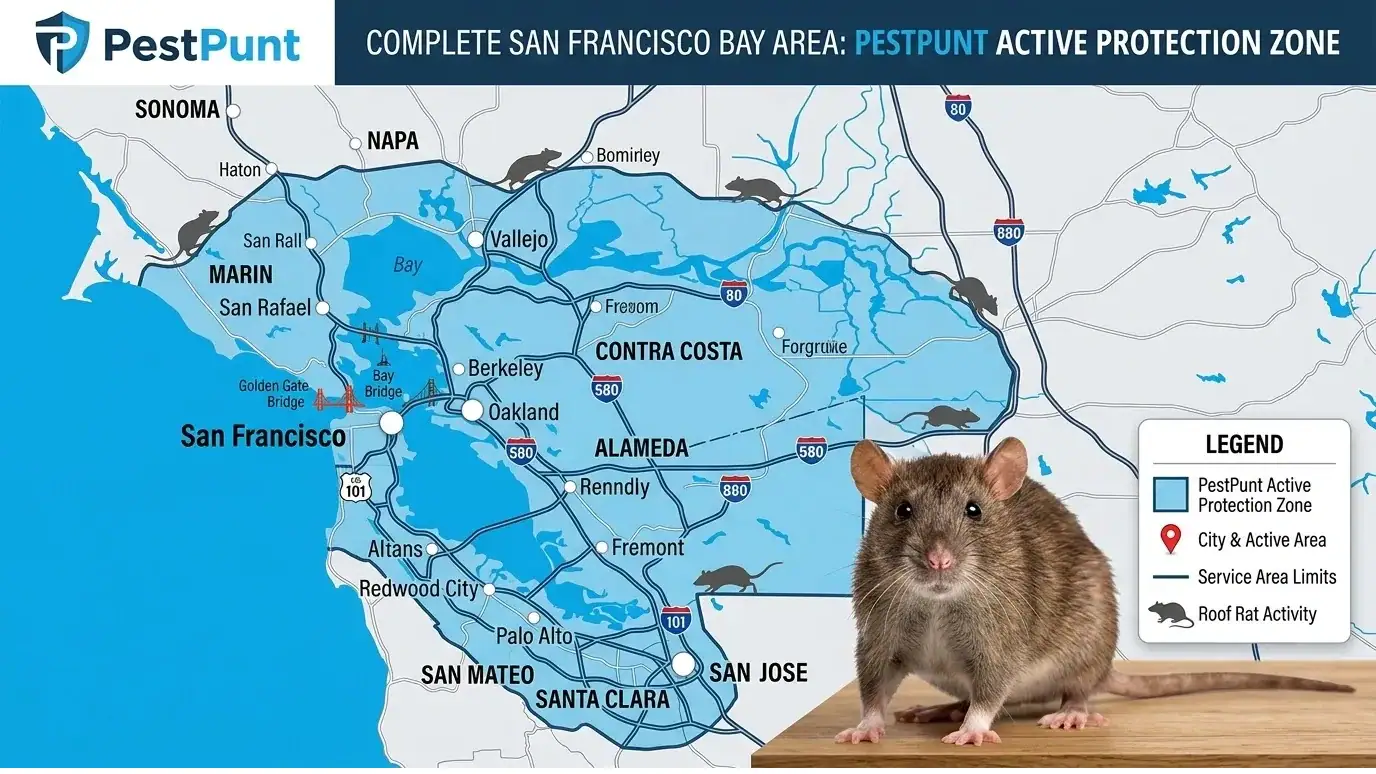
PestPunt's licensed technicians provide rodent pest control services across twelve Bay Area cities. Each service area is staffed by technicians with local field knowledge of the specific building stock, geography, and species pressure in that city:
Need service in a Bay Area city not listed? Call (888) 217-6759 — we work with licensed partner operators across Northern California when a location falls outside our direct service boundary.
Bay Area Homeowner's Rodent Prevention Guide (2026)
The most cost-effective rodent management is prevention — specifically, structural exclusion and harborage reduction that removes the conditions supporting colony formation. Here's what PestPunt recommends for Bay Area property owners based on the most common inspection findings in 2025–2026:
Exterior — The First Line of Defense
- Trim all tree branches to at least 4 feet from the roofline. Roof rats are excellent jumpers — 4 feet is the minimum safe gap. Many SF neighborhood trees require trimming every spring season to maintain this clearance.
- Seal all gaps ½ inch or larger around the roofline. Focus on soffit returns, the junction between fascia and rafter tails, and the corners where two roof planes meet. Use copper mesh + foam or sheet metal — not caulk alone, which rats gnaw through in under 10 minutes.
- Hardware-cloth screen all roof and attic ventilation. 18-gauge galvanized ¼-inch mesh is the California standard for permanent rodent exclusion screening on vent openings.
- Eliminate all exterior food sources within 100 feet of the structure. Bird feeders, unsecured compost bins, fallen fruit from citrus or fig trees, and pet food left outdoors overnight are the primary drivers sustaining urban rodent colonies in SF neighborhoods.
- Inspect and repair garage door bottom seals annually. A warped or worn door seal is the single most common Norway rat entry point in residential garages across Daly City, San Mateo, and South Bay neighborhoods.
Interior — Removing Interior Harborage
- Seal all plumbing pipe penetrations through walls and floors with fire-rated expanding foam or cement. Under kitchen sinks and behind washing machines are the most commonly missed interior entry points.
- Store dry food (grain, pet food, bird seed) in sealed hard-sided containers — polypropylene bins with locking lids, not original paper or cardboard packaging, which rats gnaw through in under one minute.
- Eliminate clutter in garages, basements, and crawlspaces that provides nesting material. Cardboard boxes stacked against walls are a primary nesting substrate for roof rats in Victorian attics and garages.
Victorian-Specific Considerations
San Francisco's Victorians were built in construction phases from 1870–1915. Wood-lath wall systems, rubble stone foundations, and non-continuous subfloor framing create internal rodent highways that modern balloon-frame homes simply don't have. In our experience servicing Victorians across the Castro, Haight, and Mission, the most effective long-term control strategy combines: (1) roofline exclusion sealing, (2) attic snap-trap programs maintained monthly, and (3) annual exterior inspection audits each October before the highest-risk season onset. This three-layer approach consistently outperforms one-time treatment-and-seal programs on these property types.
Frequently Asked Questions — Rodent Pest Control in San Francisco & Bay Area
San Francisco is primarily a roof rat (Rattus rattus) city. Roof rats dominate in attics, wall voids, and the dense Victorian housing stock across the Castro, Mission, Haight, and Richmond District. Norway rats (Rattus norvegicus) concentrate in sewer lines, commercial alley corridors in SoMa and Chinatown, and basement-level food service environments. House mice (Mus musculus) are prevalent in multi-unit residential buildings citywide.
A professional rat removal service in San Francisco typically ranges from $300 to $850 for an initial treatment and inspection, depending on infestation severity, property size, and the number of confirmed entry points. Exclusion sealing is usually quoted separately based on the scope of work. Monthly monitoring programs for ongoing control average $80–$150 per visit. Attic remediation and insulation replacement is a distinct service billed on a per-project basis.
The best exterminator for rodents in San Francisco should hold an active California Structural Pest Control Board (SPCB) Branch 2 license, be knowledgeable about local species (roof rats vs. Norway rats), and be compliant with California AB 1788 rodenticide restrictions. Ask for a written inspection report, a documented trap map, and a exclusion plan with material specifications — any licensed professional should provide these as standard deliverables.
No. California AB 1788 restricts the use of second-generation anticoagulant rodenticides (SGARs) such as brodifacoum and bromadiolone in non-agricultural urban settings. These restrictions apply across the Bay Area and the rest of California. PestPunt's treatments are fully compliant — we use snap-trap programs and, where bait is indicated, first-generation rodenticides only. This approach is also more effective for roof rats than SGAR programs.
Commercial pest and rat control in San Jose or Oakland is typically priced on a contract basis. A standard monthly monitoring program for a restaurant or food retail location (up to 3,000 sq ft) ranges from $120–$250/month, including trap servicing, documentation reports, and health department inspection preparation. Larger facilities, warehouse accounts, and multi-building campuses are quoted individually after a site survey.
Yes. PestPunt provides 24/7 emergency rodent removal in San Francisco and across the Bay Area. For urgent situations — a live rat in a commercial kitchen, active rodent access to a healthcare facility, or a severe residential infestation requiring same-day response — call (888) 217-6759 any time.
For a standard 1,200–2,000 sq ft San Francisco Victorian with crawlspace and attic access, the initial inspection and trap deployment takes 1.5–2 hours. Exclusion sealing — the critical step that prevents re-infestation — is typically a separate 2–4 hour visit. Complete elimination of an active roof rat infestation, including the 30-day follow-up verification, is generally achieved within 2–4 weeks. Heavily infested attics requiring remediation will extend the timeline.
Bay Area rats are documented carriers of leptospirosis (urine-contaminated soil or water contact), murine typhus (rat flea bites), rat-bite fever (Streptobacillus moniliformis), and salmonellosis (fecal contamination of food surfaces). Deer mice in the East Bay hills can carry hantavirus. The SFDPH Vector Control Program monitors these vectors actively in high-density neighborhoods and can be reached at (415) 355-3800 for public health concerns related to rodent activity.
Yes. Roof rats breed year-round in San Francisco because the city's average low temperature never drops below 45°F — the threshold at which reproductive activity significantly slows in temperate climates. Unlike Chicago or New York, where winter delivers a natural population check, SF roof rat colonies sustain continuous breeding cycles. Activity does show a slight seasonal uptick in September–November when fruiting trees finish and rats seek alternative food sources and warmer shelter.
DIY snap trapping can reduce a small, contained mouse infestation. It is rarely effective as the sole strategy for roof rat infestations in San Francisco, for two reasons: (1) roof rats are neophobic (suspicious of new objects in their environment) and will avoid unset traps for 3–7 days, requiring pre-baiting patience and proper trap placement that most homeowners underestimate; (2) without structural exclusion sealing, any population reduction is temporary — new individuals from the same colony or adjacent colonies will recolonize within weeks. A professional exterminator for rats provides the structural sealing that makes elimination permanent.
Get a Same-Day Rodent Inspection in San Francisco
If you're hearing scratching in walls at night, finding droppings in kitchen cabinets, or seeing rub marks along baseboards — you have an active infestation that won't resolve without professional intervention. PestPunt's licensed technicians bring species-specific knowledge of Bay Area rodent biology, California-compliant treatment protocols, and the structural exclusion expertise that distinguishes a permanent solution from a temporary fix.
Call (888) 217-6759 for a same-day inspection in San Francisco, Oakland, San Jose, or any of our 12 Bay Area service cities. For 24/7 emergency response, visit our emergency rodent removal page. For a full overview of our pest control services, visit the PestPunt homepage or browse our site map for all available service pages.