Do Rats Return to the Same Nest Site? A California Field Guide to Rat Site Fidelity and Re-Entry
Understanding rat site fidelity, spatial memory, and scent trails. Learn why rats come back after removal and the exact steps to stop re-entry permanently across California properties.
The Direct Answer: Rats Show Strong Site Fidelity
Short answer: Yes. Rats return to the same nest night after night, and they come back to a cleared property once the conditions that made it attractive stay unchanged. Rats hold a detailed mental map of your home, reinforce a fixed runway with scent marks, and avoid unfamiliar routes by instinct. Removing the animals never ends the cycle on its own. Sealing the entries, stripping the nest and killing the odor trail does.
A rat that has built a nest in your attic, crawl space, garage wall or ivy bank treats that spot as a permanent address. It leaves at dusk, follows a route it has walked hundreds of times, feeds, and returns before dawn. Field observations across pest management and university extension research agree on the same point: rats are creatures of habit that reuse the same pathways to conserve energy and stay hidden. Roof rats in particular forage in small groups and keep returning to the same food source, following the same pathway between the nest and that food.
That habit runs deeper than convenience. A rat leaving a known route burns more calories, spends longer in the open and raises its exposure to cats, coyotes, owls and traffic. Every night it repeats a proven path, it survives. Evolution rewarded the individuals who stayed put, so site fidelity became hard-wired.
The question most California homeowners actually mean when they search this is slightly different: after I get rid of them, do rats come back? The honest answer is that they come back with remarkable reliability if you only removed the animals. A trapped rat is a vacancy, not a solution. The cavity is still warm, the insulation is still shredded into a bowl, the gap in the soffit is still open, and the urine trail leading to it still reads "safe route" to every rat within a few hundred feet.
Why Rats Come Back: Four Behavioral Mechanisms
1. Spatial memory that survives long absences
Rats navigate using an internal map, not trial and error. Decades of neuroscience on rodent hippocampal place cells established that rats encode specific locations and recall them after long gaps. In practical terms, a rat that fed under your kitchen sink in March remembers the route in June. It does not need to rediscover your home. It needs only to find the door open again.
This also explains a pattern we see constantly on second visits. A homeowner seals one gap, the activity stops for a week, and then it restarts at a different point ten feet away. The rat did not give up and leave. It ran its memorized approach, found the opening closed, tested the adjacent weak points it already knew about, and used the next one.
2. Scent trails and grease marks that outlast the rat
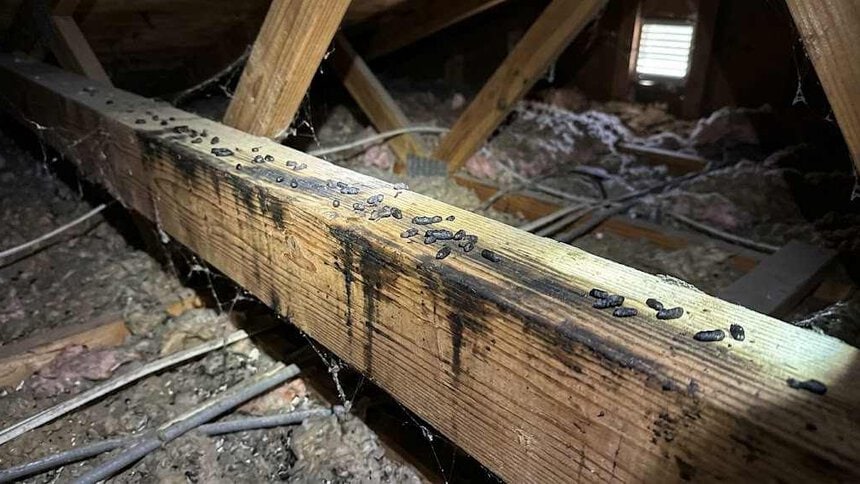
Rats deposit urine as they travel and smear sebum, the oil in their fur, along every surface they brush against. Those dark, greasy smudges on joists, pipe collars and baseboards are not just evidence for you. They are a chemical signpost for the next rat. The marks say a route is passable, that other rats used it safely, and that something worth reaching sits at the end.
This is the single most underestimated factor in repeat infestations. You can trap every rat in an attic and seal every hole, and the space still smells occupied. If one new gap opens later, a scouting rat finds a pre-marked highway and moves in far faster than it would into a neutral space. Odor decontamination and soiled-insulation removal are not cosmetic steps. They reset the invitation.
3. Neophobia, the fear of the new
Rats, especially Norway rats, react to novel objects in a familiar space with suspicion. A new trap, a new bait station, a fresh patch of hardware cloth: all of it gets avoided for days before the animal will approach. That same instinct works in reverse. A rat strongly prefers the familiar nest over an unknown alternative, so it tolerates disturbance, noise and even partial destruction of the nest rather than relocate. When a homeowner bangs on the ceiling to scare rats out, the rat usually moves three feet into a wall void and comes back that night.
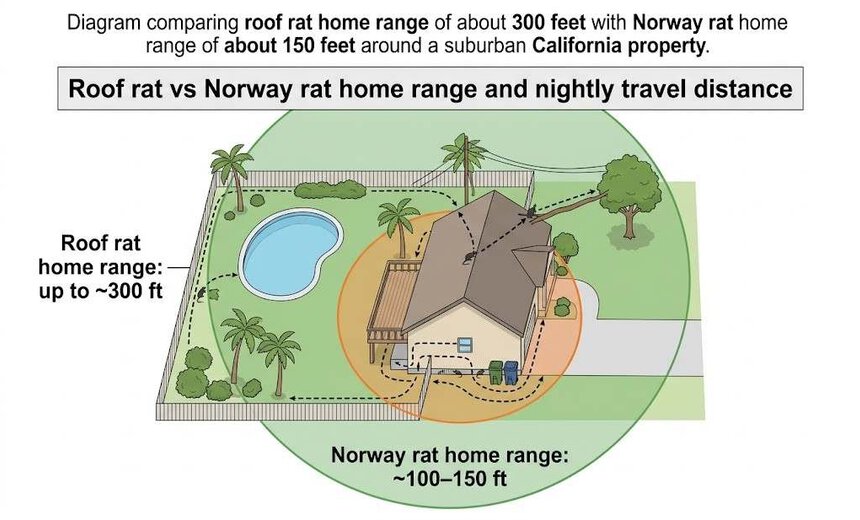
4. A small home range that keeps everything close
Rats do not roam. Roof rats routinely travel up to about 300 feet for food and may live in the landscaping of one residence while feeding at another, and they are often seen at night running along overhead utility lines or fence tops. Norway rats stay tighter, generally within 100 to 150 feet of the burrow. Inside that circle sit the nest, the water, the food and several backup harborages. A property that offers all four has no reason to be abandoned, and a property that offers three of the four will be recolonized by a rat nesting next door.
Roof Rats and Norway Rats Return by Different Doors
California has two commensal rat species, and treating them the same is the most common reason exclusion work fails. Roof rats and Norway rats are present in almost all cities across California, and the two species cannot interbreed. Roof rats typically nest in enclosed and elevated spaces such as attics, wall voids, ceiling voids and cabinets, and they will periodically burrow into soil or occupy sewers when elevated nesting sites are unavailable.
| Return factor | Roof rat (Rattus rattus) | Norway rat (Rattus norvegicus) |
|---|---|---|
| Typical nest site | Attic corners, ceiling voids, palm skirts, dense ivy, bougainvillea, wall cavities above the first floor | Ground burrows along foundations, under decks, beneath woodpiles, in crawl spaces and sewer laterals |
| Return route | Utility lines, fence tops, tree limbs touching the roof, vine-covered walls | Ground-level runways hugging walls, fence lines, irrigation trenches |
| Re-entry point | Roof-to-wall junctions, unscreened attic and dormer vents, gaps behind fascia, chimney chase | Foundation cracks, crawl space vents, garage door corners, utility and sewer penetrations |
| Nightly range | Up to roughly 300 feet | Roughly 100 to 150 feet |
| Reaction to nest disturbance | Shifts to a secondary attic void or exterior vegetation, returns within days | Digs a bolt hole or moves to a satellite burrow a few yards away |
| Exclusion priority | Roofline sealing, vent screening, tree and vine trimming back 4 feet from the structure | Foundation sealing, crawl space vent mesh, subterranean barriers, drainage repair |
Field tell: If droppings sit on top of attic insulation and along ceiling joists, you have roof rats and your exclusion budget belongs on the roofline. If droppings cluster along the base of exterior walls and inside the crawl space, you have Norway rats and the budget belongs at grade. Mixed evidence at both elevations on the same property is more common in older Los Angeles and Bay Area housing stock than most homeowners expect, and it doubles the sealing scope.
Five Return Scenarios We See on California Properties
"Do rats come back" has more than one answer, because more than one thing can walk back through the gap. These are the five patterns that account for nearly every repeat call.
Scenario 1: The surviving colony member
Snap traps and bait rarely take an entire colony in one pass. The dominant males and the bold juveniles hit traps first; the cautious breeding females often hold back for a week or more. Activity drops, the homeowner assumes success, and three weeks later scratching returns overhead. Nothing new arrived. The remainder of the colony simply resumed normal movement once the novel objects stopped appearing.
Scenario 2: The vacancy effect
This one surprises people. A fully cleared nest void is prime real estate: pre-shredded bedding, stable temperature, no predators, a tested entry hole and a scent-marked approach. A rat from a neighboring yard, well inside its normal 300-foot range, finds it and moves in. The homeowner concludes the treatment failed. In reality the treatment worked and the structure was never closed.
Scenario 3: The relocated rat that walks home
Live-trapping and releasing a rat "a few blocks away" is close to a guaranteed return. Rats released within their known landscape navigate back within one or two nights. Beyond that, relocation runs into a legal and ethical wall: California regulations restrict the relocation and release of captured wildlife, and releasing a commensal rodent simply exports the problem to a neighbor. Humane lethal trapping combined with exclusion is the standard responsible approach.
Scenario 4: The seasonal returner
California properties run on a rodent calendar. Late autumn cooling drives roof rats from citrus and avocado canopies into attics. The first heavy winter rains flood Norway rat burrows and push them into crawl spaces and garages. Spring landscaping and irrigation start create fresh outdoor harborage. Summer fruit drop resets the food supply. A house that was clear in July can be occupied by November through the exact same gap, at the exact same nest corner, as the previous year.
Scenario 5: The construction-triggered return
Reroofing, solar panel installation, HVAC replacement, fence work and fire-rebuild framing all open temporary access. Solar arrays in particular create a sheltered, warm cavity between panel and roof deck that roof rats colonize aggressively across Southern California. The rats did not choose your house at random. They exploited a new door on a property they already knew.
How Long Until Rats Come Back? Realistic Timelines
These ranges reflect what happens on California properties after the animals are removed, sorted by how much of the underlying problem got addressed.
| What was done | Typical time to renewed activity | What drives the outcome |
|---|---|---|
| Trapping only, nothing sealed | 2 to 6 weeks | Open entries plus intact scent trails; the void refills from inside the colony or from next door |
| Bait only, nothing sealed | 3 to 8 weeks | Population dips, then rebounds; carcass odor in voids adds a secondary problem |
| Partial sealing, obvious gaps only | 1 to 4 months | Rats test known weak points and enter through the ones that were missed |
| Full exclusion, nest left in place | 4 to 12 months | Structure holds, but residual pheromone makes any future breach attractive immediately |
| Full exclusion plus nest removal and decontamination | Years, often indefinitely | No entry, no odor signal, no nest cavity; recolonization requires a new structural failure |
| Full exclusion plus sanitation plus exterior habitat correction | Longest durability | Removes harborage and food within the home range, not just access to the building |
Notice what does not appear in that table: the number of rats removed. Volume of catch has almost no predictive value for how long a property stays clear. The durability comes from the building envelope and the sanitation, every time.
Why Disturbing a Nest Usually Makes Things Worse
The instinct to tear out a nest the moment you find one is understandable and almost always counterproductive when it happens in the wrong order.
- It scatters a locatable colony. A concentrated nest is a target. Break it up and the rats disperse into wall voids, soffit runs and subfloor cavities where they are far harder to reach, while continuing to breed.
- It rarely evicts anyone. Rats tolerate disturbance and return once the noise stops, because the alternative is an unknown location with unknown predators.
- It aerosolizes contaminated dust. Dry sweeping or shop-vacuuming dried urine and droppings sends particles into the breathing zone. Public health guidance is explicit: ventilate the space for at least 30 minutes first, never dry sweep or dry vacuum, mist the material with a disinfectant or a diluted bleach solution, let it soak, then remove it wet while wearing gloves and respiratory protection. The CDC's rodent cleanup guidance covers the full protocol.
- It can expose you to live young. Nests found between February and May frequently hold pups, and a cornered adult female defends them.
The correct sequence is inspect, exclude, remove the animals, then remove the nest and decontaminate. Reversing steps one and four is how a contained problem becomes a whole-house problem. Where droppings and urine have soaked insulation across a large area, remediation belongs with a crew equipped for it. Our rodent droppings clean-up service in Los Angeles handles containment, removal and disinfection under the ventilation and PPE protocols above.
What Actually Stops Rats From Coming Back
Three levers control return. Pull all three and the problem ends. Pull one and you buy weeks.
Lever 1: Exclusion, done to rodent tolerances
A rat can pass through a gap the size of a US quarter, roughly half an inch. It can gnaw a smaller opening into a usable one in minutes, because rodent incisors grow continuously and cut through wood, soft mortar, aluminum flashing, plastic and foam without effort.
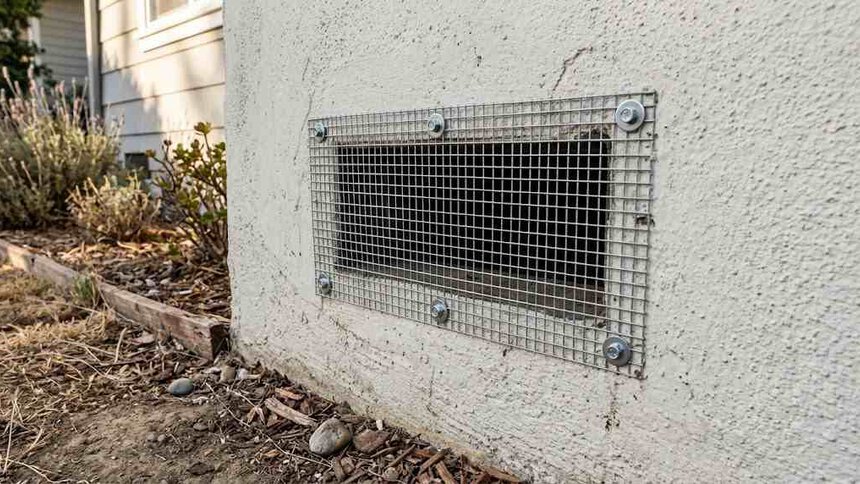
- Seal with materials rats cannot chew: 19-gauge or heavier galvanized hardware cloth at quarter-inch mesh, sheet metal, hydraulic cement, and copper mesh packed behind sealant. Expanding foam and steel wool alone do not hold.
- Screen every attic, gable, foundation and crawl space vent. Inspect the dryer vent, the bath fan terminations and the AC line set penetration.
- Close the gap where the garage door meets the jamb and the slab. That corner is the single most common Norway rat entry we document.
- Repair damaged roof tile underlayment, lifted ridge caps, open fascia gaps and the collar around every plumbing vent stack.
- Check the crawl space access door seal and any sewer lateral penetration through the slab.
Lever 2: Removing the reason to come back
Exclusion keeps rats out of the building. Sanitation and habitat work keep them off the property.
- Harvest fallen citrus, avocados, figs, walnuts and persimmons daily during season. In California this is the highest-yield single change most homeowners can make, since roof rats specifically target tree fruit and nuts.
- Bring pet food and water bowls in overnight and store bulk pet food in metal or thick rigid plastic with a locking lid.
- Trim tree limbs, bougainvillea and vines back at least four feet from the roofline and fence tops. Skirt palm trees; untrimmed palm skirts are among the most productive roof rat nest sites in the state.
- Thin dense ivy and ground cover against foundations, which supplies both harborage and a covered runway.
- Fix irrigation leaks, hose bib drips and AC condensate pooling. Water is often the limiting resource in inland California, and the property that supplies it wins the colony.
- Secure trash and green waste bins with tight lids and keep them off the wall line.
Lever 3: Erasing the signal
After the structure is closed and the animals are gone, remove nesting material, contaminated insulation and droppings, then treat runways and the nest cavity with an enzymatic or oxidizing cleaner that breaks down urine proteins rather than masking them. Ordinary household cleaners leave the pheromone intact under a citrus smell. Rats read through that instantly.
For integrated, non-chemical-first strategy, the UC IPM rat management guidelines remain the most reliable California-specific reference, and the full UC IPM Pest Notes: Rats publication goes deeper on species behavior, trap placement and rodenticide cautions. Both emphasize the same order of operations we use in the field: remove food and shelter, close entryways, then trap.
Is the Nest Active or Abandoned? A Field Checklist
Before you spend money, establish whether you are dealing with a live colony or historical evidence. Work through these in order, with a bright flashlight held at a low angle to the surface.
Droppings age test
Fresh rat droppings are dark, moist-looking and slightly soft, with a faint sheen. Within a few days they dull and harden. After two or three weeks they turn grey and crumble to powder under a gloved finger or a screwdriver tip. A pile of uniformly grey, crumbling pellets with no dark ones mixed in usually means the route went quiet. Always wear gloves.
Tracking patch
Dust a thin layer of unscented talc or plain flour across a suspected runway in a six-inch band, photograph it, and check the next morning. Live traffic leaves four-toed front prints, five-toed rear prints, and often a thin tail drag line between them. This is the single most decisive DIY test available, it costs nothing, and it tells you the direction of travel.
Rub mark quality
Run a gloved fingertip along a dark smudge on a joist or pipe. Current traffic leaves marks that feel slightly tacky and smear. Old marks are dry and chalky and do not transfer.
Sound pattern
Scratching and rolling noises concentrated between dusk and roughly 2 a.m. indicate active rats. Daytime noise in a previously quiet house often means a large population, a disturbed nest, or a different animal entirely, such as squirrels, which are diurnal.
Gnaw edges
Fresh gnawing on wood or plastic exposes pale, clean material with sharp edges. Older gnawing oxidizes, darkens and dulls. Compare a suspected point against a knowingly fresh cut for a reference.
A caution about false negatives: A quiet week means very little. Rats reduce movement during trapping pressure, after a predator appears, or in extreme heat. We have inspected attics that read completely dormant on every test above and still found a breeding colony two rooms over, in a void the homeowner never suspected. Evidence that disappears in one location often means the colony shifted, not that it left.
California-Specific Return Triggers
Rat return patterns are not uniform across the state. These are the local drivers that most affect whether a cleared property stays clear.
Coastal and Southern California
Mature landscaping, year-round fruit production and mild winters support dense roof rat populations in Los Angeles, Orange County, San Diego and the Bay Area peninsula. Detached garages, older Spanish tile roofs with degraded underlayment, and untrimmed palms create near-permanent harborage. Homes here typically need roofline exclusion plus an annual vegetation management cycle, not a one-time seal.
Central Valley and inland
Agricultural edges, irrigation canals, walnut and almond orchards and storage outbuildings feed heavy seasonal pressure. Norway rat burrow systems around foundations and outbuildings dominate. Exclusion here focuses at grade, and drainage correction matters as much as sealing.
Urban infill and multi-unit properties
Shared walls, common trash enclosures and sewer laterals mean a single unit can never solve the problem alone. When a neighboring unit remains open, your sealed unit simply stops being the easiest option. Coordinated exclusion across adjacent properties produces results that individual treatment cannot.
Post-fire and rebuild zones
Rebuild framing, temporary structures and disrupted natural habitat displace rodents into whatever shelter exists. Properties near recent construction see return pressure well above baseline for a year or more after the work finishes.
We dispatch across the state, including targeted work in neighborhoods like Norwalk, CA pest control service areas where older single-story housing stock and mature fruit trees combine to create persistent roof rat activity. You can review coverage on our service locations page.
What a Proper Return-Prevention Inspection Covers
When a PestPunt field representative arrives, the goal is not to count rats. It is to answer three questions: where is the nest, how are they getting in, and what keeps bringing them back.
- Species confirmation. Droppings shape, dropping elevation, gnaw height and runway position identify roof rat versus Norway rat, which determines every subsequent decision.
- Nest location. Attic voids, ceiling cavities, wall bases, crawl space, garage framing, subfloor, exterior burrows and vegetation are checked in sequence. Locating the nest, rather than the activity, is the difference between a fix and a cycle.
- Runway mapping. Rub marks, droppings lines, urine staining under UV and tracking patches produce a route map from entry point to nest to food.
- Entry-point survey. Full perimeter and roofline inspection down to quarter-inch gaps, including vents, penetrations, the garage jamb, the roof-wall junction and every utility entry.
- Attractant audit. Fruit trees, pet feeding, bins, irrigation, bird feeders, compost, wood stacks and dense ground cover within the home range.
- Exclusion scope and sanitation plan. A written list of what to seal and in what material, plus the extent of nest removal and decontamination required.
- Verification. A follow-up check confirming the runways went cold, using the same tracking-patch method so results are objective rather than assumed.
Our full rodent and pest services overview explains how inspection, exclusion and sanitation fit together on a single dispatch.
Common Questions About Rat Site Fidelity & Re-Entry
Yes. A rat leaves at dusk, follows a memorized route to food and water, and returns to the same nest before dawn. It reinforces that route with urine and body oil each trip, which is why runways show as dark greasy lines on joists and baseboards.
They come back when the entry points and attractants remain. Removal without exclusion leaves the cavity, the runway, the scent marks and the gap intact. Either surviving colony members or a neighboring rat occupies the space, commonly within two to six weeks.
Roof rats routinely cover up to about 300 feet between nest and food in a single night. Norway rats generally stay within 100 to 150 feet of the burrow. Relocated rats released within a few hundred yards frequently navigate back within one or two nights.
Rarely on a permanent basis. Rats tolerate disturbance because relocating to an unknown site carries higher risk. They typically shift to a secondary void inside the same structure and return once activity stops, which makes the colony harder to locate rather than smaller.
Yes. Residual urine and sebum carry pheromones that mark a route as safe and established. A cleaned-out attic that still smells occupied is more attractive to an incoming rat than a neutral space, which is why decontamination matters alongside sealing.
Productive nest sites get reused across generations. Attic corners over warm ceilings, ivy banks, palm skirts and the void behind a garage water heater are recolonized each autumn as temperatures drop and outdoor food thins out.
Check dropping freshness, lay a talc or flour tracking patch across the runway overnight, and test whether rub marks feel tacky or chalky. Fresh droppings are dark and soft; old ones are grey and crumble. Live runways show footprints and tail drags by morning.
Small, dry, accessible areas can be handled with gloves, a fitted respirator, ventilation of at least 30 minutes, wet misting with disinfectant, and wet removal into double-bagged waste. Never dry sweep or dry vacuum. Soaked insulation, large soiled areas and confined crawl spaces warrant professional remediation.
Rodenticides reduce numbers temporarily and do nothing about return, since the entry and the nest remain. They also carry secondary poisoning risk to pets, owls, hawks, bobcats and coyotes, and California has tightened restrictions on several anticoagulant products. Exclusion first, trapping second, and rodenticide only where a licensed applicator determines it is appropriate.
Almost always because the scope covered removal but not exclusion and sanitation, or because sealing missed entry points at a different elevation than the ones that were closed. A treatment that does not end with a written entry-point list and a verified cold runway is incomplete.
Properties that receive full exclusion, nest removal, decontamination and exterior habitat correction commonly stay clear for years. Recolonization at that point requires a new structural failure, such as roof damage, a construction penetration or a degraded vent screen.
California Mobile Rat Control Services
Stop the Re-Entry Cycle with Professional Help
Understanding rat site fidelity is the first step. Taking action is the second. Contact our team at (888) 217-6759 to schedule a full property assessment and get a tailored plan to eliminate rats and keep them from returning.