Rodent Droppings Clean Up Service in Norwalk, CA
If you've found small, dark droppings along your attic insulation, garage baseboards, or kitchen cabinets in Norwalk, you're not imagining things — and you shouldn't sweep them up. Norwalk sits in a part of southeastern Los Angeles County where older tract housing, mild year-round temperatures, and nearby flood-control channels combine to make rodent activity a recurring issue rather than a one-time event. This page walks through what's actually happening in your home, the health risks involved, and how a proper clean up is done — the way a field technician would explain it, not a sales page.
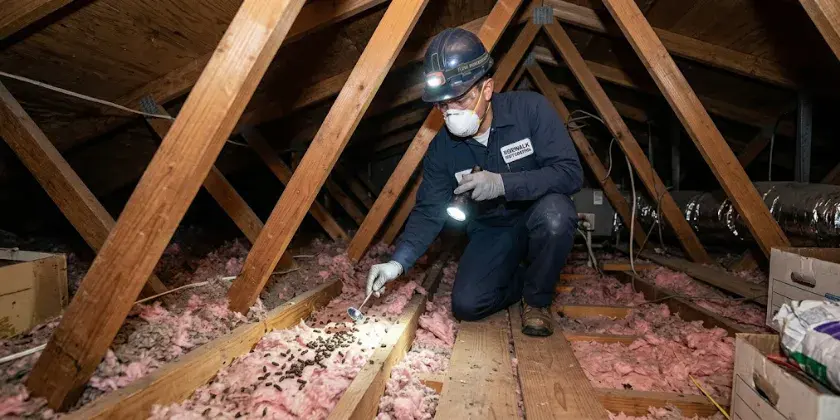
Why Rodent Droppings Show Up So Often in Norwalk Homes
Norwalk's housing stock is dominated by single-story tract homes built between the 1950s and 1970s, many with original vent screens, aging garage door seals, and foundation gaps that have widened slightly over decades. Those small gaps — often no larger than a quarter — are all a mouse needs, and a gap the size of a half-dollar is enough for a mature rat. Homes near the Coyote Creek channel, the San Gabriel River corridor, or areas backing onto greenbelts and flood-control easements tend to see more pressure from roof rats, which travel along fence lines, power lines, and overhanging trees before finding a way into an attic or soffit.
Seasonal shifts matter too. As Southern California temperatures cool in fall and early winter, rodents move from yards and landscaping into the shelter, warmth, and insulation of attics, garages, and wall voids. That's when most droppings discoveries happen — homeowners turn on the attic light to grab holiday decorations and find a scattering of dark pellets across the insulation.
Note on local specifics: Exact neighborhood-level patterns (which blocks, which channels, which housing tracts see the heaviest activity) should be confirmed against current field data before being treated as guaranteed fact for any one property — general climate and housing-age patterns hold true across the region, but every property is different.
Where Rodents Actually Get In
The entry points we see most often on this type of housing stock aren't dramatic — they're small, easy-to-miss gaps that widen over decades:
- Dryer vent flaps that no longer close fully, especially on older exterior vent covers
- Roof-to-fascia gaps where tile or composition roofing meets the fascia board, a common roof rat entry point
- Garage door seals that have shrunk or cracked with age, leaving a gap along the bottom edge
- Foundation vents with damaged or missing screens
- Utility line penetrations where plumbing or electrical lines pass through an exterior wall, often sealed loosely during original construction
Any one of these is a minor repair on its own. Left unaddressed, they're the reason a home gets "cleaned" and then re-contaminated within a season.
Health Risks: Why Rodent Droppings Are More Than a Nuisance
Rodent droppings and urine are not just unsightly — they carry real pathogen risk, and the risk is highest during clean up, not just while the infestation is active.
Hantavirus
Hantavirus is carried by certain rodents, most notably deer mice, and spreads to people primarily through inhaling airborne particles from disturbed droppings, urine, or nesting material. The CDC's hantavirus prevention guidance is explicit that urine, droppings, and nesting material should be cleaned up safely rather than swept or vacuumed dry, since dry disturbance is what puts contaminated particles into the air people breathe.
Salmonella and Other Bacteria
Rodent droppings can carry salmonella and other bacteria that contaminate kitchen surfaces, pantry items, and food-prep areas. This is one of the more overlooked risks in homes where droppings are found in cabinets or near countertops rather than attics.
Allergens and Respiratory Irritation
Dried rodent urine and dander are known asthma and allergy triggers, particularly in homes with recurring attic or crawlspace activity where old contamination builds up unnoticed over months or years.
Lymphocytic Choriomeningitis and Other Rodent-Borne Concerns
House mice can also carry lymphocytic choriomeningitis virus (LCMV), which spreads through contact with urine, droppings, or saliva — another reason mouse activity in kitchens and pantries shouldn't be treated as purely cosmetic. Households with young children, pregnant occupants, or immunocompromised family members carry higher stakes if contamination isn't handled correctly, since these groups are more vulnerable to complications from rodent-borne pathogens.
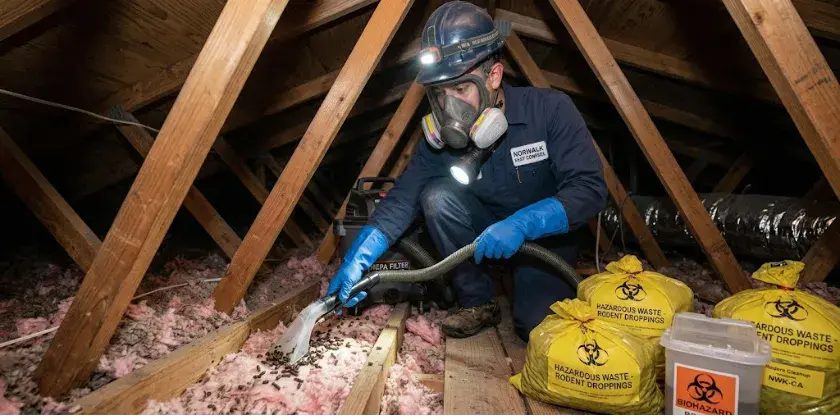
Why DIY Clean Up Often Goes Wrong
Most DIY rodent clean up mistakes come from good intentions executed the wrong way. The most common ones we see:
- Dry sweeping or vacuuming droppings — the single biggest mistake, and the one most directly tied to airborne pathogen exposure.
- Skipping ventilation — entering an enclosed attic or crawlspace immediately without airing it out first.
- Using the wrong disinfectant concentration — household cleaners that aren't EPA-registered disinfectants, or bleach solutions mixed too weak to be effective.
- Cleaning without sealing entry points — a clean attic with an open gap will usually be re-contaminated within weeks.
- Ignoring insulation contamination — droppings and urine soak into blown-in insulation; surface wiping doesn't address what's trapped underneath.
None of these mistakes are about carelessness — they're about not knowing the sequence. That sequence is exactly what a proper clean up follows.
The Professional Rodent Droppings Clean Up Process
Here's the actual sequence a field technician follows on a rodent droppings job, step by step:
Ventilate and isolate the space.
Doors and windows (or attic access panels and vents) are opened for at least 30 minutes before anyone enters to begin work.
Suit up in PPE.
HEPA-rated respirator, disposable gloves, and coveralls go on before any droppings are touched or disturbed.
Wet everything down first.
Droppings, urine trails, and nesting material are saturated with an EPA-registered disinfectant and left to soak — never swept or vacuumed while dry.
Remove and double-bag waste.
Once saturated, waste is wiped up with disposable materials, double-bagged, and sealed for disposal.
Sanitize surfaces and ductwork.
Attic decking, subfloor, insulation-adjacent surfaces, and HVAC ducting (if contaminated) are treated to remove residual bacteria and odor.
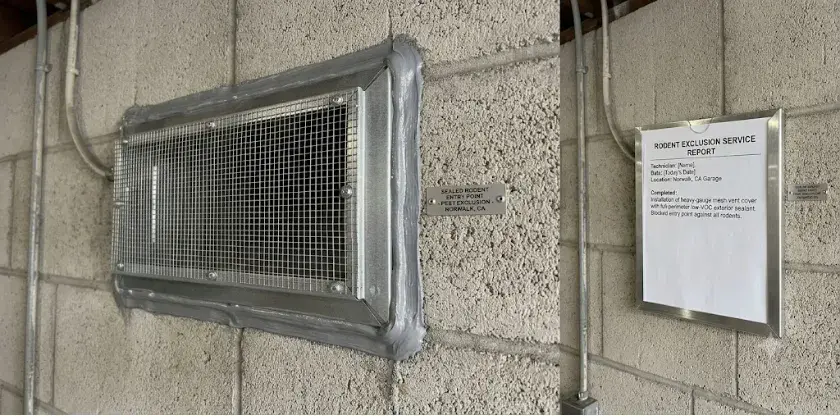
Seal entry points.
Gaps around vents, gnaw holes, foundation cracks, and garage seals are identified and closed off — this is what actually prevents the problem from repeating.
Optional monitoring.
Discreet monitoring stations can be placed to confirm the space stays clear after the initial visit.
Skipping any of these steps — especially the sealing step — is why homeowners sometimes clean the same attic twice in one year.
California Rodenticide Law: What AB 1788, AB 2552, and Diphacinone Mean for Your Home
California's approach to rodent control has shifted significantly over the past several years, and it directly affects what treatment options are legally available to homeowners and pest professionals alike.
AB 1788 (2020)
California's Department of Pesticide Regulation confirms that AB 1788, effective January 1, 2021, prohibits most residential and commercial uses of second-generation anticoagulant rodenticides — brodifacoum, bromadiolone, difenacoum, and difethialone — statewide, with narrow exemptions for public health and specific agricultural uses.
AB 2552 (2025)
AB 2552 expanded that prohibition to first-generation anticoagulants chlorophacinone and warfarin, effective January 1, 2025, closing what had been a workaround for pest control operators after the original 2020 law.
Diphacinone's Restricted Status
Diphacinone, another first-generation anticoagulant, remains classified as a restricted material in California. That means its use is limited to specific exempted sites and licensed applicators rather than being available for general residential application — a distinction that matters if you've been told "we'll just put out bait" as the whole solution.
The practical effect for Norwalk homeowners: bait-only treatment is no longer the default toolkit it used to be. Exclusion (sealing entry points), sanitation (removing food sources and cleaning contamination), and trapping have become the primary, legally available strategies for most residential rodent problems in California. This is exactly why a droppings clean up service that only wipes surfaces — without sealing and sanitation — falls short of what the law and the science both point toward.
Identifying Your Rodent: Droppings, Size, and Behavior
Not all droppings mean the same problem. Species identification changes the treatment plan.
| Species | Dropping Size & Shape | Typical Location | Behavior Note |
|---|---|---|---|
| House Mouse | ~1/4 inch, pointed ends, rice-grain size | Kitchen cabinets, pantry, wall voids | Nests close to food sources; short foraging range |
| Roof Rat | 1/2–3/4 inch, tapered/spindle-shaped ends | Attics, upper wall voids, roof eaves | Excellent climbers; enter via trees, power lines, rooflines |
| Norway Rat | 3/4 inch, blunt rounded ends, larger diameter | Crawlspaces, garages, near foundations | Burrowing behavior; stays closer to ground level |
Featured-snippet answer: Mouse droppings are about a quarter-inch long with pointed ends, similar to a grain of rice. Roof rat droppings are larger — a half-inch to three-quarters of an inch — with tapered ends, while Norway rat droppings are blunter and thicker. Fresh droppings look dark and slightly moist; old droppings are dry, gray, and crumble when touched.
Active Infestation or Old Contamination? How to Tell
Homeowners often find droppings and assume the worst — or assume it's an old, resolved issue. Here's how to tell the difference:
Signs of an Active Infestation
- Droppings that are dark, soft, and shiny rather than dry and crumbly
- Fresh gnaw marks on wood, wiring insulation, or stored cardboard
- Grease or rub marks along baseboards and entry points from repeated travel
- Scratching or scurrying sounds in walls or the attic, especially after dark
- A persistent ammonia-like odor in enclosed spaces
Signs of Old, Resolved Contamination
- Droppings that are pale gray, dry, and crumble to dust when touched
- No fresh gnaw marks or grease trails
- No sounds or sightings over several weeks of observation
Even old contamination should still be professionally cleaned and sanitized — dried urine and dander remain an allergen and odor source long after rodents are gone.
Attic, Crawlspace, or Garage: Why the Clean Up Approach Changes by Location
Not every rodent droppings job looks the same, because contamination behaves differently depending on where it's found:
| Location | Common Contamination Pattern | Extra Consideration |
|---|---|---|
| Attic | Droppings scattered across insulation, along joists and decking | Contaminated insulation often needs partial or full removal, not just surface wiping |
| Crawlspace | Droppings along the ground, near vapor barriers and ductwork | Confined space increases PPE and ventilation requirements; ducting may need separate sanitation |
| Garage | Droppings near storage boxes, along wall-floor junctions | Stored items may need inspection and disposal if heavily contaminated |
| Kitchen / Pantry | Droppings inside cabinets, behind appliances | Food-contact surfaces require food-safe disinfectant protocols, not just general cleaners |
This is part of why a flat, one-size-fits-all quote rarely reflects the actual job — the location of the contamination changes both the method and the time required.
What Affects the Price of a Rodent Droppings Clean Up
Quotes vary because contamination is never identical from one property to the next. The factors that actually move the price:
- Square footage affected — a single hot spot near an attic access panel costs less than contamination spread across an entire attic floor
- Insulation condition — heavily soaked insulation usually needs partial removal and replacement, not just disinfection
- Number of access points needing exclusion — one vent repair is a different job than sealing five separate gaps around a roofline
- Duct involvement — if droppings or urine have entered HVAC ducting, sanitation extends beyond the attic itself
- Site accessibility — tight crawlspaces or steep roof access can add time regardless of contamination size
Because of this variation, a field representative confirming the scope on-site (or from clear photos) will always be more accurate than a flat online price.
What a PestPunt Rodent Droppings Clean Up Includes
As a Service Area Business, PestPunt doesn't operate storefronts in Norwalk or anywhere else — instead, a local field representative is dispatched directly to your property. A typical visit includes:
- On-site inspection to identify species, contamination level, and entry points
- Safe, CDC-aligned droppings and urine clean up using proper PPE and disinfection
- Sanitation of affected insulation, decking, and surfaces
- Exclusion work to seal gaps, vents, and gnaw holes
- Guidance on trapping and sanitation practices going forward, in line with current California rodenticide restrictions
If you're dealing with an active, ongoing rodent problem rather than just a droppings clean up, our broader 24/7 Los Angeles rodent response service covers trapping, exclusion, and follow-up monitoring across the county. For general pest control services beyond rodents, visit the PestPunt homepage to see the full range of dispatched services available statewide.
Frequently Asked Questions
Cost depends on the size of the contaminated area, the level of contamination, and whether exclusion and sealing work is needed. A field representative can give you an exact quote after reviewing photos or completing an on-site inspection.
Yes. Dry sweeping or vacuuming can aerosolize particles carrying hantavirus, salmonella, and other pathogens. The safer sequence is to ventilate the space, then wet the droppings with disinfectant before any removal.
Mouse droppings are about a quarter-inch with pointed ends. Roof rat droppings run a half-inch to three-quarters of an inch with tapered ends. Norway rat droppings are blunter and slightly larger in diameter.
Use is now restricted. AB 1788 and AB 2552 have banned most second- and first-generation anticoagulant rodenticides for general residential use, shifting the primary toolkit toward trapping, exclusion, and sanitation.
Diphacinone is a first-generation anticoagulant rodenticide that remains a restricted material in California, limited to exempted sites and licensed applicators rather than general household use.
Fresh droppings are dark, soft, and shiny; old droppings are dry and crumble easily. Active infestations also show fresh gnaw marks, grease trails, live sightings, and nighttime scratching sounds.
Yes, though infection is rare. It spreads through inhaling airborne particles from disturbed droppings or urine. The CDC recommends wetting the area with disinfectant before cleanup rather than sweeping or vacuuming it dry.
A single attic or crawlspace typically takes two to four hours depending on contamination level and square footage. Larger jobs with insulation replacement or extensive exclusion work can take a full day.
Most standard policies treat rodent infestation as a maintenance issue and exclude it from coverage, though resulting damage like a chewed wire causing a fire may be covered separately. Check your specific policy.
Accessible food, cluttered storage, unsealed foundation gaps, vegetation touching rooflines, and proximity to waterways or flood-control channels all draw rodents indoors, especially as temperatures shift in fall.
Cleaning alone doesn't stop reinfestation. Without sealing entry points, rodents can return within weeks, undoing the clean up — exclusion work is a core part of any thorough service.