House Mouse vs Baby Rat: Key Differences You Can Check Right Now
A rodent the size of your thumb is sitting in a glue trap or scurrying along a baseboard, and you need to know what it actually is before you decide what to do next. Size alone will not tell you. A young rat and an adult house mouse can weigh almost the same amount, which is exactly why so many California homeowners guess wrong and end up setting the wrong kind of trap in the wrong place for weeks.
Why This Mix-Up Happens So Often
A house mouse reaches full size within a few months and stays small its entire life. A rat starts life far smaller than that, blind, hairless, and about the size of a jellybean, then grows quickly. Somewhere around the three-to-six-week mark, a growing rat pup passes directly through the size range of an adult mouse. That overlap window is short in the rat's life but common enough in the field that pest technicians see it constantly: a homeowner catches something mouse-sized, assumes mouse-sized means mouse, and treats for the wrong species.
The confusion matters because mice and rats do not respond to the same bait stations, the same trap placement, or the same exclusion work. Treating a rat problem as a mouse problem buys you a few quiet days and then a returning infestation, because the adults that produced that pup are still active in the structure.
The Size Test Fails More Often Than You Think
An adult house mouse measures roughly 5 to 7 inches long including its tail and weighs about half an ounce. A rat pup at six weeks old already weighs close to that same amount and keeps growing toward 200 grams by eight weeks. For the first two or three weeks after birth, a pup is unmistakably tiny and hairless, so nobody confuses it with an adult mouse at that stage. The confusion sets in later, once fur has grown in and the eyes have opened, when the pup looks like a fully formed small rodent rather than a newborn.
If you are relying on a tape measure or a kitchen scale to settle the question, you are relying on the one method that fails precisely in the range where identification matters most. Proportion, not size, is what separates the two.
The Tail Test: The Single Most Reliable Field Check
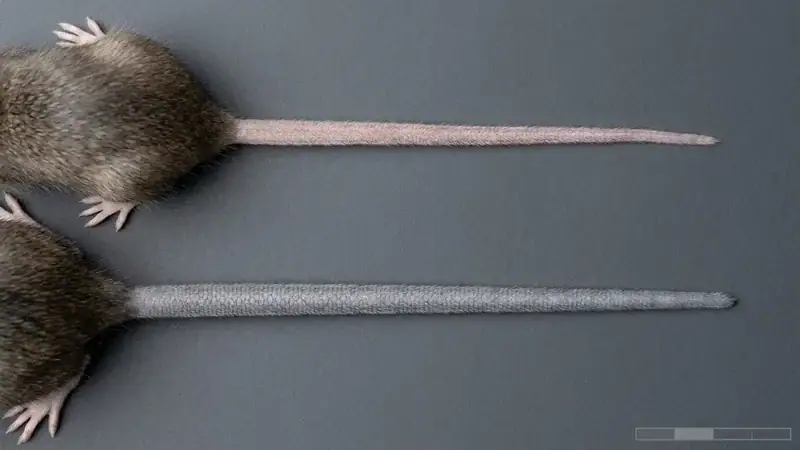
Every pest technician who has pulled rodents out of a wall void learns this test early, because it works even on a young, half-grown animal. Compare the length of the tail to the combined length of the head and body.
Field Test: Tail-to-Body Ratio
Measure or visually compare the tail against the head-plus-body length.
Mouse: the tail is thin, lightly haired, and equal to or longer than the head and body combined.
Baby rat: the tail is thicker, hairless or nearly so, and noticeably shorter than the head and body combined.
This ratio holds true even on a rat pup that is still small enough to be confused with a mouse by weight, which is why it outperforms a size comparison every time.
Eyes and Coloring: A Secondary Check
Eye size follows the same proportional pattern as the ears. A mouse's eyes look large and prominent against its small, narrow head, dark and round enough to stand out clearly even from a short distance. A young rat's eyes sit on a wider face and read as proportionally smaller, even though the actual eye size is not dramatically different between the two animals at this age. Coat color overlaps enough between the species that it should never be your primary test, since both a house mouse and a young Norway rat commonly show brownish-gray fur with a paler underside, but a house mouse's coat usually reads as a more uniform light gray-brown, while a young rat's coat often looks slightly coarser and darker along the back.
Head, Feet, and Ears: Reading the Proportions
Put a mouse and a young rat next to each other and the body length might be close, but the proportions never match. A mouse's head is small and narrow relative to its body, with a pointed muzzle and large, rounded ears that look oversized on such a small frame. A young rat carries a broad, blunt head and disproportionately large feet, both clear signs that the animal is still growing into an adult body plan that will end up much larger than any mouse.
Ears settle close calls quickly. A mouse's ears stand out prominently against its head. A rat's ears, even as a juvenile, sit smaller and closer to the skull. If the ears look large enough to seem almost too big for the head, you are looking at a mouse.
Feet deserve a closer look too, especially the hind feet. A mouse's feet stay small and proportional through adulthood, built for quick, light movement across open surfaces. A young rat's hind feet already look oversized for its current body length, a preview of the stronger climbing and digging ability it will rely on as an adult. That single detail, checked alongside the tail ratio, resolves almost every case where size and coloring alone leave the identification unclear.
| Feature | House Mouse (adult) | Baby Rat (3–6 weeks) |
|---|---|---|
| Body length (excl. tail) | 2.5–3.5 inches | 2–4 inches, growing weekly |
| Weight | ½–1 ounce | Approaches 3–7 ounces by 6–8 weeks |
| Tail vs. body | Equal to or longer | Shorter, thicker, hairless |
| Head shape | Small, narrow, proportional | Broad, blunt, oversized for body |
| Ears | Large relative to head | Small relative to head |
| Feet | Proportional | Noticeably large |
Droppings: Shape, Size, and Where You Find Them
If you never see the rodent itself, droppings still give you an answer. Mouse droppings are small, granular, and pointed at both ends, roughly the size of a grain of rice, and a single mouse can leave dozens scattered across a kitchen or pantry in one night. Rat droppings, even from a half-grown juvenile, run noticeably larger and thicker, closer to the size of a coffee bean, with blunter, rounder ends, and they tend to show up in smaller, more concentrated clusters near a nest or a regular travel path rather than scattered widely.
Placement matters as much as size. Mice explore more of a structure and leave droppings along a wider range of surfaces. Rats, including juveniles that stay close to the nest, concentrate their droppings near a single harborage site, which is often your first clue that you are dealing with a nest rather than a lone wandering mouse.
Smell and Other Sensory Clues Worth Checking
House mice carry a distinct musky odor that builds up wherever a population has been active for a while, strong enough that many homeowners notice it before they ever spot an actual mouse. That smell comes from a combination of urine and oil secretions the animals leave along their regular travel paths, and it tends to concentrate near nesting sites and frequently used routes behind appliances or inside cabinets. A young rat produces a similar musky note, but the smear marks it leaves along walls and baseboards, sometimes called rub marks, tend to run darker and greasier because a rat's body carries more oil and moves along the same path more consistently over time as it matures.
Whiskers offer one more subtle check if you get a clear look. A mouse's whiskers are long relative to its narrow head and constantly in motion as it investigates its surroundings. A young rat's whiskers, while proportionally similar in function, sit on a broader face and read as shorter relative to the width of the head, reinforcing the same broad-head pattern that shows up in the ears and feet.
Behavior and Movement: What You Will Actually Observe
Watch how the animal moves and you get another reliable clue. Mice are bold and curious by nature. They will cross open floor space, climb onto counters, and explore new objects within days of encountering them. A young rat behaves differently. It stays close to the nest, moves clumsily compared to an adult, and rarely ventures into open, exposed areas alone. A rodent caught wandering a room by itself, some distance from any obvious nest, is acting far more like a mouse than a young rat still learning to navigate its surroundings.
Sound offers a secondary clue. Mice produce a light, quick scurrying and higher-pitched noises. Even a young rat tends to produce heavier, more deliberate movement, closer to what an adult rat sounds like, because the additional body mass changes how it interacts with flooring and wall cavities.
Gnaw Marks and the Damage Each One Leaves Behind
Mouse gnawing looks like fine, shallow scratches, usually on soft materials like cardboard, paper, or thin plastic packaging. Rats, even before they reach full adult size, already carry stronger jaw musculature and will chew through tougher material, including soft wood, wiring insulation, and some soft metals and plastics that a mouse could never break through. A hole in a baseboard the size of a quarter, or wiring insulation stripped back in a straight line, points toward a rat problem rather than a mouse problem, regardless of how small the animal you actually saw appeared to be.
Nesting Habits: Where Each One Actually Lives
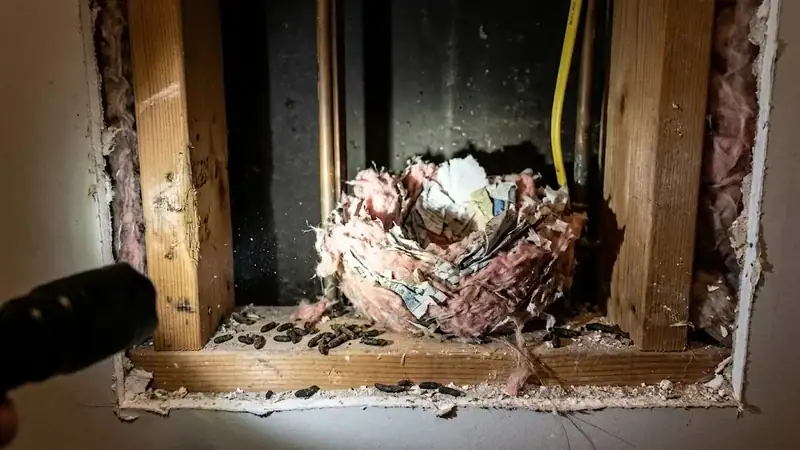
Mice build nests from shredded paper, fabric, or insulation, typically within about 30 feet of a reliable food source, tucked into dark, warm corners such as behind appliances or inside wall voids near a heat source. Rats favor a different setup. A breeding female often selects a burrow, a crawl space void, or a section of wall or subfloor close to a stable food and water source, and she will defend that nest site actively while pups are present. If you already suspect rats and want to understand how persistently they hold onto a chosen nest site, our guide on whether rats return to the same nest walks through what drives that behavior and why removing the nest matters as much as removing the animal.
Why Getting the Identification Wrong Costs You Real Time
Bait formulated and placed for mice will not clear a rat problem, and a trap sized for a mouse often fails to hold a young rat that keeps growing heavier by the week. Homeowners who misidentify the species at the start commonly spend two or three extra weeks cycling through the wrong approach before the infestation is actually addressed, all while the breeding pair that produced the pup continues reproducing elsewhere in the structure. Getting the species right on day one is the difference between a single effective response and a repeating cycle of partial fixes.
This is also where local conditions matter. California's mix of dense urban housing stock, older wood-frame construction, and mild winters supports both species well beyond what colder climates allow, which is part of why service requests around identification stay high statewide. If you are in the Norwalk area specifically, our Norwalk, CA pest control service page covers what local response looks like once identification is confirmed.
Litter Size and Why One Sighting Rarely Stays One Sighting
A single confirmed mouse or rat pup almost never represents the whole population living in a structure, and the two species differ enough in reproductive pace that the species you confirm changes how urgently you should act. A house mouse can produce a new litter roughly every three weeks under favorable conditions and reaches sexual maturity in as little as five to eight weeks, which means a small population can multiply into a significant one within a single season if it goes unaddressed. Rats reproduce on a slightly longer cycle per litter but produce larger litters on average, and a young rat found alone almost always means an active breeding female and additional pups are still present somewhere nearby in the same nest.
That difference in reproductive math is exactly why confirming the species changes the urgency of your response. A confirmed mouse sighting justifies prompt action because the population curve accelerates quickly. A confirmed young rat justifies an even more immediate response, because the pup you found is rarely the only one, and the adults responsible for it are still actively producing more.
California-Specific Relevance: Why Local Climate and Species Overlap Matter
California hosts more than just the house mouse and the Norway rat. The deer mouse, a separate species that sometimes moves into cabins and outbuildings in rural and semi-rural parts of the state, carries a distinct health consideration: it can harbor the hantavirus that causes hantavirus pulmonary syndrome, a risk the common house mouse does not carry. Distinguishing a house mouse from a deer mouse relies on a different set of cues than the mouse-versus-rat comparison covered here, primarily coat color and the sharp white underside markings the deer mouse carries, so a rural property owner benefits from ruling out that third possibility as part of a full identification.
Statewide, both house mice and rats shift indoors as outdoor temperatures drop in fall and early winter, which is the period when homeowners most often report finding a young rat and mistaking it for a mouse. Warmer coastal regions extend the active breeding season further into the year than colder inland areas do, which means the size-overlap window described above can appear on a slightly different calendar depending on where in the state you live.
Field teams responding across California properties report a consistent pattern behind this confusion: the call almost always starts with someone describing "a small mouse" that, on closer inspection at the property, turns out to be a young rat still weeks away from full size. That gap between what a homeowner expects to find and what is actually present is precisely why an on-site identification check, rather than a phone-based guess, changes the outcome of the treatment plan from the first visit.
When to Handle It Yourself and When to Bring in a Professional
A single mouse caught on a snap trap, with no droppings elsewhere in the home and no gnaw damage, is a manageable do-it-yourself situation for most households. A young rat, concentrated droppings near one location, gnaw damage through wood or wiring, or repeated captures over several nights all point toward an active breeding nest rather than a single stray animal, and that scenario benefits from a trained inspection rather than a guess. Confirming the species correctly before treatment begins saves both the cost of the wrong product and the extended timeline of a repeated infestation.
Sealing entry points matters regardless of which species you confirm, since both mice and young rats can enter through gaps far smaller than most homeowners expect, a mouse through an opening the width of a pencil and a young rat through a gap not much larger. Checking utility penetrations, garage door seals, and vent screens for gaps of that size is a reasonable first step to take while you wait on a professional inspection, since closing obvious entry points slows continued entry even before treatment begins.
Our full list of services covers what a confirmed identification leads into, from exclusion work to targeted treatment, and our coverage locations page shows where our mobile field teams currently dispatch across California.
Common Questions About Mouse vs. Baby Rat Identification
Can a baby rat really be mistaken for a mouse?
Yes. A rat pup between roughly three and six weeks old overlaps in body length and weight with an adult house mouse, so size alone will not settle the question. The tail-to-body ratio and the proportion of the head and feet to the body are far more reliable indicators than size at a glance.
What is the fastest way to tell a baby rat from a mouse without touching it?
Look at the tail against the body. If the tail is thin, haired, and about as long as the head and body combined, you are looking at a mouse. If the tail is thick, hairless, and clearly shorter than the head and body together, you are looking at a young rat.
Do baby rats live with their mother or alone?
Rat pups stay close to the nest and to their mother for the first several weeks of life and rarely wander far on their own. A rodent found exploring open floor space alone, away from any nest, is behaving more like a mouse than a young rat.
Are house mice or young rats more likely to cause structural damage?
Young rats grow into adults that chew through far tougher material than mice ever will, including soft wood, insulation, and some plastics and soft metals. A juvenile rat already has the stronger jaw structure that will produce that damage as it matures, while a mouse's gnawing stays limited to fine scratches on soft materials.
What time of year do baby rats show up most in California homes?
Rat and mouse activity inside California homes both increase in fall and early winter as outdoor food and shelter become scarcer and rodents move toward buildings that hold consistent warmth and food. A litter discovered indoors during this window is worth a closer identification check rather than an assumption either way.
California Mobile Rodent ID & Control Services
Confirm the Species Before You Treat
On-site identification changes the entire treatment plan. Contact our team at (888) 217-6759 to schedule a full property assessment and get a tailored response for the species actually present.