Roof Rat vs Norway Rat: How to Tell Them Apart (2026 Identification Guide)
When evaluating property concerns regarding unexplained noises or structural damage, proper pest categorization is crucial for meaningful resolution. Roof rats and Norway rats look similar initially, but they utilize unique nesting areas, display differing behaviors, and require tailored strategies for mitigation. This comprehensive resource helps clarify visual and physical distinctions so property owners can recognize and address the specific issue appropriately.
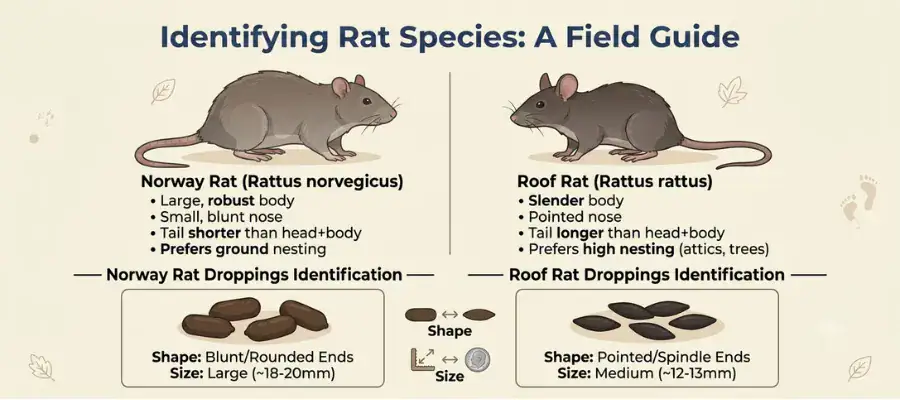
Quick answer: The fastest way to tell them apart is the tail. A roof rat's tail is longer than its head and body combined, while a Norway rat's tail is shorter than its body. Roof rats are slimmer with large ears and a pointed snout, and they nest above ground in attics and trees. Norway rats are stockier with small ears and a blunt snout, and they burrow at ground level near foundations, woodpiles, and gardens.
Why Correct Identification Actually Matters
Most structural assessment guides stop at physical description, but the species you're dealing with directly changes where you should inspect, where you should place monitoring devices, and how you should seal your property. Roof rats are agile climbers that enter through rooflines, overhanging branches, and utility lines, so exclusion work has to focus on the upper third of a structure. Norway rats dig and burrow, so exclusion work has to focus on foundation gaps, vent screens, and ground-level entry points. Misplacing solutions for a roof rat problem, or ignoring the attic when Norway rats are actually the culprit, misallocates resources and allows the situation to worsen.
This distinction also affects deployment strategies under current EPA rodent management guidance, which emphasizes first identifying structural entry points and nesting patterns before choosing a control method. This ensures that applied solutions are highly effective and pose minimal risks to household residents and surrounding environments.
Roof Rat vs Norway Rat: Full Comparison Table
| Trait | Roof Rat (Rattus rattus) | Norway Rat (Rattus norvegicus) |
|---|---|---|
| Also known as | Black rat, ship rat, house rat | Brown rat, sewer rat, barn rat, wharf rat |
| Tail length | Longer than head and body combined | Shorter than head and body combined |
| Body build | Slender, sleek, athletic | Stocky, heavy-set, muscular |
| Weight | Roughly 5–9 ounces | Roughly 7–18 ounces |
| Body length (excluding tail) | Approximately 6–8 inches | Approximately 7–9.5 inches |
| Ears | Large, prominent, visible above fur | Small, close to head, partially covered by fur |
| Snout | Pointed, triangular | Blunt, rounded |
| Fur color | Dark brown to black, sometimes gray-brown; smooth | Coarse brown or gray fur with lighter underbelly |
| Eyes | Large and prominent | Smaller relative to head size |
| Primary nesting sites | Attics, wall voids, trees, dense shrubs, palm fronds | Burrows, basements, crawl spaces, beneath woodpiles |
| Climbing ability | Excellent; runs along wires, fences, and branches | Poor to moderate; rarely climbs above ground floor |
| Swimming ability | Limited | Strong; comfortable in sewers and waterways |
| Diet preference | Fruit, nuts, seeds, snails, tree bark | Garbage, meat, grain, pet food, garden produce |
| Droppings shape | Spindle-shaped, pointed ends, roughly ½ inch | Capsule-shaped, blunt ends, roughly ¾ inch, larger overall |
| Typical U.S. range | Coastal and warmer climates, common statewide in California | Found throughout the 48 contiguous United States |
Physical Differences: What to Look For First
When you get even a brief look at the animal — whether it's darting across a fence line or caught on a security camera — three features settle the identification faster than anything else: the tail-to-body ratio, the ear size, and the snout shape.
Tail Length: The Single Most Reliable Cue
Hold the animal's silhouette in your mind and compare the tail to the rest of the body. On a roof rat, the tail is uniformly dark and noticeably longer than the combined length of the head and body. On a Norway rat, the tail is proportionally shorter, often appearing stubby by comparison and slightly lighter on the underside. This single ratio resolves the vast majority of identification questions on its own.
Ears and Snout
Roof rats have large, thin, almost translucent ears that stand up clearly above the fur line, paired with a pointed, narrow snout that gives the face a delicate, angular look. Norway rats have small, thick ears that sit close to the skull and are often partly hidden in fur, paired with a blunt, rounded snout that gives the face a heavier, more rounded appearance.


Body Size and Build
Norway rats are the larger and heavier of the two species, with a thick, muscular build suited to digging. Roof rats are lighter and more streamlined, built for climbing and balancing on narrow surfaces like wires and fence tops. If you're comparing two specific examples side by side, the leaner, more agile-looking animal is almost always the roof rat.
Behavioral and Habitat Differences
Physical traits are useful when you can see the animal directly, but most property owners identify an environmental issue through behavior and location long before they ever spot the subject itself. This is often the more practical diagnostic method.
Where Each Species Nests
- Roof rats nest above ground: attics, soffits, wall voids, palm trees, dense ivy, and overgrown shrubs.
- Norway rats nest at or below ground: burrows along foundations, under concrete slabs, in crawl spaces, and beneath stacked wood or debris.
- Roof rats travel along utility lines, fences, and tree branches to reach a structure's roofline.
- Norway rats dig extensive burrow systems, often with multiple entrances near foundation walls or garden beds.
According to university extension pest management guidelines, roof rats are frequently found nesting in citrus trees and dense landscaping, which is a major reason they're so common in California's residential and agricultural environments alike.
Noise Location as a Diagnostic Clue
If you're hearing activity but haven't seen anything, the location of the noise is one of the most underutilized evaluation tools available. Scratching, scampering, or gnawing sounds coming from the ceiling, attic, or upper walls point strongly toward roof rats. The same sounds coming from beneath the floor, inside a crawl space, or along the base of exterior walls point toward Norway rats.
Feeding Behavior
Roof rats favor fruit, nuts, seeds, snails, and tree bark, and they often carry food away to eat it somewhere sheltered rather than feeding where they forage. Norway rats are more opportunistic, feeding on garbage, pet food, grain, and meat scraps, typically consuming food closer to where they find it. If you notice fruit disappearing from trees or gnawed citrus still on the branch, that pattern favors roof rats. If you notice torn garbage bags or raided pet food bowls at ground level, that pattern favors Norway rats.
Droppings Comparison: A Fast Ground-Level Check
Droppings are one of the clearest and most accessible diagnostic signs, since direct visual confirmation of the animal isn't required. Roof rat droppings are spindle-shaped with distinctly pointed ends, roughly half an inch long, and are usually scattered in elevated locations like attic insulation, rafters, or along pipes. Norway rat droppings are noticeably larger, capsule-shaped with blunt, rounded ends, and are typically found in clusters at ground level near burrow entrances, along baseboards, or inside cabinets.
Signs You Have Roof Rats vs Signs You Have Norway Rats
Roof Rat Warning Signs
- Scratching or scurrying sounds from the attic or ceiling, especially at night
- Gnaw marks on roof eaves, fascia boards, or attic vents
- Droppings concentrated in attic insulation or along rafters
- Grease marks or dark smudges along wires, pipes, or beams from repeated travel
- Fruit disappearing from trees, or gnawed fruit still hanging on branches
- Rustling in dense shrubs, ivy, or palm trees near the home
Norway Rat Warning Signs
- Burrow holes along foundations, under sheds, or near garden beds
- Gnaw marks on lower walls, door frames, or baseboards
- Droppings clustered near burrow entrances or in basements
- Torn garbage bags, raided pet food, or damaged grain storage
- Noises from beneath floors or inside crawl spaces
- Visible runways in overgrown grass or mulch near burrow systems
Health and Property Risks Associated With Each Species
Both species pose comparable risks once they've established themselves inside or near a structure. Their urine, droppings, and nesting material have been associated with diverse respiratory and bacterial exposure, and both species gnaw continuously to wear down their incisors, which frequently leads to chewed electrical wiring, a recognized fire hazard, along with damaged insulation, irrigation lines, and stored goods. The EPA's guidance on rodent management notes that the health and property risk of either species increases the longer the situation is left unaddressed, since populations expand rapidly and contamination spreads to additional areas.
The practical difference is exposure location. Roof rat contamination tends to concentrate in attic insulation, HVAC ductwork, and stored items in upper areas of a property, so cleanup and air-quality precautions matter more in those elevated spaces. Norway rat contamination tends to concentrate in kitchens, basements, garages, and crawl spaces, making lower-level structural sealing and sanitation a primary focus.
How Identification Changes the Assessment Strategy
If structural signs point to roof rats:
Inspection and exclusion should heavily focus on the roofline, eaves, attic vents, and any tree branches or wires touching the structure. Corrective placement is most effective when concentrated along beams, ledges, and elevated travel paths rather than at ground level.
If structural signs point to Norway rats:
Inspection and exclusion should heavily focus on foundation gaps, vent screens, door sweeps, and burrow entrances at ground level. Corrective placement is most effective near burrow openings, along interior wall bases, and near accessible food or waste sources.
Misidentifying the pest can result in misdirected efforts, allowing the problem to persist in unmonitored areas of your structure. Should you find yourself uncertain about the specific rodent type, or if multiple signs overlap, consulting with a mobile service specialist can clarify the situation and highlight precise vulnerabilities.
Reproduction and Population Growth: Why Speed of Response Matters
Both species reproduce quickly enough that a minor incident can become a major structural concern within a single season if left unaddressed. Roof rats typically reach sexual maturity within two to three months and can produce four to six litters per year, with each litter averaging six to eight pups. Norway rats mature slightly faster and are, if anything, even more prolific breeders, capable of producing similarly sized litters at a comparable or higher frequency when food and shelter are abundant.
This reproductive pace is the fundamental reason early evaluation and structured responses matter so much. A single pair of either species, given consistent access to resources and shelter, can realistically expand into dozens of individuals within a few months. Because both species are nocturnal, cautious, and skilled at staying out of sight, populations frequently become well established before direct observation occurs. That gap between "first sign" and "first sighting" is exactly why seeking expert consultation early on often produces more manageable outcomes.
Regional Distribution: Which Species You're More Likely to Encounter
Geography plays a bigger role in property evaluation than most guides mention. Roof rats thrive in warmer, coastal, and Mediterranean-type climates, which is exactly why they're so entrenched throughout California — from citrus groves in the Central Valley to dense residential landscaping along the coast. Their preference for climbing and nesting in vegetation means neighborhoods with mature trees, palm plantings, ivy-covered fences, and overhead utility lines tend to see seasonal activity concentrate year after year, often worsening in late summer as resources shift.
Norway rats, by contrast, are established across virtually the entire continental United States and tend to cluster around older infrastructure: sewer systems, aging foundations, dense urban cores, agricultural storage buildings, and areas with heavier ground-level food waste. In California, Norway rat activity is often heaviest in older urban neighborhoods, near commercial food-handling areas, and in properties adjacent to waterways or drainage channels, since the species is a highly capable swimmer.
It's common for a single property to feature structural conditions that favor one species over the other, but mixed activity does happen, particularly in older developments. When complex or overlapping signs manifest, scheduling an evaluation with a mobile service professional is the most practical step.
Common Misidentification Mistakes to Avoid
Even diligent property owners misinterpret signs in a few predictable ways. Recognizing these common evaluation errors ahead of time significantly improves the usefulness of the comparisons made above.
Mistake 1: Judging Size Alone
People often assume the larger profile indicates a distinct behavioral threat and use overall size as their primary identifier. Size is actually one of the least reliable diagnostic cues, since juveniles of the larger species can easily resemble the adult form of the smaller. Tail-to-body ratios and ear dimensions provide much clearer distinctions.
Mistake 2: Confusing Roof Rats With House Mice
Because juvenile roof rats possess a smaller frame, they are occasionally miscategorized as standard house mice. The defining feature remains the anatomical proportions: even young roof rats display the longer tail and oversized ears typical of their lineage, whereas house mice present a compact, delicate build alongside considerably smaller droppings.
Mistake 3: Assuming Location Alone Confirms Species
While upper-level activity points strongly to roof rats and ground-level activity points strongly to Norway rats, individuals of either group can occasionally be discovered in unexpected zones, especially inside complex structural frameworks. Location serves as a very strong indicator rather than an absolute rule, requiring cross-verification with physical indicators.
Mistake 4: Delaying Action for Visual Confirmation
Because these animals instinctively avoid direct human environments, evidence such as droppings, gnaw damage, and acoustic signals are often the only indications present for weeks. Delaying a professional review until an animal is visually confirmed usually ensures the underlying structural vulnerability has worsened, given how rapidly populations can capitalize on favorable conditions.
Frequently Asked Questions
Comparing the tail to the body is the fastest method. A roof rat's tail is longer than its combined head and body length, while a Norway rat's tail is shorter than its body. Roof rats also feature larger ears, a pointed snout, and a slimmer build, whereas Norway rats have small ears, a blunt snout, and a stockier framework.
Roof rats are the species almost always found in attics, upper wall voids, and trees due to their agile climbing abilities. Norway rats generally stay at or below ground level, nesting in exterior burrows, crawl spaces, and basements, though they can occasionally reach upper floors in multi-unit structures.
Roof rat droppings are typically spindle-shaped with pointed ends and are commonly found in elevated areas like attics or along structural rafters. Norway rat droppings are larger, capsule-shaped with blunt ends, and are usually deposited at ground level near burrows or along lower baseboards.
Both species are widely distributed in California, but roof rats are especially prevalent in coastal, suburban, and agricultural regions due to the mild climate and abundant vegetation. Norway rats are more commonly observed in older urban developments with extensive underground infrastructure and concentrated waste.
Both species have the capacity to contaminate stored goods, gnaw on electrical wiring, and introduce potential health hazards. Neither is inherently more dangerous than the other, but the structural and health risks escalate the longer an issue goes unaddressed, as waste materials accumulate in hidden voids.
Next Steps If You've Identified an Issue
Once you better understand the nature of the environmental conditions, the next priority is confirming exact entry points before attempting exclusion modifications, since sealing inappropriate areas simply redirects activity. For a more comprehensive look at options regarding addressing structural vulnerabilities, see our insights on professional rodent inspection services in the Los Angeles area. For further educational information and Service Area Business parameters across California, visit the PestPunt homepage.
Reviewed by the PestPunt Quality Team
This material is continually updated based on operational experience across California SAB zones, cross-referenced with established structural management standards and recognized public health advisories. References are provided below for independent verification.
Sources Referenced
Connect with a Professional Specialist in California
When dealing with potential structural issues, such as unexplained noises or property damage, accurate initial evaluation is the key to meaningful resolution. Reach out to our professionals at (888) 217-6759 to discuss your specific situation and explore mobile service solutions tailored to your area.
Information on this page is based on accepted environmental and structural management sources. It is provided for educational purposes and is not a substitute for a professional on-site evaluation or direct medical advice. If you suspect an acute health concern related to environmental exposure, consult a registered healthcare provider immediately.