Norway Rat vs. House Mouse: The Complete Size Comparison and Identification Guide
Field-tested markers to distinguish Norway rats from house mice — body length, tail ratio, droppings, ears, and the juvenile rat trap that fools most homeowners.
Norway Rat vs. House Mouse: Key Differences at a Glance
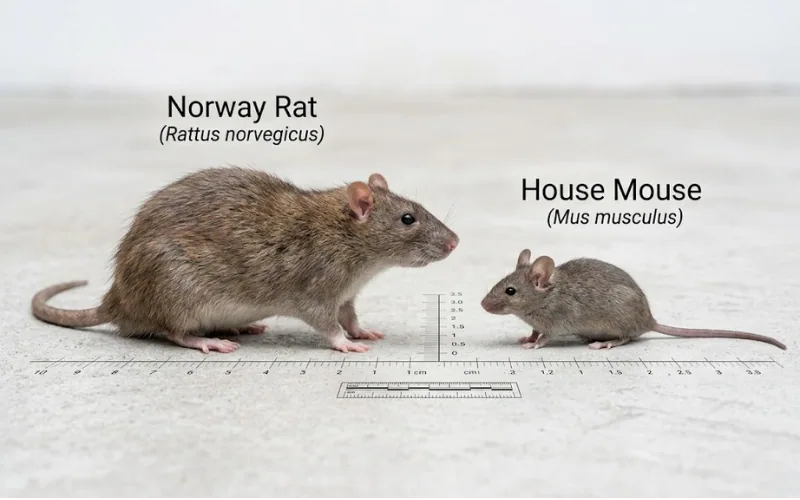
Quick answer: An adult Norway rat measures 7 to 9.5 inches in body length (not counting the tail) and weighs roughly 7 to 18 ounces. An adult house mouse measures 2.5 to 3.75 inches in body length and weighs about half an ounce to one ounce. A full-grown Norway rat runs two to three times longer than a house mouse and can outweigh it by a factor of ten or more.
If something is moving along your baseboard at night or leaving droppings behind your pantry shelf, the first useful question isn't how to get rid of it — it's what species you're actually dealing with. Norway rats and house mice require different trap sizes, different bait station placements, and different exclusion materials. Treat a rat infestation with mouse-sized tools, or a mouse infestation with rat-scale gear, and the rodent activity simply continues. Across California, from coastal cities with old sewer infrastructure to inland agricultural corridors, these are the two rodents that field technicians identify most often during on-site inspections. This guide breaks down exactly how Norway rats and house mice differ in size, which physical markers hold up even during a two-second sighting, and why juvenile rats are the real reason most homeowners misidentify what they're looking at.
Body Length, Tail, and Weight: The Full Breakdown
Size is the fastest way to separate these two rodents, but only if you know which measurement to trust. Total length figures that include the tail can be misleading, since a mouse's tail is proportionally much longer relative to its body than a rat's is. The table below separates body length from tail length so the comparison actually holds up in the field.
| Measurement | House Mouse (Mus musculus) | Norway Rat (Rattus norvegicus) |
|---|---|---|
| Body length (head to base of tail) | 2.5–3.75 in | 7–9.5 in |
| Tail length | 2.75–4 in | 6–8 in |
| Tail vs. body | Equal to or longer than body | Shorter than body and head combined |
| Adult weight | 0.5–1 oz | 7–18 oz |
| Gnaw mark width | ~1/12 in (2mm) | ~1/6 in (4mm) |
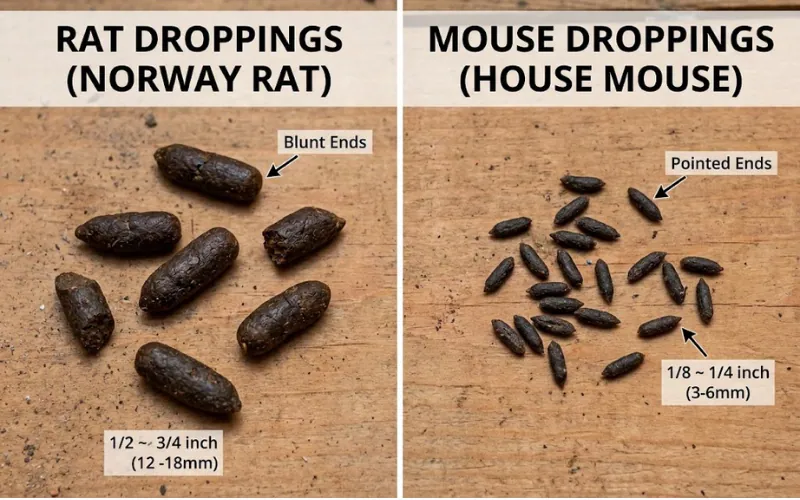
| Dropping size | 1/8–1/4 in, pointed ends | 1/2–3/4 in, blunt ends |
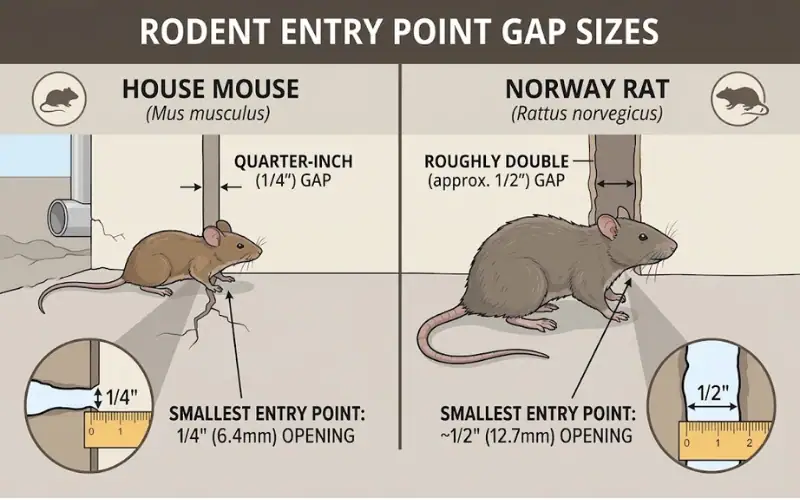
| Minimum entry gap | 1/4 in (dime-sized) | 1/2 in (quarter-sized) |
Notice the tail rule in the table above, because it's more reliable than raw length alone. A house mouse's tail is roughly equal to or slightly longer than its own body. A Norway rat's tail is always shorter than its combined body and head length. This single ratio works even on a rodent you only see for a moment, and it's the same field test UC's Statewide Integrated Pest Management Program recommends for distinguishing rat species from each other, and it applies equally well when separating rats from mice.
Beyond Size: Ears, Snout, Fur, and Droppings
Size alone isn't always available as a data point, especially if the rodent is hiding, moving fast, or already dead when you find it. These secondary markers hold up regardless of the animal's exact age or size.
Ears and snout
House mice have large, thin ears that look oversized relative to their small heads, paired with a pointed, triangular snout and long whiskers. Norway rats have small, close-set ears that barely rise above the fur line, paired with a blunt, rounded nose. This proportion difference is often visible even in poor lighting, because a mouse's ears catch light and cast a distinct silhouette that a rat's don't.
Fur and tail texture
Norway rats carry coarse, shaggy fur in brown to grayish-brown tones with a lighter gray belly, and their tails are thick, hairless, and scaly. House mice have finer, shorter fur in gray to light brown shades, and their tails, while also scaly, are noticeably thinner and carry a faint layer of fine hair that a rat's tail lacks entirely.
Droppings
Droppings are often the first evidence homeowners find, long before they see a live rodent. Mouse droppings are small, roughly rice-grain sized at 1/8 to 1/4 inch, with pointed ends, and a single mouse can leave 50 or more scattered across a kitchen overnight. Norway rat droppings are much larger, roughly 1/2 to 3/4 inch, with blunt rounded ends rather than points, and they tend to cluster near burrows, runways, and feeding sites rather than being scattered widely.
Gnaw marks
Both rodents gnaw constantly to wear down their incisors, but the marks they leave scale with their jaw size. Rat gnaw marks measure roughly 1/6 inch (4mm) across, while mouse gnaw marks are finer, closer to 1/12 inch (2mm) — described by UC IPM as "scratchy marks" because of how shallow and narrow they appear compared to a rat's bite.
Why Juvenile Rats Get Mistaken for Mice
This is the single biggest source of rodent misidentification, and it's worth explaining in detail because most online comparisons skip it. A juvenile Norway rat can be close to the same body length as an adult house mouse, which means size alone fails at exactly the moment homeowners rely on it most. Field technicians run into this constantly during initial inspections: a caller reports "a huge mouse" or "the smallest rat we've ever seen," and the animal turns out to be a young rat rather than either extreme.
The tell isn't length, it's proportion. Young rats have disproportionately large heads and feet relative to their body size, a trait that persists until they reach full maturity. An adult mouse never has this proportion; its head, feet, and body scale evenly no matter its age. Two field checks settle the question quickly: look at the tail thickness and texture — a juvenile rat's tail is already noticeably thicker and less flexible than any mouse's tail — and look at the ears relative to the head, since even a young rat's ears sit close to the skull rather than projecting outward the way a mouse's ears do at any age.
Behavior Differences That Track With Size
Body size doesn't just affect appearance; it drives fundamentally different behavior patterns that matter directly for control strategy.
Trap caution (neophobia): Norway rats are highly neophobic, meaning they avoid new objects in their environment, including traps and bait stations, for several days before approaching. Mice show far less caution and will investigate new objects, including traps, within hours of encountering them. This single behavioral difference explains why a trapping plan that works quickly on mice can appear to fail completely on rats, when in reality the rats simply haven't finished their observation period yet.
Nesting location: House mice nest close to food sources and rarely travel far once established indoors, favoring wall voids, cabinet interiors, and areas behind large appliances. Norway rats burrow at ground level, denning along foundations, beneath woodpiles, in dense vegetation, and around garden beds, then travel into structures to feed rather than living inside them exclusively. When Norway rats do move indoors, they typically stay at basement and ground-floor level rather than climbing into upper walls or attics.
Foraging pattern: Mice feed frequently in small amounts close to their nest. Rats forage more deliberately and will carry food back to a burrow or safe feeding spot rather than eating in the open, which is why bait placement location matters as much as bait type. If you're dealing with an established burrow system in your yard rather than just structural entry, our guide to identifying and destroying rat burrows walks through how to locate and eliminate active denning sites.
California Relevance: Where Each Rodent Thrives
California's rodent pressure isn't uniform across the state, and knowing which species dominates your region sharpens both identification and control planning.
Coastal cities with older sewer and storm-drain infrastructure, including San Francisco, Oakland, and parts of Los Angeles, carry long-established Norway rat populations tied to aging underground systems and dense urban food waste. If your rodent activity is centered around drains, sewer laterals, or below-grade areas, that pattern points strongly toward Norway rats rather than mice, and our sewer rat control guide covers the specific exclusion challenges that come with drain-based entry points.
Inland agricultural regions, including the Central Valley, see heavier house mouse pressure tied to harvest cycles, when field rodent populations move toward structures as crops are cleared and outdoor food sources disappear. California's mild, largely frost-free climate also means neither species experiences a true dormant season the way rodents do in colder states — breeding continues nearly year-round, which is why infestations that start small in early fall can be fully established by winter if left unaddressed.
Health Risks Tied to Each Species
Both rodents carry disease risk, but the specifics differ enough to matter for how seriously a given infestation should be treated. Norway rats and house mice can both transmit salmonella through food contamination, and both leave droppings and dander capable of triggering allergy and asthma symptoms in sensitive individuals, a risk the EPA highlights specifically for indoor environments like schools and homes. Leptospirosis, spread through contact with rodent urine, is more closely associated with rats than mice.
One point of confusion worth correcting directly: hantavirus in California is primarily linked to deer mice, a wild species distinct from the common house mouse, not to Rattus norvegicus or Mus musculus. The California Department of Public Health tracks hantavirus exposure risk statewide, and the CDC's hantavirus overview confirms the primary reservoir species involved. If your infestation involves confirmed house mice rather than deer mice, that specific risk is not the relevant concern, though general sanitation precautions still apply. For general prevention around any rodent species, the CDC's rodent control guidance outlines safe cleanup procedures that reduce exposure regardless of species.
If you've already had a mouse infestation in a contained area like a garage, crawlspace, or storage room, proper decontamination matters more than most homeowners assume. Our guide to cleaning mouse-contaminated areas covers the specific steps for safely clearing droppings and nesting material without spreading contaminants into the air.
Why This Size Difference Changes Your Control Strategy
Correct identification isn't an academic exercise — it directly determines which tools and materials actually work.
- Trap sizing: Standard mouse snap traps lack the spring tension and platform size to reliably catch or hold a Norway rat, while oversized rat traps often fail to trigger on a mouse's lighter body weight.
- Entry point sealing: Because mice fit through gaps as small as 1/4 inch and rats need roughly 1/2 inch, an exclusion plan built only around rat-sized openings will leave every mouse-sized gap wide open.
- Material gauge: Steel wool and hardware cloth need finer mesh to stop mice than to stop rats; coarse mesh rated for rat exclusion often still allows mouse entry.
- Bait station placement: Because rats are neophobic and forage along fixed routes, stations need to sit along established runways for days before activity appears; mice investigate new stations far faster, so lack of quick activity on a station doesn't necessarily mean the area is rodent-free.
Getting this wrong doesn't just waste money on the wrong equipment — it extends the length of an infestation while the correct entry points and nesting sites stay untouched. A field inspection that starts with species confirmation, rather than assuming based on a quick glance, is what actually shortens the timeline to resolution. If you'd rather have a technician confirm the species and map entry points directly on your property, our statewide rodent inspection and control services are dispatched directly to California addresses.
Frequently Asked Questions
Can a large house mouse be mistaken for a small rat?
Rarely, and only briefly. Even the largest house mice top out around 3.75 inches of body length, while the smallest adult Norway rats start around 7 inches. The confusion usually happens with juvenile rats, not oversized mice, because young rats have proportionally larger heads and feet that make their overall size harder to judge at a glance.
What is bigger, a Norway rat or a roof rat?
Norway rats are heavier and stockier overall, though roof rats often measure longer because more of their length comes from a tail that exceeds their body length. Norway rats have a tail shorter than their body and head combined, which is the fastest way to tell the two species apart in the field.
Do house mice carry the same diseases as rats?
Both rodents can carry salmonella and contribute to allergy and asthma triggers through droppings and dander. Leptospirosis risk is more closely associated with rats. Hantavirus in California is primarily linked to deer mice, not the common house mouse, so correct species identification matters for accurately assessing health risk.
How can I tell rat droppings from mouse droppings?
Mouse droppings are about 1/8 to 1/4 inch long with pointed ends, and a single mouse can leave 50 or more per day scattered along travel paths. Norway rat droppings are much larger, roughly 1/2 to 3/4 inch, with blunt rounded ends rather than points.
What size hole can a rat fit through compared to a mouse?
A house mouse can squeeze through a gap about 1/4 inch wide, roughly the size of a dime, because its skeleton flexes around its skull, the widest part of its body. Norway rats need a larger opening, around 1/2 inch, about the size of a quarter, to fit through.
Are baby rats the same size as adult mice?
Young rats can be close to the same body length as an adult mouse, which is the single biggest source of rodent misidentification. The reliable tell is proportion: a juvenile rat has noticeably larger feet and a thicker, less flexible tail relative to its body than an adult mouse ever does.
Which is more destructive to a home, rats or mice?
Rats cause more structural damage per animal because of their size, gnawing strength, and burrowing behavior near foundations. Mice cause more cumulative damage in some homes simply because of faster breeding cycles and their ability to exploit far smaller entry points throughout a structure.
PestPunt — Statewide California Rodent Services
- PestPunt
- Service Area (California Statewide): Providing 100% on-site mobile services directly to your property.
- As a Service Area Business (SAB), we do not have physical office visits. Our local expert field representatives are dispatched directly to your location.
- 24/7 Dispatch Phone: (888) 217-6759
- Email: [email protected]

Connect with a Professional Rodent Specialist in California
When you're unsure whether you're dealing with rats or mice, proper identification is the first step toward effective control. Reach out to our professionals at (888) 217-6759 to discuss your specific situation and explore mobile inspection and control solutions tailored to your property.
Information on this page is based on established environmental health and pest identification standards. It is provided for educational purposes and is not a substitute for a professional on-site evaluation or direct medical advice. If you suspect an acute health concern related to environmental exposure, consult a registered healthcare provider immediately.