Field Mice vs. House Mice: Identification & Prevention
Updated for 2026 · Written for homeowners, renters, cabin owners, and property managers.
You spot a small rodent in the garage, and you need to know one thing fast: is it a field mouse or a house mouse? The answer changes how you clean, where you place traps, and how much caution you need around droppings.
Start Here: Field Mice vs House Mice at a Glance
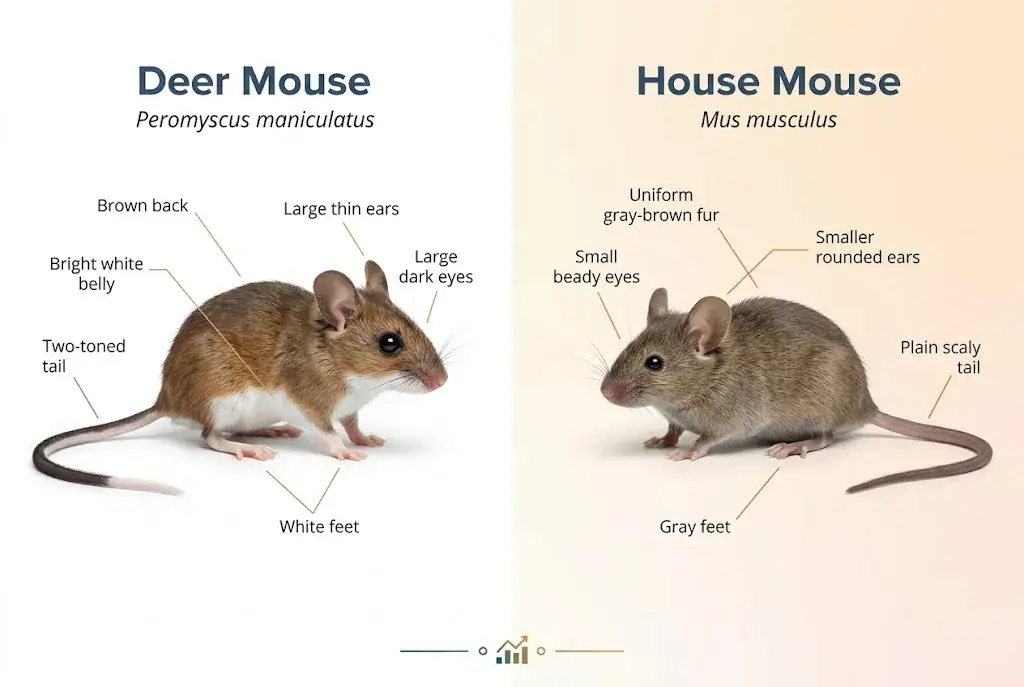
Short answer: A field mouse, which often means a deer mouse, has a brown back, a bright white belly, white feet, large eyes, and a two-toned tail. A house mouse has uniform dusty gray-brown fur, small dark eyes, and a plain, scaly tail. Field mice live mainly outdoors and push into buildings in fall and winter. House mice live inside buildings all year.
The health stakes also differ. Public health agencies tie hantavirus to deer mice, not house mice. You still need to treat both animals as a problem, because both contaminate food, chew wiring, and multiply when you ignore them.
Why the Field Mouse vs House Mouse Question Matters
Most people call every small rodent "a mouse" and move on. That habit costs you time, because the two animals behave differently. A house mouse already lives in your building, so you fight a resident population. A field mouse usually comes from outside, so you fight an entry problem.
The label changes three decisions:
- How you clean. Deer mice can carry the hantavirus that affects people in North America, so you wet-clean and avoid raising dust.
- Where you look. Field mice come through garages, sheds, vents, and rooflines, then nest near the exit. House mice spread through the whole structure.
- How fast you act. House mice breed all year indoors. A small sighting can become a full infestation within weeks.
Deer mice thrive in fields, woods, deserts, and mountains, while house mice follow people into every city and town. That overlap means many properties can face both animals at different times. This guide gives you the identification checks, the safety rules, and the control steps that match each animal.
If you already suspect deer mice, read our detailed deer mouse identification and hantavirus resources alongside this page.
Field Mouse vs House Mouse: Side-by-Side Comparison
Use this table as your quick reference. Field mouse details describe the deer mouse, the species homeowners meet most often.
| Trait | Field mouse (deer mouse) | House mouse |
|---|---|---|
| Scientific name | Peromyscus maniculatus | Mus musculus |
| Back color | Buff, reddish-brown, or gray-brown | Dusty gray-brown |
| Belly | Bright white, with a sharp line between back and belly; white feet | Light gray or buff, blending into the back; no sharp line |
| Tail | Sharply two-toned: dark above, white below; lightly furred | One color; scaly with very fine hair |
| Eyes and ears | Large, dark, prominent eyes; large, thin ears | Small, beady eyes; smaller, rounded ears |
| Body build | Delicate, long hind feet, strong jumper | Compact and stocky |
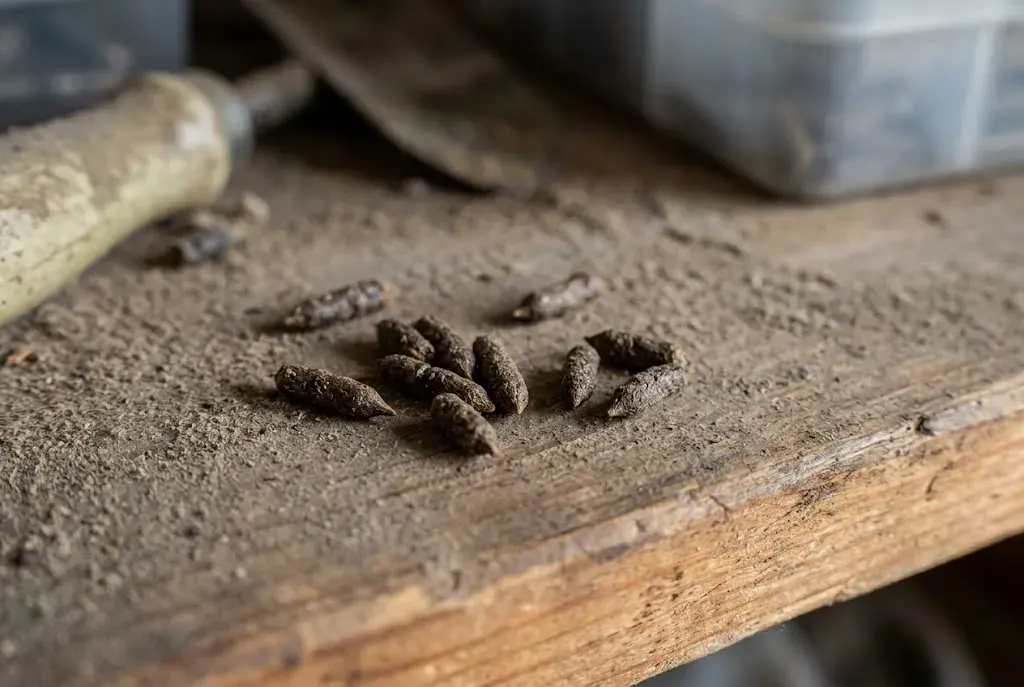
| Droppings | Small, pellet-like, often scattered or piled in caches | About 1/8 to 1/4 inch, rod-shaped with pointed ends, concentrated along runways |
| Odor | Little noticeable smell | Strong, musky odor in established infestations |
| Preferred habitat | Fields, woodland, brush, woodpiles, sheds, cabins | Homes, apartments, restaurants, warehouses, stores |
| Feeding style | Collects and stores seeds and nuts in caches | Nibbles small amounts from many spots |
| Breeding | Mostly spring through fall; longer in mild climates | Year-round indoors; multiple litters per year |
| Main entry season | Fall and winter; also after harvest, mowing, or land clearing | Any month |
| Hantavirus risk | Yes. Deer mice carry Sin Nombre virus. | Not considered a hantavirus risk by public health agencies |
| Best first response | Seal entry points, trap near exits, wet-clean with care | Trap heavily along walls, remove food access, seal gaps |
What Is a Field Mouse? The Species Behind the Name
"Field mouse" is a casual label, not a scientific one. Homeowners, hardware stores, and even some pest websites apply it to several outdoor rodents. That loose usage causes confusion, so know which animal you actually face.
Deer mouse (Peromyscus maniculatus)
The deer mouse is the animal most people mean. It lives across most of North America, from grassland and scrub to mountain forest. It has soft fur, big black eyes, large ears, a white belly, and white feet. Its coat reminds people of a fawn, which explains the name.
Deer mice adapt quickly. They nest in burrows, hollow logs, woodpiles, and wall voids. They also nest inside stored boxes, RVs, and parked vehicles. In buildings, they favor garages, sheds, barns, cabins, crawl spaces, and attics.
White-footed mouse (Peromyscus leucopus)
The white-footed mouse looks almost identical to the deer mouse. It lives in woods, brushy areas, and suburbs across the eastern, central, and southern United States, and it moves indoors in fall like its cousin. Experts often need measurements to separate the two, so treat any white-bellied, big-eyed mouse with the same caution.
Lookalikes: harvest mice and voles
Two more animals earn the "field mouse" label:
- Western harvest mouse. A small mouse of grassy areas and farm edges. It rarely enters homes.
- Voles. Stocky rodents with short tails, small ears, and blunt noses. Voles chew garden plants and dig surface runways through lawns and ground cover. They seldom enter buildings.
If you see a chunky animal with a short, stubby tail outside, you probably found a vole. If you see a slim, white-bellied mouse with a long tail near your garage, you probably found a deer mouse.
Field note: Do not confuse a small rat with a large mouse. Young rats have big heads and big feet compared with their bodies, while adult mice have small heads and small feet. Roof rats, common in warm regions, also grow a tail longer than their body. If the animal looks bigger than your hand's width, you probably have a rat, and the control plan changes.
What Is a House Mouse? The Indoor Specialist
The house mouse is the most common mouse in and around buildings worldwide. It arrived in North America with European settlers and now lives alongside people in cities and towns across the continent. A house mouse weighs less than an ounce, measures about three inches from nose to rump, and carries a tail about as long as its body.
This mouse depends on human spaces. It nests in walls, cabinets, appliance voids, stored clothing, and insulation. It finds food in pantries, pet bowls, garbage, and crumbs. It needs very little water, so a dry kitchen cabinet works fine for it.
House mice travel short distances. A typical mouse roams a small area around its nest, often within a few dozen feet. That habit explains why you find droppings in the same corners day after day, and why one trap rarely solves the problem.
How to Tell a Field Mouse From a House Mouse: Five Visual Checks
You do not need a lab. You need a good look at the belly, the tail, the eyes, the ears, and the build. A dead mouse in a snap trap works best for identification. Photograph it with your phone before you dispose of it, and never pick it up with bare hands.
Check 1: Belly and coat color
Roll your eyes over the underside. A deer mouse shows a bright white belly with a clear line where the brown back ends. A house mouse shows a belly only slightly lighter than its back, and the colors blend. This is the fastest and most reliable check.
Check 2: Tail
Look at the tail in good light. A deer mouse has a two-toned tail: dark on top and white underneath, with light fur. A house mouse has a single-color tail that looks scaly and nearly bare. Tail length varies, so trust the color pattern instead.
Check 3: Eyes
Deer mice have large, round, black eyes that bulge slightly. House mice have small, beady eyes that sit close to the head.
Check 4: Ears
Deer mouse ears look large, thin, and nearly hairless. House mouse ears look smaller and rounder, and they sit closer to the skull.
Check 5: Build and movement
A deer mouse looks slim, with long back feet, and it leaps and bounds when startled. A house mouse looks compact and scurries along walls, often pausing to sniff. A house mouse also tends to keep close to the wall, while a deer mouse crosses open floor more boldly when it believes nobody watches.
Quick ID and Difference Checklist
- Coat color: field mice have a brown back and white belly; house mice have uniform gray-brown fur.
- Tail: field mice have a two-toned furred tail; house mice have a plain, scaly tail.
- Eyes and ears: field mice have larger eyes and ears; house mice have smaller, beady eyes.
- Habitat: field mice prefer outdoor cover and invade in fall and winter; house mice live indoors year-round.
- Breeding: house mice breed year-round indoors; field mice breed mostly in warm seasons.
- Health risk: public health agencies link hantavirus to deer mice, not house mice.
When the checks disagree, treat the animal as a deer mouse until a professional identifies it. That approach costs you nothing extra and protects your health.
Droppings, Smell, Sounds, and Other Signs You Can Use
Most homeowners find the signs long before they see the mouse. Use signs to confirm activity. Do not use them as your only identification method.
Droppings: helpful, but not decisive
House mouse droppings measure roughly 1/8 to 1/4 inch, look dark, and taper at both ends. A single mouse leaves dozens each day, so you find them in clusters along runways. Deer mouse droppings look similar and sometimes slightly smaller, and they often appear scattered or piled near food caches. The shapes overlap too much for a reliable call. Treat every dropping as potentially contaminated, and read the safe cleanup steps below before you touch anything.
Food caches and nests
Deer mice hoard. Open a stored box, a drawer, a shoe, or a glove compartment and you may find a pile of seeds, nuts, dog kibble, or bird seed. A house mouse does not stash food this way. It eats small meals in many places, so you find chewed packaging and crumbs instead.
Both mice build nests from soft material. Expect shredded paper, insulation, fabric, and dry plant fibers packed into a ball the size of a fist. Do not poke a nest. Nests carry dust, urine, and droppings.
Smell, grease marks, and urine trails
An established house mouse population produces a musky, stale odor that gets stronger over time. House mice also leave greasy smudges where their fur rubs along baseboards and pipes, plus tiny urine dots on dark surfaces. Deer mice leave less odor. A strong smell with very few visible mice often points to a hidden population or a dead animal. Our dead rodent removal services page explains how professionals locate and remove carcasses inside walls and ceilings.
Sounds and timing
Both animals stay active mostly at night. You hear scratching, scurrying, and light squeaks in walls and ceilings, typically in the first hours after dark and again before dawn. Daytime sightings usually signal a crowded population or a disturbed nest.
Gnaw marks and damage
Mice gnaw to keep their teeth short and to reach food. Look for ragged, 1/16-inch chew marks on cardboard, soft plastic, insulation, and wire coating. Deer mice in vehicles and RVs often chew wiring and air filters. House mice chew food packaging, electrical cables inside walls, and the edges of cabinets.
Behavior, Diet, and Breeding: How the Two Mice Live
Field mouse (deer mouse)
- Diet: Seeds, nuts, berries, fungi, and insects.
- Food habit: Stores food for later.
- Temperament: Cautious. It flees when startled.
- Breeding: Seasonal, with several litters in warm months.
- Home base: Burrows, woodpiles, brush, rafters, stored items.
House mouse
- Diet: Nearly anything people eat, plus glue, soap, and cardboard.
- Food habit: Nibbles many times a night.
- Temperament: Curious. It explores new objects, including traps.
- Breeding: Year-round indoors, with litters of several pups.
- Home base: Wall voids, cabinets, appliances, storage.
Why house mice multiply faster
A female house mouse carries her pups for about three weeks. Her young can breed at roughly six to eight weeks old. Climate-controlled homes remove the seasonal brakes that limit outdoor populations. A pair that slips into a warm pantry in November can produce several generations by spring.
Deer mice reproduce fast too, but outdoor weather, predators, and food shortages slow them. In mild climates, deer mouse breeding seasons stretch longer, so do not assume winter stops them.
Why the behavior difference affects your trapping
House mice explore everything new, so a trap often catches them quickly. Deer mice approach new objects more warily, so you may need to leave traps in place for several days and bait them with a nut or a dab of peanut butter. Both respond to a pea-sized amount of bait. More bait wastes product and lets the mouse lick it off without triggering the trap.
How Each Mouse Gets Into Your Home
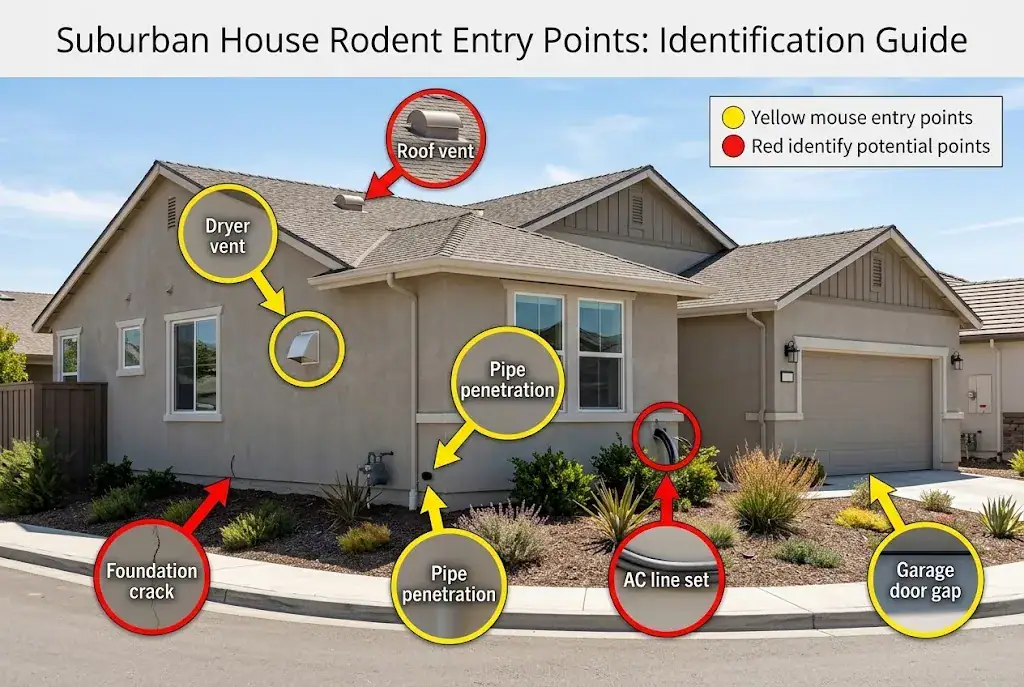
Any mouse can squeeze through a gap about the width of a pencil, roughly 1/4 inch. You rarely see the entry point because mice choose dark, low-traffic spots. Walk the outside of your building slowly and check every gap you can find.
Garages and sheds
Garages top the list for field mice. A worn door seal leaves a gap along the bottom edge. Storage boxes, old furniture, bird seed, and pet food give mice both shelter and a meal. Technicians commonly find deer mouse activity in garages first, then in adjoining walls and attics.
Attics, rooflines, and vents
Mice climb well. They follow tree limbs, wires, and rough stucco up to roof edges, then use loose flashing, damaged vents, and gaps under tiles. Insulation gives them warm nesting material. If you hear footsteps overhead at night, read our guide to attic rodent solutions by local experts.
Pipes, vents, and utility lines
Gaps around plumbing, gas lines, air-conditioner line sets, dryer vents, and cable entries give mice indoor access. Builders often leave these openings wider than necessary, and the filler material degrades over time.
Cabins, RVs, and seasonal buildings
Mountain and foothill cabins, vacation rentals, barns, and stored RVs face the highest deer mouse pressure. A closed building stays quiet for months, so mice settle in and breed. The next person who opens the door stirs up dust, and that dust can carry virus particles. Past hantavirus clusters in national park lodging showed how mice nesting in building walls can put visitors at risk.
What triggers a move indoors
- Cold and rain. Fall and winter storms push field mice toward dry shelter.
- Harvest, mowing, and clearing. Land disturbance displaces mice from their outdoor homes.
- Food and clutter. Bird feeders, pet bowls, open trash cans, and woodpiles attract mice and hide them.
- Overgrown plants. Ivy, dense shrubs, and branches touching the roof create hidden highways.
Health Risks: Hantavirus, Germs, and Allergens
Deer mice and hantavirus
Hantavirus pulmonary syndrome (HPS) is a severe respiratory disease. In the western United States, Sin Nombre virus causes most cases, and deer mice carry it. Other wild rodents carry related hantaviruses in other regions, but health agencies do not list house mice as a source of infection. For a practical workplace guide, read this state public health hantavirus toolkit. You can also read our deer mouse identification and hantavirus resources.
People usually get infected by breathing in air that contains dust from infected mouse urine, droppings, or nesting material. Enclosed, poorly ventilated spaces raise the risk, including sheds, cabins, barns, garages, and crawl spaces. You cannot catch the Sin Nombre virus from another person.
Early symptoms look like the flu: fever, fatigue, muscle aches, headache, and chills. Breathing trouble can follow days later. Symptoms can appear one to eight weeks after exposure. If you develop these symptoms after cleaning up after rodents or entering a rodent-infested space, contact a healthcare provider promptly and mention the exposure.
Important: Most deer mice do not carry the virus, and most people who clean up after mice stay healthy. Still, you cannot tell by looking whether a particular mouse carries it. Follow the wet-cleaning steps below every time.
What house mice still spread
House mice pose a different set of problems. They contaminate food and surfaces with urine, droppings, and hair. They can spread bacteria such as Salmonella, and their dander and droppings can trigger allergies and asthma, especially in children. They chew through wire insulation, which raises fire risk, and they damage insulation, stored goods, and packaging. Do not treat a house mouse problem as harmless because it lacks the hantavirus link.
Who should take extra care
Anyone who cleans sheds, cabins, barns, RVs, or storage units faces higher exposure. Parents, pet owners, people with asthma, and people with weakened immune systems should leave heavy cleanup to a professional. Seek that help when you find a nest, a large number of droppings, or a dead mouse inside a wall.
How to Clean Up After Mice Safely
Use the same method for both species. It costs little and works. The steps below follow guidance from public health agencies, including the CDC hantavirus prevention guidance.
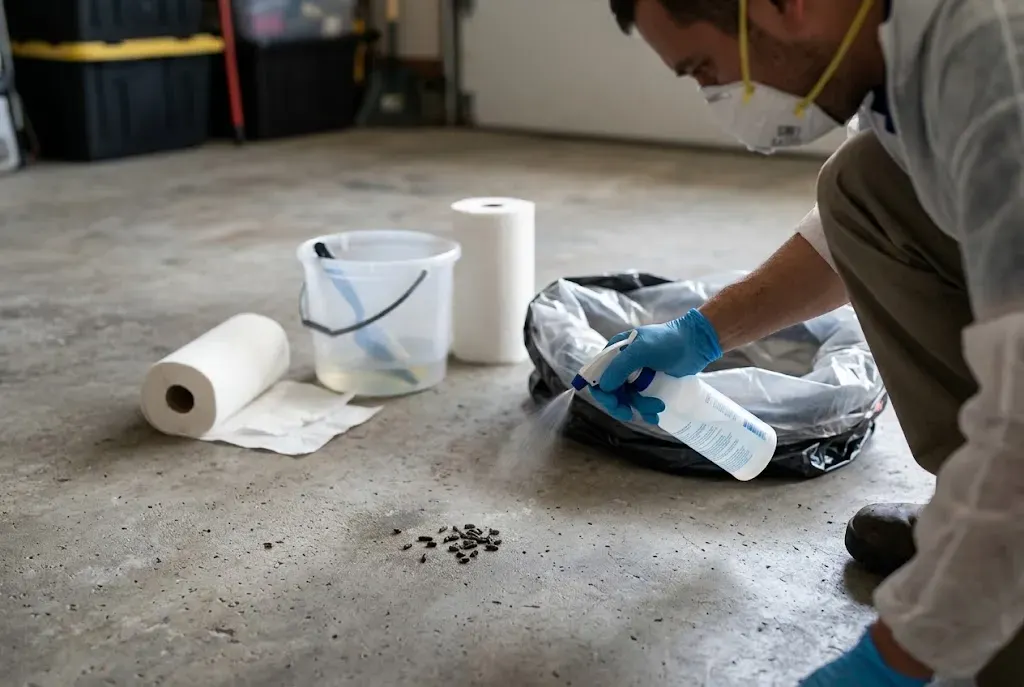
- Air out the space. Open doors and windows and leave for at least 30 minutes before you start. Keep children and pets away.
- Put on protection. Wear rubber, vinyl, or nitrile gloves. For a large buildup or an enclosed space, hire a professional who uses a respirator.
- Soak, do not sweep. Spray droppings, nests, and dead mice with an EPA-registered disinfectant that lists the label directions, or with a freshly mixed solution of one part household bleach to nine parts water. Wet everything thoroughly.
- Wait five minutes. Give the disinfectant time to work.
- Wipe up with paper towels. Place the towels, droppings, and nest material in a plastic bag. Seal it, then place it inside a second bag.
- Disinfect the area. Mop hard floors and wipe counters, shelves, and tools with disinfectant. Shampoo rugs and upholstery, or clean them with a steam cleaner.
- Throw the bags in a lidded outdoor trash can.
- Wash your hands. Disinfect your gloves, remove them, and wash your bare hands with soap and water.
Never do this: Do not sweep, vacuum, or blow out dry droppings. Those actions lift contaminated dust into the air you breathe. A standard household vacuum does not solve the problem.
When a mouse dies inside a wall, ceiling, or crawl space, you smell it before you find it. Do not cut random holes. Call a professional who can locate the carcass, remove it, and disinfect the area. Our dead rodent removal services page explains that process.
Mouse Control: What Works for Each Type
Public health guidance for mice follows a simple rule: seal up, trap up, clean up. The order matters. Seal first, because trapping without sealing only empties the room while more mice arrive.
Step 1: Seal every gap a pencil can enter
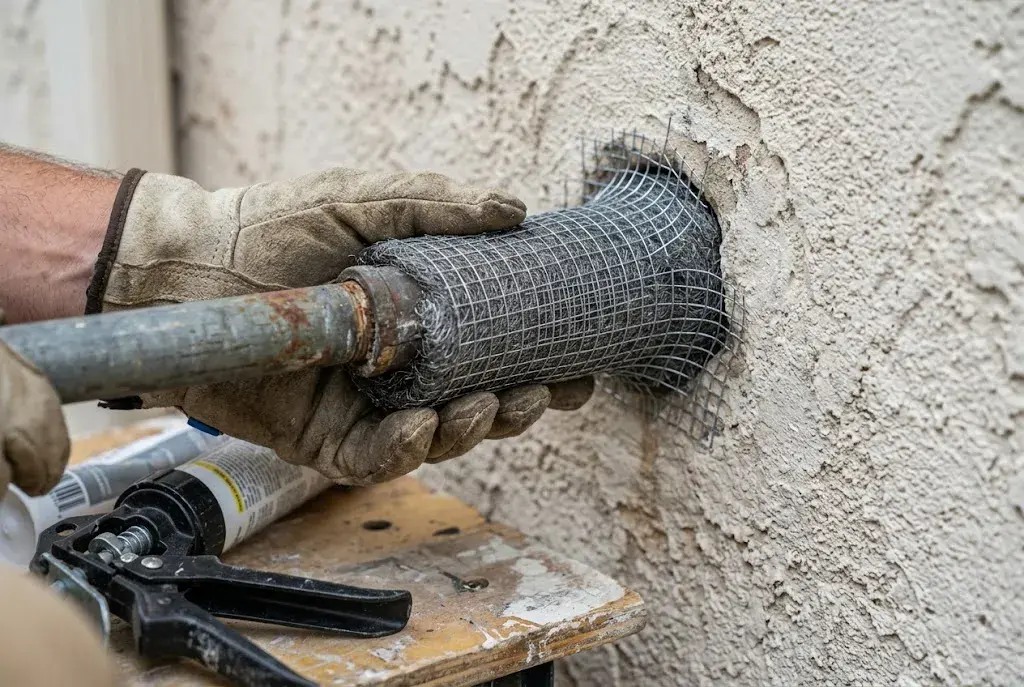
- Stuff steel wool into small holes, then seal over it with caulk.
- Cover larger openings with 1/4-inch galvanized hardware cloth, sheet metal, or mortar.
- Install a tight door sweep and a garage door bottom seal.
- Screen attic, crawl space, and foundation vents with 1/4-inch mesh.
- Fill gaps around pipes, cables, and air-conditioner lines.
- Repair damaged flashing, loose roof tiles, and cracked stucco.
Do not use foam alone. Mice chew through it. Combine foam with metal mesh or steel wool.
Step 2: Trap with the right method
For field mice
- Place snap traps near garage doors, sheds, vents, and any spot where you found a food cache.
- Set traps against walls with the trigger end toward the wall.
- Bait with a nut or a pea-sized dab of peanut butter.
- Check traps every day and keep trapping for several days after the last catch.
- Wear gloves when you handle traps and dead mice, and follow the wet-cleaning steps.
For house mice
- Set many traps: place them every few feet along walls, behind appliances, and inside cabinets.
- Put traps where you find droppings and rub marks.
- Bait lightly and vary the bait if mice ignore it.
- Move traps a short distance if they catch nothing after a few days.
- Keep trapping until you stop finding fresh droppings.
Public health agencies advise against glue traps for deer mice. Glue traps leave live, stressed animals that you then must handle, and they increase your exposure.
Step 3: Remove food, water, and shelter
- Store pantry food, pet food, and bird seed in hard plastic or metal containers with tight lids.
- Clean crumbs and grease from counters, stovetops, and floors every night.
- Fix leaky faucets, sprinklers, and pipes.
- Move firewood, lumber, and debris far from the building. Public health guidance recommends keeping woodpiles, trash cans, and dumpsters as far as 100 feet from buildings when possible.
- Trim vegetation away from the roofline and walls.
- Keep storage boxes off the floor and use sealed plastic bins instead of cardboard.
What to avoid
- Poison baits in walls and attics. A poisoned mouse can die where you cannot reach it and leave a smell for weeks. Many regions also restrict certain anticoagulant rodenticides because they harm owls, hawks, and other wildlife that eat poisoned rodents. Ask any technician which products they use and why.
- Ultrasonic repellers. Research shows limited and short-lived effects. They do not replace sealing.
- Mothballs and peppermint oil. These products do not reliably keep mice out and may create other safety concerns.
- Sweeping or vacuuming droppings. You raise dust. See the cleanup steps above.
- Waiting. A house mouse population grows every week you delay.
DIY or Professional Help? How to Decide
You can handle a single mouse in a garage with good traps and a tube of steel wool. Many infestations need more. Call a professional when any of these statements fit your situation:
- You trapped for a week and still see droppings or hear noise.
- You hear scratching in walls, ceilings, or the attic at night.
- You find droppings or nests in an attic, crawl space, or wall void.
- You suspect deer mice in a cabin, barn, shed, or closed building.
- You smell a dead animal you cannot reach.
- You cannot find how the mice get in.
- Children, older adults, or people with health conditions live in the home.
- You manage a rental, business, restaurant, or other shared property.
A professional identifies the species, finds the entry points you miss, seals them, sets traps in the right places, and cleans up safely. If you need fast help, see our page on rapid and effective rodent control. The same inspection-first approach applies to every property.
What to Expect When You Call PestPunt
PestPunt runs as a service area business across California. We do not operate a storefront or office that you visit. Our local expert field representatives travel to your property, and our dispatch line runs 24/7. A thorough rodent visit should cover these points:
- Your description. Tell the dispatcher what you saw, where you saw it, and when. Share photos of the animal, droppings, or damage if you have them.
- Species identification. The representative checks the animal or the signs to tell deer mice, house mice, rats, or voles apart.
- Inspection. The representative walks the exterior and interior, checking rooflines, vents, garage doors, utility gaps, attics, and crawl spaces.
- A matching plan. The plan covers exclusion, trapping, sanitation, and any cleanup needs. Ask about the products, the timeline, and the cost before you agree.
- Follow-up guidance. You learn what to store, trim, and repair so the problem does not return.
Before you call, have these ready: the address where service happens, where you saw or heard the mice, how long the activity has lasted, whether children or pets live there, and a few phone photos. Do not clean up droppings before the visit unless you need to protect food or living areas. Wet-clean only as described above.
Seasonal Mouse Prevention Checklist
Mouse prevention works best when you follow the calendar. In mild climates mice stay active all winter, but the seasons still shape mouse behavior.
Late summer and fall: block entry before the rains
- Inspect the roofline, vents, and garage door seal.
- Seal gaps with metal mesh and steel wool.
- Move firewood and debris away from the house.
- Switch to sealed containers for stored food and seed.
Winter: watch for new activity
- Check the garage and attic every few weeks for droppings and chew marks.
- Keep a few snap traps set along garage walls as an early warning.
- Clear leaf litter and debris after storms.
Spring: reopen and repair
- Open cabins, sheds, and RVs with care: air them out for 30 minutes, then wet-clean any droppings.
- Repair winter damage to screens, flashing, and weatherstripping.
- Trim plants away from the structure as growth picks up.
Summer: remove food and cover
- Keep pet food indoors and clean up fallen fruit.
- Mow and trim vegetation near the building.
- Inspect air-conditioner lines, dryer vents, and irrigation areas for new gaps.
Field Mice vs House Mice: Frequently Asked Questions
What is the main difference between a field mouse and a house mouse?
Color and lifestyle separate them. A field mouse, usually a deer mouse, has a brown back, a white belly, white feet, and a two-toned tail. A house mouse has uniform gray-brown fur and a plain scaly tail. Field mice live mainly outdoors, while house mice live inside buildings year-round.
Is a field mouse the same as a deer mouse?
Often, yes. People use "field mouse" as a loose label for several outdoor rodents. Across North America, the deer mouse (Peromyscus maniculatus) is the species people most often mean, but voles, harvest mice, and white-footed mice also get called field mice.
Do house mice carry hantavirus?
No. Health agencies link hantavirus cases in the United States to deer mice and a few other wild rodents, not to house mice. House mice still spread other germs and contaminate food, so treat every infestation seriously.
Why do field mice come inside my house?
Cold weather, rain, harvest, mowing, and land clearing push field mice toward shelter. They enter through gaps around garage doors, pipes, vents, and rooflines, then nest in garages, attics, crawl spaces, sheds, and stored items.
Can I tell the species from droppings alone?
No. Deer mouse and house mouse droppings overlap in size and shape. Use droppings as a sign of activity, then confirm the species by looking at the animal's belly, tail, eyes, and ears, or by sending a clear photo to a professional.
How do I clean up mouse droppings safely?
Air out the space for at least 30 minutes, wear gloves, spray droppings and nests with a freshly made disinfectant or a 1-to-9 bleach-and-water solution until wet, wait five minutes, wipe up with paper towels, and seal everything in a bag. Never sweep or vacuum dry droppings.
Do the same traps work for both mice?
Snap traps work for both, but placement differs. House mice roam a small area and nibble in many spots, so you need several traps along walls. Field mice follow outdoor-to-indoor routes, so you need traps near entry points, garages, and food caches. Health agencies advise against glue traps.
When should I call a pest professional?
Call when you see repeated activity after a week of trapping, find droppings in an attic or wall void, smell a dead animal you cannot reach, suspect deer mice in an enclosed space, or cannot find the entry points. Professionals identify the species and seal the building.
The Bottom Line on Field Mice vs House Mice: Look at the belly and the tail first. A white belly and a two-toned tail point to a deer mouse, which belongs to the species health agencies connect with hantavirus. A uniform gray-brown coat and a plain scaly tail point to a house mouse, which breeds faster indoors and spreads through your whole building.
Either way, your plan stays the same in outline: seal the gaps, trap the mice, remove the food and shelter, and clean up with wet methods only. When the problem grows beyond a single trap line, call for help early. A mouse problem costs less to solve in week one than in month three.
California Mobile Rodent Control Services
Confirm the Species. Clean Safely. Stop the Exposure.
A local field representative travels to your property anywhere in California for on-site identification, entry-point inspection, and safe cleanup guidance. Call (888) 217-6759 for 24/7 dispatch.