How Fast Do Rats Reproduce? Breeding Cycle Explained (2026 Guide)
Understanding rat breeding biology — gestation, litter size, sexual maturity, and why California’s mild climate accelerates population growth. Learn the numbers behind a rat infestation and how to act before it compounds.
How Fast Do Rats Reproduce? The Core Numbers
Summary: Female rats reach breeding age at 4–5 weeks, gestation lasts 21–23 days, and they can conceive again within 2 days of giving birth. One female can produce up to 6 litters per year, with 6–12 pups per litter. This leads to exponential population growth unless interrupted.
Who this matters for: California property owners, landlords, and facility managers — mild year-round climate removes winter dormancy, so breeding continues every month.
Key takeaway: A single pregnant rat can lead to hundreds of descendants within a year if entry points and food sources remain unmanaged.
A rat problem rarely stays small. One pregnant female that slips into a garage, crawl space, or shed in California can turn into a colony of dozens within a single season. Understanding exactly how fast rats reproduce is not academic trivia — it is the single most useful piece of information for deciding whether to act today or wait a week. This guide breaks down the real biology behind rat breeding, translates it into numbers you can use, and shows what the cycle means for a property owner trying to stay ahead of an infestation.
How Do Rats Reproduce? Understanding Rat Mating Behavior
Rats are not seasonal breeders the way many wild mammals are. A female rat, called a doe, can enter estrus roughly every four to five days year-round whenever food, warmth, and shelter are available. In a heated structure, a wall void, or a Southern California yard that never freezes, that cycle never pauses for winter. A male, called a buck, will actively seek out receptive females across a territory that can span a full city block, which is one reason a rat problem often appears in several structures on the same street within weeks of each other.
Rat Gestation Period
Once mating occurs, gestation lasts between twenty-one and twenty-three days — shorter than almost any other mammal of comparable size. Because the female can become pregnant again during postpartum estrus, which happens within twenty-four to forty-eight hours after birth, she can be nursing one litter while already carrying the next. This overlapping cycle is the core reason rat populations expand faster than most homeowners expect.
Signs of Rat Mating Activity Around Your Property
Field technicians look for a specific pattern before a client even reports seeing a rat: fresh grease marks along baseboards from repeated travel along the same route, increased nighttime scratching in wall cavities during spring and fall breeding peaks, and a sudden jump in fresh droppings near a single concentrated area, which usually marks a nesting site rather than a simple feeding stop.
The Rat Life Cycle: From Birth to Adulthood
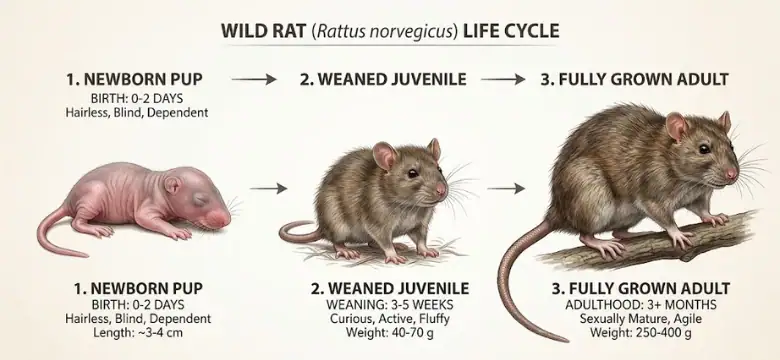
Newborn Rats (Pups)
Rat pups are born blind, hairless, and completely dependent on the nest. Their eyes open around day fourteen, and fur fully develops by roughly day ten. Because pups this young cannot regulate their own body temperature, the mother rarely leaves the nest for more than short feeding trips during the first week, which is why an active nest is often found tucked deep in insulation, wall voids, or dense yard debris.
Weaning and Independence
Weaning happens around three to four weeks of age. At this point the juveniles begin foraging alongside the mother and start exploring beyond the nest, which is frequently when a homeowner first notices droppings or gnaw marks spreading into new areas of a structure.
Sexual Maturity
This is the detail that catches most people off guard: female rats can reach sexual maturity at four to five weeks old, and males shortly after. That means the juveniles from this month's litter can be producing their own pups within roughly two months of their mother's original pregnancy, compounding the population well before anyone suspects there is more than one rat on the property.
How Many Babies Can a Rat Have?
How Many Babies Can a Rat Have at a Time?
A typical litter contains six to twelve pups, though litters of up to fourteen have been recorded where food and nesting material are abundant, such as near an unsecured trash enclosure or a cluttered garage. Litter size tends to increase slightly with the mother's age and body condition, up to a point, before declining again later in her life.
How Many Babies Can a Rat Have in a Month?
Because gestation itself takes about three weeks, one female cannot complete two full litters inside thirty days. What she can do is give birth, re-mate within two days, and deliver her next litter roughly three to four weeks later — meaning across any given month a single breeding female is either pregnant, nursing, or both, essentially without a break in productive output for as long as conditions stay favorable.
How Fast Do Rats Multiply? The Exponential Math
The numbers above look manageable individually. Stacked together across a full year, they explain why pest professionals treat an early rat sighting as urgent rather than cosmetic.
| Timeframe | Approximate Population From One Breeding Pair |
|---|---|
| Month 1 | 2 adults + first litter of 6–12 pups |
| Month 3 | First litter reaches maturity and begins breeding |
| Month 6 | Multiple overlapping litters across two generations |
| Month 12 | Potentially hundreds of descendants under ideal, unmanaged conditions |
These figures represent a theoretical ceiling assuming abundant food, no predators, and no intervention — real-world mortality from disease, competition, and control efforts keeps most colonies well below this maximum. Even so, the trajectory is exponential rather than linear, which is why waiting two extra months to address a sighting can mean the difference between removing one nest and managing an established colony.
Field observation: In inspections across California properties, a lone rat spotted in daylight — normally a strictly nocturnal animal — is one of the more reliable indicators that the nest nearby is already overcrowded and juveniles are being pushed to forage during unusual hours.
Factors That Speed Up or Slow Down the Rat Breeding Cycle
Not every rat population grows at the same rate. The theoretical maximum assumes ideal conditions; real properties rarely offer all of them at once. Four variables consistently determine whether a colony expands quickly or stalls out.
Food Quality and Consistency
A female with steady access to high-calorie food, such as pet kibble, bird seed, or unsecured trash, reaches breeding condition faster after each litter and tends to produce larger litters. Properties where food access is inconsistent typically see smaller litters and longer gaps between pregnancies.
Shelter Stability
Rats invest significant energy defending a stable nest site. A colony that gets disturbed repeatedly often relocates before a litter is weaned, which resets part of the reproductive timeline. A well-hidden, undisturbed cavity removes that friction entirely.
Temperature and Regional Climate
Coastal California properties with mild year-round conditions rarely see a true breeding pause. Inland desert regions may see a brief mid-summer dip, but colonies shift into shaded burrows or structures, making an infestation appear dormant while it is actually relocating.
Predation and Competition
Outdoor colonies face pressure from owls, hawks, snakes, and cats, all of which reduce the number of rats that survive to breeding age. Indoors, that pressure disappears almost entirely, allowing indoor populations to reach the higher end of the reproductive potential.
Rat Reproduction vs. Mouse, Lifespan, and California Climate
Rat Reproduction vs. Mouse Reproduction: Why the Distinction Matters
Property owners often use "rat" and "mouse" interchangeably, but the two species breed at different rates and require different control strategies. House mice mature slightly faster and produce more litters annually, while rats produce fewer litters with more pups per litter and grow into a physically larger, more destructive animal. Because the two species are frequently found on the same property, especially where sanitation and exclusion gaps overlap, a thorough inspection should never assume a single species is responsible for all activity. Our companion guide on cleaning areas contaminated by mice infestation outlines the sanitation differences worth understanding if both species have been active on the same property.
How Long Do Rats Live? Rat Lifespan Explained
How Long Do Wild Rats Live?
In the wild, or in an unmanaged yard environment, rats face constant pressure from predators, weather, disease, and vehicle strikes. Under those conditions, most wild rats survive only four to twelve months. That short individual lifespan is exactly why the species compensates with such a fast breeding cycle: rapid reproduction offsets a high natural mortality rate.
Rat Lifespan Indoors vs. Outdoors
A rat that establishes itself inside a structure, attic, or protected crawl space faces far fewer threats and enjoys steadier access to food. In that setting, a rat life cycle can extend to twelve to twenty-four months, giving a single female far more time to produce successive litters than she would ever get outdoors. This is one reason indoor colonies, once established, tend to be more persistent and harder to fully resolve without professional-grade exclusion work.
Why the Rat Breeding Cycle Matters for California Property Owners
Climate is not a side detail here — it is a major driver of how the breeding cycle plays out locally. In regions with hard winters, cold temperatures and frozen ground naturally suppress rat activity for several months each year. Across most of California, mild year-round temperatures remove that natural pause. Coastal, valley, and urban properties alike can see active breeding in every month of the calendar rather than a defined spring-to-fall season, which means a rat issue identified in December deserves the same urgency as one found in June.
Common Myths and How to Spot a Breeding Population
Common Myths About Rat Reproduction
Several widely repeated claims about how fast rats breed do not hold up against the actual biology, and believing them tends to delay action at the exact point when speed matters most.
- Myth: "One rat is not a problem." — A single rat sighting rarely means a single rat. Because females can already be pregnant when first spotted, and juveniles reach breeding age within a few weeks, one visible rat is frequently evidence of a nest that has been active for a month or more.
- Myth: "Rats only breed in warm months." — This is true in regions with harsh winters, but across most of California, indoor and even many outdoor rat populations continue breeding through every season since temperatures rarely drop low enough to force dormancy.
- Myth: "Cats will keep a rat population under control." — A resident cat may reduce activity in open areas, but adult rats, especially the larger Norway rat, often avoid direct confrontation with cats and will simply shift travel routes and nesting locations to less-monitored parts of the property, leaving the underlying breeding cycle largely uninterrupted.
- Myth: "If I stop seeing rats, the problem is solved." — Rats are naturally cautious and often reduce visible daytime activity after a disturbance such as trapping or noise, without the underlying population actually declining. A drop in sightings should be confirmed with physical evidence, such as fresh droppings or gnaw marks, rather than treated as proof the colony is gone.
Field Signs You Already Have a Breeding Rat Population
Experienced field technicians rarely rely on a single clue. They look for a pattern across several indicators before concluding a nest is active and breeding rather than a single transient rat passing through:
- Droppings of mixed sizes in the same location, which usually indicates both adults and juveniles are using the same route.
- Gnaw marks at varying heights along a wall, consistent with animals of different sizes.
- A strong, persistent ammonia-like odor concentrated in one enclosed area, often signaling an established nest rather than incidental foraging.
- Daytime activity from an otherwise nocturnal species, which frequently points to an overcrowded nest pushing subordinate rats to forage at off-hours.
- Rapidly reappearing damage after initial cleanup, suggesting new juveniles are replacing removed individuals faster than expected.

How to Slow Down or Stop Rat Reproduction
Exclusion Comes First
No trapping or baiting program outpaces an open entry point. Sealing gaps as small as a half-inch around utility lines, vents, and foundation cracks removes the access that allows outdoor colonies to move indoors and accelerate their breeding cycle in a protected space. Property owners dealing with burrow activity in the yard itself can review the detailed process in our guide on how to destroy rat burrows in your yard, which addresses the outdoor nesting sites that often feed an indoor infestation.
Sanitation Interrupts the Food Supply
Because litter size and breeding frequency both respond to food availability, tightening access to pet food, securing trash enclosures, and clearing dense vegetation reduce the resources that let a female produce larger, more frequent litters. Properties near sewer lines or older plumbing infrastructure face an additional pathway worth addressing directly in our resource on how to get rid of sewer rats.
Habitat Modification Removes Nesting Material
Clutter, stacked firewood, dense ground cover, and unused insulation all provide nesting material that shortens the time a female needs to prepare for a new litter. Removing these materials from around the foundation slows the cycle even before any trapping begins. If mice have also been active alongside a rat population, our guide on cleaning areas contaminated by mice infestation covers the sanitation standards that apply to both species.
When Rat Populations Require Professional Intervention
Once juveniles from an initial litter reach breeding age themselves, a do-it-yourself response is competing against a compounding timeline rather than a fixed number of rats. At that stage, a full property inspection that maps every entry point, nesting site, and travel route is usually more effective than repeated trapping alone. Our rodent control services page outlines the inspection and exclusion process used across California properties to break the breeding cycle rather than temporarily reducing visible activity.
Common Questions About Rat Reproduction
A female rat can conceive again within 24 to 48 hours of giving birth, carry a litter for 21 to 23 days, and produce up to six litters a year. A single breeding pair can theoretically be the ancestor of hundreds of rats within twelve months.
An average litter contains six to twelve pups, though litters of up to fourteen are documented in ideal conditions with abundant food and shelter.
A single female cannot complete a full litter cycle in one month since gestation alone takes three weeks, but because she can conceive again almost immediately after birth, she can produce a new litter roughly every three to four weeks, adding six to twelve pups per cycle.
Wild rats typically survive four to twelve months due to predators, disease, poor weather, and vehicle strikes, while rats living in a protected structure with steady food can live twelve to twenty-four months.
Rats reach sexual maturity remarkably early, between four and five weeks of age, which means the pups born this month can be producing their own litters before their own mother finishes her next pregnancy.
California's mild year-round climate removes the seasonal die-off that colder regions experience, so breeding continues in every month rather than pausing for winter, which allows populations near consistent food and shelter to compound faster than in harsher climates.
Yes. Indoor rats face fewer predators, more stable temperatures, and steadier food access, all of which shorten the time between litters and increase the odds that a colony reaches its full reproductive potential compared with an outdoor population.
Removing visible rats without addressing entry points and food sources often has limited long-term effect, since remaining juveniles can reach breeding age within weeks and quickly replace the removed individuals unless the underlying conditions that supported the colony are also corrected.
Further Reading on Rodent Biology and Public Health
For readers who want the underlying public health and biological research behind rodent management, the CDC's rodent health information covers disease risks tied to rat populations, while the EPA's rodenticide safety guidance explains regulatory standards for chemical control methods. The University of California Integrated Pest Management Program publishes detailed, research-based rat biology and control notes specific to California conditions, and the USDA APHIS Wildlife Services program documents broader rodent damage management research used across the country.
PestPunt — Service Area Business
- PestPunt
- Service Area (California Statewide): Providing 100% on-site mobile services directly to your property.
- As a Service Area Business (SAB), we do not have physical office visits. Our local expert field representatives are dispatched directly to your location.
- 24/7 Dispatch Phone: (888) 217-6759
- Email: [email protected]

California Mobile Rat Control Services
Stop the Breeding Cycle with Professional Help
Understanding rat reproduction is the first step. Taking action is the second. Contact our team at (888) 217-6759 to schedule a full property assessment and get a tailored plan to eliminate rats and keep them from returning.