Why Do Rats Chew Through Wires and Wood? The Biology, the Risk, and What It Means for Your Home
If you have found a chewed phone charger, a stripped wire in the garage, or a fresh gouge in a fascia board, you already know rats did it. What most homeowners do not know is why a rat would rather chew a live wire than eat the food sitting a few feet away. The answer has nothing to do with taste and everything to do with a biological problem every rat is born with: teeth that never stop growing.
Why Do Rats Chew Wires and Wood? The Short Answer
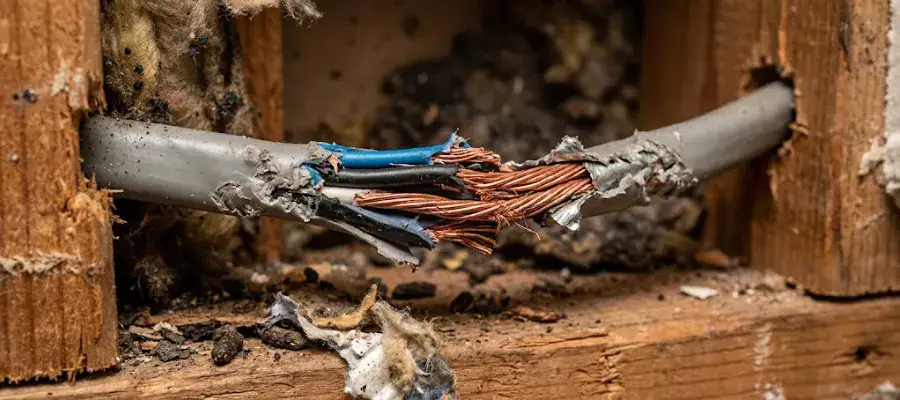
Summary: Rat incisors never stop growing, adding roughly four to five inches of new tooth per year, so rats gnaw constantly to file that growth down. Electrical wiring and wood framing offer the firm resistance rats need, which is why gnawed insulation, exposed copper, and enlarged entry holes in framing are among the most reliable signs of an active rat problem.
Who this matters for: California homeowners, landlords, and facility managers finding chewed phone chargers, stripped wires in garages, or fresh gouges in fascia boards and door frames.
Key takeaway: Left unaddressed, chewed wiring can create arc faults and fire risk, while chewed framing widens the entry points rats use to move between attic, wall, and crawl space.
This guide breaks down the dental biology behind the behavior, why wires and wood get targeted differently, how to read the damage to confirm you are dealing with rats and not another pest, and the concrete steps that stop the chewing at its source rather than just patching the symptom.
The Root Cause: A Rat's Teeth Never Stop Growing
Rats belong to the order Rodentia, a name drawn directly from the Latin rodere, "to gnaw." That is not a coincidence of naming; it describes the single defining trait of every animal in the group. A rat's four front incisors, two upper and two lower, grow continuously for the animal's entire life. They are never capped, never finished, and never stop erupting from the jaw.
Roughly Four to Five Inches of New Tooth Every Year
Field reports and pest biology sources commonly place rat incisor growth at around four to five inches per year, depending on age and how heavily the animal gnaws. That is an enormous rate of growth for teeth housed in an animal roughly the size of a small shoe. If a rat stopped chewing entirely, its incisors would keep extending until they curled past the jaw, preventing the mouth from closing and eventually causing the animal to starve. Gnawing is not optional behavior for a rat; it is the only mechanism it has to keep its own mouth functional.
Enamel Harder Than Iron and Copper
The front surface of a rat incisor is coated in enamel measuring approximately 5.5 on the Mohs hardness scale, the same scale used to rank minerals from talc to diamond. That places rat enamel above iron and copper on the same scale, which is a large part of why rats can gnaw through soft metals, aluminum flashing, and PVC conduit, not only wood and drywall. The back of the tooth is softer dentin, so as the rat chews, the front wears more slowly than the back, and the tooth naturally sharpens itself into a chisel edge with every bite. That self-sharpening design is exactly what allows a rat to strip wire insulation in minutes rather than hours.
Why Electrical Wiring Attracts Rats Specifically
Wiring is not the only thing rats chew, but it shows up in an outsized share of pest damage reports, and three overlapping factors explain why.
The Right Resistance, Not the Right Taste
A rat needs something firm enough to wear its incisors down but not so hard that it risks cracking a tooth. PVC and rubber wire jackets sit in exactly that middle range, giving rats a satisfying, low-injury-risk surface to grind against, similar to the resistance they would get from a green twig or a nut shell in the wild.
Wiring Runs Along Established Travel Routes
Rats do not wander a structure randomly. They memorize and reuse the same paths along wall cavities, joists, and attic framing, and electrical runs are almost always installed along those same structural lines. A wire is rarely the first thing a rat finds; it is the thing sitting directly in the path the rat was already using to move between its nest and a food source.
Warmth and Nesting Material
Live wiring generates a small amount of ambient warmth, which is attractive to a nesting rat, particularly a pregnant female looking for a sheltered, temperature-stable spot. Stripped insulation and shredded wire coating also double as soft nest lining, so a single gnawed section of cable can serve two purposes at once: tooth maintenance and construction material.
Why Wood Is Chewed for a Different Reason Than Wire
Wood damage and wire damage often get lumped together, but rats approach the two materials with different goals in mind.
Wood as a Doorway, Not Just a Chew Toy
A rat can squeeze through a gap roughly the width of its thumb, but many entry points into a structure start smaller than that. Rats will gnaw at the edges of a knot hole, a gap around a utility penetration, or a soft, moisture-damaged corner of fascia board specifically to enlarge it into a usable opening. Once that hole exists, it gets reused and widened every season, which is why an old, smooth-edged rat hole in siding or framing is almost always larger than a fresh one.
Wood as Structural Tooth Maintenance
Away from entry points, rats also gnaw on exposed wood simply because it offers reliable resistance, the same reason they target wire. Roof rafters, subfloor joists, and stored lumber in a garage are common targets even when there is no need to create an opening; the rat is filing its teeth, not building a door.
Wood and Cardboard as Nesting Material
Shredded wood fiber, along with cardboard and insulation, gets pulled apart and packed into wall voids, attic corners, and crawl space debris to build a nest. If you find fine wood shavings piled in a corner rather than scattered evenly, that concentration is usually the entrance to an active nest rather than incidental gnawing. For a full walkthrough on locating and safely clearing an active nest once you find one, see our rodent nest identification and removal guide.
Field Note: Judging a Rat's Age by Its Chew Marks
One detail that gets missed in most chew-damage inspections is that juvenile rats and adult rats leave measurably different marks. A juvenile's incisors are narrower and its bite force is lower, so early damage often looks like shallow scoring or partial gnaw attempts that never fully break through a surface. As the same animal matures, the gouges widen and the entry holes it created earlier get chewed larger to accommodate its growing body. If you see a mix of shallow scratch marks and fully chewed-through holes in the same area, you are very likely looking at one colony across multiple generations rather than a single rat, which changes how aggressively the exclusion work needs to be scoped.
The Fire and Structural Risk Chewing Creates in a California Home
California's housing stock includes a large share of homes built before modern wire-gauge and rodent-barrier standards, with attics, crawl spaces, and detached garages that give rats easy, undisturbed access to wiring for months at a time. Once insulation is stripped from a live wire, two exposed conductors touching, or moisture bridging the gap during a rare rain event, can create an arc fault. That arc generates intense, localized heat, which is more than enough to ignite dry insulation, dust, or the very nesting material a rat packed around the wire.
Fire investigators and pest control industry sources frequently cite rodent damage as a contributing factor in structure fires where an ignition source is never conclusively traced, precisely because the damage is hidden behind drywall or above a ceiling until an inspection or a repair happens to expose it. Beyond fire risk, chewed wood framing around utility penetrations lets moisture into wall cavities, which leads to rot, mold, and a slowly enlarging entry point that invites the next generation of rats before anyone notices the first sign of damage.
If You Find Exposed Copper Wiring
Do not touch or attempt to tape over an exposed wire yourself. If you can safely reach your electrical panel, shut off the breaker for that circuit, photograph the damage for your records, and keep the area clear until an electrician and a rodent inspection have both assessed it. Patching the insulation without closing the rat's entry point almost always results in the same wire being chewed again within weeks.
Confirming It Is Rats: How the Damage Compares to Other Pests
Chew damage from rats, mice, and squirrels can look similar at a glance, but the dimensions of the marks and the location of the damage usually settle the question.
| Trait | Rat | Mouse | Squirrel |
|---|---|---|---|
| Gnaw mark width | Wide, paired grooves, roughly 1/8 inch apart | Fine, closely spaced grooves | Broad, splintered chewing |
| Typical entry hole size | Around 2 inches, smooth-edged when reused | Around 1/2 inch, often near ground level | 2 inches or larger, near roofline |
| Common location | Wall voids, attics, garages, along ground-level travel routes | Kitchens, low wall gaps, pantry areas | Roof eaves, soffits, attic vents |
| Droppings near damage | Roughly 1/2 to 3/4 inch, capsule-shaped | Roughly 1/8 to 1/4 inch, thin | Larger, often found on attic insulation |
If you are working through identification and the marks or droppings you are seeing do not match the rat profile cleanly, it is worth confirming the species before treatment, since exclusion and trap placement differ meaningfully between rats, mice, and squirrels.
What to Do the Moment You Find Chew Damage
When you discover active chew damage, the clock starts immediately. Follow this exact sequence to secure the property and prevent a catastrophic electrical failure.
Stop and secure power
Shut off power to any circuit with exposed or chewed wiring before doing anything else. Do not rely on the breaker to trip automatically.
Photograph everything
Document the chewed material, nearby droppings, and any visible entry hole before you clean up or repair. Insurers and technicians both need the untouched scene.
Trace the damage back
Chewed wire or wood rarely sits in isolation; follow the path a few feet in either direction to find where the rat is getting in.
Check for an active nest
Use the signs described in our nest identification guide, since removing rats without removing the nest usually means the damage returns within days.
Have electrical repaired
Use a licensed electrician rather than taping over exposed wire, since taping does not restore the wire's fire rating.
Close the entry point
Use a rat-resistant material once the animals are cleared, not before, since sealing an active entry point simply forces rats to chew a new one nearby.
Rodent-Proofing Wires and Wood So the Chewing Stops for Good
Because the underlying driver is dental biology, not a behavioral quirk, prevention has to remove the opportunity rather than try to change the rat's habits.
- Use rodent-resistant wire loom or metal conduit on any wiring run through an attic, crawl space, or garage where rats have travel access.
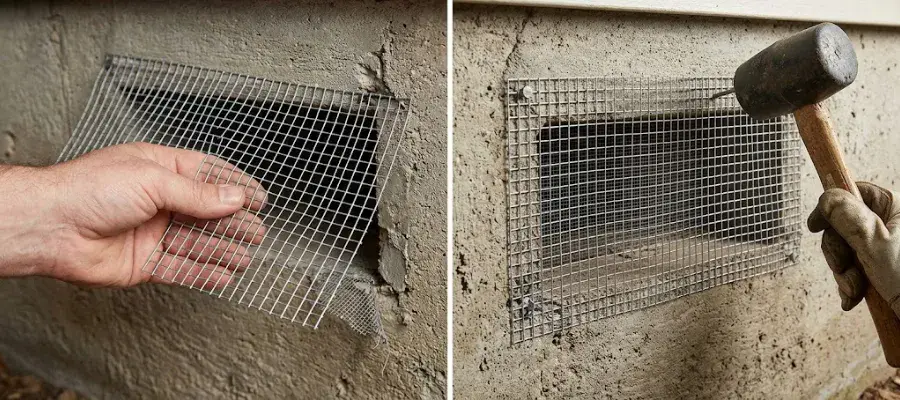
- Seal gaps larger than a quarter inch around utility penetrations, vents, and foundation lines with steel wool packed behind a durable exterior sealant, since rats can compress their bodies through openings that small.
- Cap and screen roof and foundation vents with hardware cloth rated for rodents, not standard insect screening, which a rat's incisors go through easily.
- Trim vegetation and stored lumber away from the structure so rats are not given a bridge from the yard directly onto a roofline or into a garage.
- Remove standing food sources and clutter in garages and sheds, since a well-fed rat still gnaws for tooth maintenance, but a food-scarce structure gives rats far less reason to stay and nest.
Materials-based prevention research from cable and utility engineering has repeatedly found that a hard outer jacket alone is not enough to stop rodents, since a tough surface still satisfies the gnawing instinct; the more reliable fix combines physical barriers with removing rat access to the area entirely.
Common Questions About Rat Chew Damage
Rats target wires because the firm outer jacket gives their incisors resistance without being so hard it damages their teeth, and because wires run along the same joists, wall cavities, and attic beams rats already use as travel routes. The behavior is driven by tooth maintenance, not a preference for wiring itself.
A rat's incisors grow continuously throughout its life, commonly cited at roughly four to five inches per year. Because the growth never stops, a rat that goes even a few days without gnawing on something firm will already feel the difference in bite alignment.
Yes. Rat incisor enamel measures around 5.5 on the Mohs hardness scale, harder than iron and copper, which lets rats gnaw through untreated softwood framing, drywall, and even soft concrete or aluminum flashing to create or widen entry points.
Chewed insulation exposes bare copper conductors, and when two exposed wires touch or moisture reaches the gap, it can create an arc fault hot enough to ignite nearby dust, wood, or nesting material. Fire investigators and pest control industry sources frequently point to rodent damage as a contributing factor in fires where the original cause is never conclusively identified.
Rat gnaw marks are typically wider, with paired incisor grooves spaced further apart than mouse marks, and entry holes chewed by rats are usually smoother-edged and closer to two inches wide. Mouse damage looks finer and more frayed, while squirrel damage tends to appear higher on the structure, near rooflines and soffits.
Avoid touching the exposed wire, shut off power to that circuit at the breaker if you can do so safely, and photograph the damage before covering or repairing it. Then have both the electrical damage and the rodent entry point inspected, since patching the wire without closing the entry point invites repeat damage.
When to Call a Professional Instead of Handling It Yourself
DIY sealing works well for small, visible gaps you can reach safely. It is time to bring in a field inspection when chewed wiring is involved, when the entry point is inside a wall cavity or roofline you cannot access, when you are finding damage in more than one area of the structure, or when you have already sealed an opening and found a new one nearby, which usually means the colony is larger than a single point of entry suggests.
For properties anywhere in California, PestPunt dispatches field representatives directly to inspect gnaw damage, map entry points, and recommend exclusion materials based on what evidence is actually present on-site. Residents in the Norwalk area specifically can review our Norwalk, CA pest control service for local dispatch details, and anyone wanting a full overview of offerings can visit our services page or check where we currently dispatch across California.
Further Reading on Rodent Biology and Electrical Safety
For further independent reading on rodent biology and structural safety considerations, the UC IPM's rat management guidelines cover rat biology and non-chemical control in more depth. The CDC's rodent prevention resources outline the health risks tied to rodent access in and around homes. For electrical fire safety fundamentals, see the NFPA's home fire safety resources.
PestPunt — Service Area Business
- PestPunt
- Service Area (California Statewide): Providing 100% on-site mobile services directly to your property.
- As a Service Area Business (SAB), we do not have physical office visits. Our local expert field representatives are dispatched directly to your location.
- 24/7 Dispatch Phone: (888) 217-6759
- Email: [email protected]
Stop the Gnawing Before It Starts a Fire
Understanding the biological drive is the first step. Taking action is the second. Contact our team at (888) 217-6759 to schedule a full property assessment and get a tailored exclusion plan based on the chew evidence actually present on-site.