Insurance Coverage for Rodent Damage in California: What Policies Usually Pay and What They Do Not
Chewed wires, ruined insulation, and a car that will not start all raise the same question: will insurance pay? In California the answer depends on the policy type, the cause, and the exact wording. This guide explains how auto, homeowners, and renters coverage usually treat rodent damage, and how to build a stronger claim.
Insurance for Rodent Damage in California — At a Glance
Auto policies: Comprehensive covers non-collision damage. Ask your insurer whether chewed wiring qualifies and what your deductible is.
Homeowners policies: CDI lists insects, rats, and mice among perils generally not covered, along with wear and tear and neglect.
Claim strength: Photos, a mechanic's statement, receipts, and a clear timeline make a claim easier to review.
Prevention: Insurance rarely removes the rodents. Trapping, sealing, and sanitation stop repeat damage.
Why Rodent Damage Is a Hard Insurance Question
Rodent damage sits in a gray zone. Insurers write policies around sudden, accidental events such as fires, theft, and storms. Rodent infestations usually build over weeks or months, and many insurers treat them as a maintenance issue. At the same time, a rat that chews a car's wiring in one night can cause a sudden, expensive loss, and some auto policies respond to it.
We are a pest control dispatch service, not an insurance company, an agent, or a law firm. We cannot tell you what your policy pays. What we can do is explain what the California Department of Insurance publishes, describe how claims tend to go, and show you how to protect yourself before and after a loss. For vehicle-specific damage, start with our companion guide on rodent damage to car engines and wiring.
Three Questions That Decide Most Claims
- What is damaged? A car, a house, a garage, or your personal belongings fall under different coverages.
- What caused it? A sudden event and a long-term infestation get different treatment.
- What does your policy say? The declarations page and the exclusions override any general rule you read online, including this one.
Auto Insurance and Rodent Damage to Your Car
The California Department of Insurance (CDI) auto insurance guide explains the two physical damage coverages. Collision pays for damage from contact with another vehicle or an object. Comprehensive pays for damage from something other than a collision, and the guide gives fire, theft, vandalism, windstorm, flood, and falling objects as examples. The same guide states that comprehensive does not cover mechanical breakdown, normal wear and tear, or maintenance.
The guide does not name rodents in that list. Many insurers nonetheless treat animal damage as a comprehensive loss, so a chewed wiring harness may qualify. Because the answer depends on your policy wording and the insurer's review, call before you assume either way.
Questions to Ask Your Auto Insurer
- Do I carry comprehensive coverage, and what is my deductible?
- Does my policy treat animal or rodent damage as a covered comprehensive loss?
- What evidence do you want: photos, a mechanic's report, or an inspection?
- Does rental reimbursement apply, or does it only apply after a covered accident?
- How might a comprehensive claim affect my renewal?
How the Deductible Works
CDI gives a simple example. If your comprehensive coverage carries a $500 deductible and a storm causes $1,500 in damage, you pay the first $500 and the coverage pays the remaining $1,000. A rodent claim works the same way. If the repair costs less than your deductible, a claim will not pay anything, and you can skip it.
Older Cars and Lenders
CDI notes that lenders and leasing companies usually require comprehensive and collision coverage, and that some drivers of older, lower-value cars drop it. Comprehensive pays based on the market value of your car, so a repair estimate that approaches the car's value may lead to a total-loss discussion. Ask your insurer how it handles that situation.
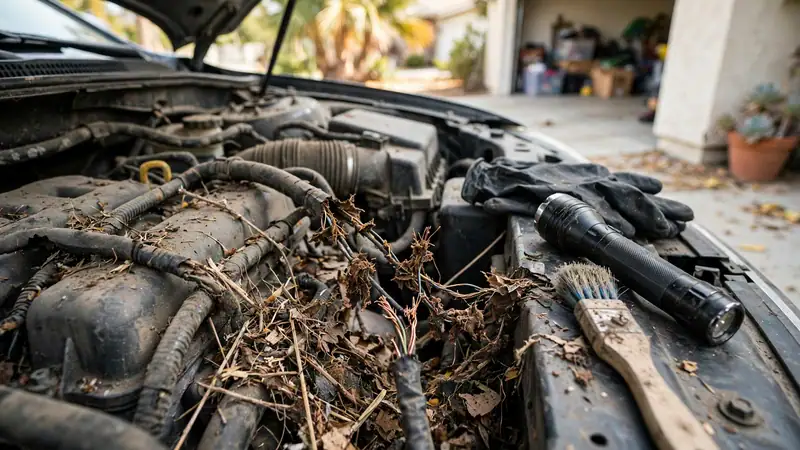
If you want to understand what rodents actually damage in a vehicle and how to spot it early, read our guide on rodent damage to car engines and wiring. It also explains why you should stop cranking a damaged car.
Homeowners Insurance and Rodent Damage in California
The CDI residential insurance guide lists perils that homeowners policies typically cover, such as fire or lightning, windstorm or hail, theft, and sudden and accidental water damage. It also lists perils generally not covered. That second list includes termites, insects, rats or mice, mold, wear and tear or maintenance, and neglect.
In practice, that means a homeowners policy usually will not pay to remove rats or mice, and it usually will not pay for the cost of repairing damage that the rodents caused to insulation, drywall, or ducts. CDI also tells consumers to read the exclusions in their contract, because wording varies.
What About a Fire Caused by Chewed Wires?
Fire is a commonly covered peril, while rodents are commonly excluded, so a loss that involves both can raise questions. Policies word this differently, and insurers evaluate each loss on its facts. We cannot predict how yours would turn out. If chewed wiring causes a fire, tell your insurer promptly and let the adjuster explain how your policy applies. UC IPM warns that rats gnawing in attics can create electrical spark and fire hazards, which is one reason we recommend a prompt inspection. See the UC IPM Pest Notes on rats for details.
Garages and Detached Structures
CDI explains that Coverage B protects other structures on your property, such as detached garages and tool sheds. The same exclusion questions apply to rodent damage in those structures. Check the declarations page and ask your agent how your policy treats them.
Endorsements and Special Programs
CDI notes that you may buy endorsements that extend coverage beyond the standard policy. Ask your agent whether any endorsement addresses pest damage. If you cannot find coverage from a private insurer, CDI describes the California FAIR Plan, which offers a basic fire policy with coverage limitations. A FAIR Plan policy does not fill every gap, so ask about supplemental coverage.
Rodent Damage Coverage Map: Auto, Home, Renters, and Warranties
Use this table as a starting point for the conversation with your insurer, not as a final answer. Every policy differs.
| Policy or contract | Rodent-related loss | What CDI publishes | What to ask |
|---|---|---|---|
| Auto comprehensive | Chewed wiring, hoses, or nesting damage | Covers non-collision damage; excludes wear, maintenance, and breakdown | Does animal damage qualify, and what is my deductible? |
| Auto collision | Rodent chewing | Covers contact with a vehicle or object | Rarely relevant, so confirm with your insurer |
| Homeowners (dwelling) | Chewed insulation, ducts, or wiring in the house | Lists rats or mice among perils generally not covered | Does any endorsement or special clause apply? |
| Homeowners (fire) | Fire that follows chewed wiring | Fire or lightning is a typically covered peril | How does my policy treat a fire with a rodent cause? |
| Renters | Damage to your belongings | Covers personal property for covered perils | Does rodent damage fall under an exclusion? |
| Home protection contract | Failed systems or appliances | Not insurance; covers breakdown from normal wear and tear | Does the contract exclude pest damage? |
| Pest control service | Removal and exclusion work | Not an insurance product | What will the visit include and exclude? |
Home protection contracts, often called home warranties, are regulated by CDI but are not insurance. CDI states they cover repair or replacement of major systems and appliances that break down from normal wear and tear, and structural items are generally not covered. Read any contract for pest-related exclusions before you count on it.
How to Document Rodent Damage Before You File a Claim
A claim is easier to review when the facts are clear. These six steps work for auto, homeowners, and renters situations alike.
Photograph Before You Touch Anything
Take wide shots and close-ups of the damage, droppings, nests, and entry points. Include the date on your phone or in your notes. Do not clean the area until you finish.
Read Your Declarations Page
Find your coverages, limits, and deductibles. CDI calls the declarations page a useful summary of your policy, and it tells you whether comprehensive or Coverage B applies.
Call Your Insurer or Agent Early
Ask how to report the loss and what evidence the company wants. Write down the date, the name of the person you spoke with, and what they told you.
Get a Written Statement From the Repair Professional
Ask your mechanic, electrician, or contractor to describe the damage and its apparent cause in writing. A clear statement helps the adjuster understand what happened.
Keep Every Receipt and Record
Save repair estimates, invoices, towing receipts, and pest control records. CDI also advises keeping inventories and photographs of belongings to speed a claim.
Stop the Source So the Damage Does Not Repeat
Book a property inspection so a professional can find and close the rodent routes. Our entry point guide shows what an inspection looks for.

Why Accurate Reporting Protects You
Be honest about what you know and what you do not. If you cannot say when the rodents first appeared, say so. If you saw droppings a month ago and ignored them, tell the adjuster. CDI's guides list fraud and material misrepresentation among the limited reasons an insurer can cancel a policy, and an insurer can also deny a claim that rests on inaccurate statements. Accurate reporting costs you nothing and protects your coverage.
Do Not Hide Pest History When You Apply
CDI also tells consumers to provide complete and accurate information when they request a quote or complete an application. If your garage had a rodent problem, answer questions about it truthfully, and keep records that show you fixed it.
Mitigation Matters
Insurers expect you to prevent further damage once you discover a problem. Moving a damaged car to a safe place, shutting off power to a damaged circuit, and calling a pest professional all show reasonable steps. Waiting weeks while the damage grows can complicate a claim.
Rodent Damage Claims Across California Neighborhoods
Rodent problems and insurance questions show up everywhere in California, but the patterns differ by neighborhood. We share these examples from the field to help you picture your own situation. They do not rank any community, and we serve all of California.
Older Homes and Detached Garages
In Land Park in Sacramento (ZIP 95818) and North Park in San Diego (ZIP 92104), older houses often have detached garages, crawl spaces, and roof lines with many gaps. When rodents move in, homeowners often discover the damage at the same time in the car, the attic, and the garage, and then ask which policy applies. Our Sacramento rodent pest control page and San Diego emergency rodent removal page describe local service.
Hillside and Dense Urban Lots
In Silver Lake in Los Angeles (ZIP 90026), steep lots with dense plantings, stairs, and shared fences give roof rats cover and routes. In the Tower District of Fresno (ZIP 93728), a mix of older homes, mature trees, and alley garages creates similar pressure. See our Los Angeles 24/7 rodent control page and the Fresno rodent exterminator page.
Renters and Multi-Unit Buildings
Renters often ask who pays. A renters policy covers your belongings for covered perils, but it may not cover rodent damage, and it does not cover the building. Tell your landlord or property manager in writing, keep a dated copy, and keep photos. For questions about a landlord's legal duties, speak with a tenant rights organization or an attorney.
A practical lesson from the field: homeowners who photograph early and call quickly usually have an easier time explaining what happened than those who wait. The evidence is fresh, and the repair estimates are clear.
What to Do If Your Insurer Denies the Claim
A denial is not always the end. These six steps help you understand the decision and decide whether to push back.
Ask for the Reason in Writing
Request a written explanation and the policy language the insurer relied on. Read that language against your declarations page and endorsements.
Compare the Denial to Your Policy
Check whether the insurer treated the loss as an excluded infestation, as wear and tear, or as something else. Understanding the reason shapes your next move.
Send Additional Evidence
If the insurer lacked a fact, such as the date the damage started or a mechanic's statement, send it in writing and keep a copy.
Ask for a Supervisor Review
Request that a supervisor or the appeals unit review the file. Keep your tone factual and polite.
Contact CDI if You Believe the Decision Was Improper
CDI states it may help with issues such as improper denial of a claim and delay in settlement. You can reach its consumer hotline at 1-800-927-4357 or file a request for assistance through its website.
Consider Independent Advice
For large losses or complex disputes, consider speaking with a licensed attorney or a public adjuster. We cannot advise you on legal strategy.

Handle It Yourself or Call a Professional?
Whatever your insurer decides, the rodents will not leave on their own. UC IPM describes successful rat control as sanitation, structural exclusion, and population control, and it says exclusion is the most successful and longest-lasting strategy around structures. Decide how much of that you can handle safely.
When You Can Start on Your Own
- You can see a single, small entry gap and reach it safely.
- You can store food in sealed containers and clear clutter.
- You can set snap traps along walls in a garage or basement.
- You can wet-clean small amounts of droppings with protection.
When a Professional Saves Time and Money
- Damage appears in several places, such as the car, attic, and walls.
- You see roof rats on fences, wires, or rooflines.
- Warning lights or damage return after a repair.
- You need a clear inspection record for your insurance file.
- Heavy droppings or nests require cleanup with protective equipment.
- You cannot safely reach the attic, roofline, or crawl space.
Our professional rat removal, rat proofing, and cleanup and decontamination pages explain the work our field representatives perform. For attic problems specifically, see our page on California attic rodent solutions.
Avoid relying on gadgets or home remedies to stop repeat damage while you wait for a claim to resolve. We cover the evidence on whether ultrasonic rodent repellers work in the next guide in this series.
Prevention Habits That Keep Rodent Losses From Repeating
The cheapest claim is the one you never file. Insurance can help after a loss, but prevention protects your car, your attic, and your deductible.
- Seal gaps larger than a quarter inch around pipes, wires, and vents with metal materials.
- Store pet food, bird seed, and trash in sealed containers.
- Trim branches away from the roof and thin dense plantings near walls.
- Inspect the attic, garage, and crawl space on a regular schedule.
- Use a weighted car cover that touches the ground if you park outside.
- Keep dated records of inspections, repairs, and pest control visits.
Our guides on what attracts mice into a home, the early signs of rodent infestation, and why rats chew through wires and wood help you catch problems early.

Six Mistakes That Weaken a Rodent Damage Claim
Cleaning Before Photographing
Once you wipe away droppings and nests, you lose evidence. Photograph first, then clean safely.
Assuming Coverage
Do not assume your policy pays or does not pay. Ask, and read the exclusions.
Waiting Too Long
Delays let damage grow and make the timeline harder to explain.
Skipping the Written Statement
A verbal explanation from a mechanic rarely helps. Ask for the findings in writing.
Ignoring the Source
Repairs without rodent control invite a second loss, and insurers may view repeat damage differently.
Overstating or Hiding Facts
Accurate reporting protects your policy. Misstatements can cause bigger problems than the original loss.
What Happens When You Call PestPunt
PestPunt operates as a mobile service across California. When you call (888) 217-6759, a dispatcher asks what you found, where you found it, and how long you think it has gone on. A local field representative then travels to your property.
The representative inspects the areas where rodents travel, identifies the species, and explains what the evidence suggests. We then recommend trapping, exclusion, and sanitation steps, and we explain what we can and cannot do. We do not decide your insurance claim and we do not promise any coverage outcome. Ask your representative what records of the visit you can share with your insurer.
You can read more about our team on the about page or browse all services.
Frequently Asked Questions About Insurance and Rodent Damage in California
It may, if you carry comprehensive coverage and your insurer treats animal damage as a covered loss. The California Department of Insurance says comprehensive covers non-collision damage but does not name rodents, so ask your insurer directly and review your deductible.
Usually not. The California Department of Insurance lists insects, rats, or mice among perils generally not covered, along with wear and tear, maintenance, and neglect. Read your policy exclusions and ask your agent about any endorsements.
Homeowners insurance generally does not pay for rodent removal, because rats and mice are listed among perils generally not covered. Pest control is also a service, not an insurance product. Ask your insurer if your policy includes any exception.
Fire is a typically covered peril, but rodents are typically excluded, so policies may respond differently. Report the loss promptly and ask the adjuster how your policy applies. We cannot predict the outcome, so rely on your insurer's written decision.
A renters policy covers your personal property for covered perils, and it may exclude rodent damage. It does not cover the building. Review your exclusions, tell your landlord in writing, and keep photos and dated records.
Take dated photos of damage, droppings, nests, and entry points before cleaning. Keep repair estimates, a written statement from your mechanic or contractor, receipts, and notes from every call with your insurer.
Ask for the reason in writing, compare it with your policy language, and send missing evidence. If you believe the denial was improper, the California Department of Insurance accepts requests for assistance, and its hotline is 1-800-927-4357.
No. PestPunt is a pest control dispatch service, not an insurer or adviser, and we cannot influence a coverage decision. We inspect, control, and seal rodent routes across California, and we can discuss what visit records you may share with your insurer.
Final Takeaways
Rodent damage insurance in California depends on the policy and the wording. Auto comprehensive may help with a damaged car, while homeowners policies usually exclude rats and mice. Read your exclusions, document everything, report accurately, and fix the source so the loss does not repeat.
For a field inspection anywhere in California, call PestPunt at (888) 217-6759. Our team dispatches directly to your property.
Mobile Rodent Control Services
Protect Your Property and Your Claim File
A field representative can inspect your home, garage, or driveway, explain what the evidence shows, and recommend how to stop repeat damage. Call (888) 217-6759 for 24/7 dispatch anywhere in California.