Mouse Nesting & Habits: What Every Homeowner Needs to Know
Learn what a mouse nest looks like, where mice build it, how their nightly habits give them away, and how to remove a nest safely before the population grows.
How Do Mice Nest? The Short Answer
Short answer: Mice build soft nests from shredded paper, fabric, insulation and similar fibers. They place those nests in warm, hidden, undisturbed spots close to food, and they rarely roam far from the nest. One female can raise dozens of young in a single year, so a small nest can become several nests quickly. Find the nest, remove the food and shelter that support it, seal the entry points, and wet-clean the area before you touch any material.
You pull a storage box off a garage shelf and find a fist-sized ball of shredded paper, fabric and insulation. Or you hear scratching behind a wall at the same time every night. Either way, one question matters most: where is the nest, and how many mice does it support?
This guide answers that question in plain language. You will learn what a mouse nest looks like, where mice build in a typical home, how their habits expose the nest, how fast a nest multiplies, and how to remove it without stirring up contaminated dust. The advice follows University of California Integrated Pest Management guidance on house mice and CDC hantavirus guidance. It applies to homes, garages, sheds and cabins, and it reflects current practice for 2026.
What Does a Mouse Nest Look Like?
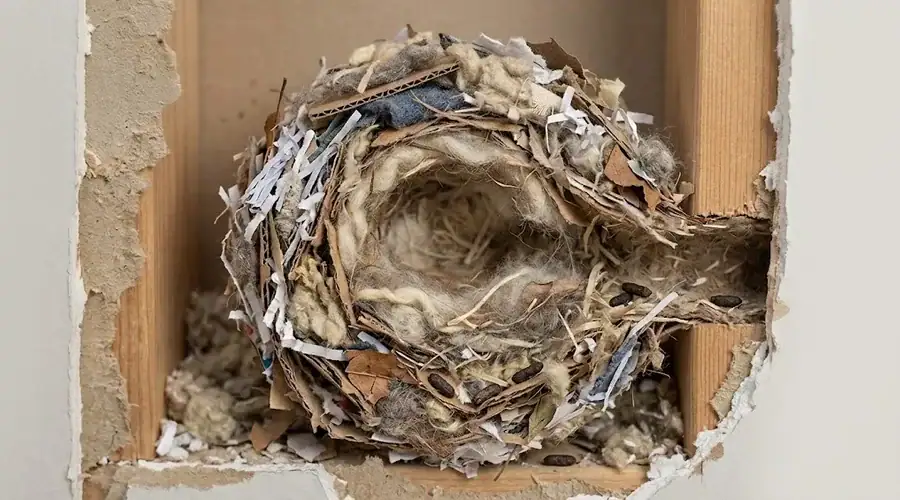
A mouse nest is a soft, insulated shelter that a mouse builds from any fibrous material it can chew and carry. Mice use the nest to sleep, stay warm, store small amounts of food and raise their young. Because the nest sits near food and heat, it tells you far more about an infestation than a single dropping does.
Key Features of a Mouse Nest
- Shape and size: Expect a loose ball or cup, usually fist-sized or a little larger, with a small side entrance.
- Materials: Mice use shredded paper, cardboard, insulation, fabric, dryer lint, pet fur, dry grass and upholstery stuffing.
- Texture: Mice chew material into fine, fluffy strips. That fine shredding separates a nest from a random pile of debris.
- Odor and staining: Long-term infestations produce a musky smell and dark urine staining around the nest.
- Contents: Look for droppings, gnawed seeds or food scraps and, in a breeding nest, pink, hairless pups.
Fresh Nest or Abandoned Nest?
A fresh nest looks clean inside, smells musky and sits beside new, dark droppings. An abandoned nest looks flat, dusty and gray, often with cobwebs and crumbly old droppings. Treat both as contaminated. Dry nesting material still releases dust when you disturb it.
| Feature | House mouse | Deer mouse | Roof rat |
|---|---|---|---|
| Typical materials | Paper, insulation, fabric, lint | Grass, moss, fur, fabric, plus cached seeds | Shredded material, twigs and leaves |
| Typical location | Indoors: behind appliances, in walls and storage | Sheds, cabins, wall voids and vehicles near wild land | Attics, upper levels, trees and dense vegetation |
| Relative size | Fist-sized | Fist-sized, often with food caches | Larger and bulkier |
| Main health concern | Salmonella, leptospirosis and LCM | Sin Nombre hantavirus | Bacteria and parasites from droppings and urine |
Species matters because it changes your cleanup precautions. House mice dominate nests inside homes, but deer mice nest in garages, cabins and outbuildings near open land. If you suspect deer mice, read our guide to deer mice dangers and health risks before you handle any nesting material.
Where Do Mice Build Nests in a Home?
Mice pick nest sites with three tests: warmth, concealment and distance to food. They want a spot that people rarely disturb, that holds heat, and that sits within a short run of a meal. Check these locations in order, starting with the places that pass all three tests.
1. Behind and Under Heat-Producing Appliances
Refrigerators, stoves, dishwashers and water heaters give off steady warmth, and the dark gap behind them stays quiet. University of California IPM guidance specifically names dark corners behind heat-producing appliances as favorite indoor nest sites.
2. Wall Voids and Attic Insulation
Insulation offers ready-made nesting material and perfect concealment. Mice tunnel through batts and blown insulation, and the tunnels lead to the wall cavity behind kitchens and bathrooms.
3. Cabinets, Pantries and Drawers
A nest in a pantry puts bedding next to food. Look behind stored bags of rice, pet food and baking supplies, and check the back corners of lower cabinets near plumbing penetrations.
4. Garages, Sheds and Storage Boxes
Cardboard boxes, holiday decorations, old clothing and paper files supply perfect material. A box that sits untouched for months becomes a nursery.
5. Crawl Spaces and Subfloors
Crawl spaces stay dark and protected, and foundation vent gaps give mice easy access. Look for torn vapor barrier, chewed insulation and nests tucked beside pipes.
6. Vehicles, RVs and Stored Equipment
Engine bays, air filters, glove boxes and RV cabinets hold heat and fibers. Mice chew wire insulation in these spaces, so a nest here can lead to expensive repairs.
7. Furniture, Mattresses and Upholstery
Unused sofas, stored mattresses and the undersides of box springs offer soft stuffing and cover. Check guest rooms and seasonal rooms first.
Most homes hold more than one nest. A main nest usually sits near the best combination of heat and food, and satellite nests appear along travel routes. When you find one nest, keep looking. The nest you see is rarely the only one.
Mouse Habits That Give the Nest Away
You may never see a mouse, yet its habits leave a clear trail. Once you understand how mice move, feed and chew, you can follow that trail straight to the nest.
| Habit | What it means | What you will see |
|---|---|---|
| Night activity | Mice forage mostly after dark, though daytime sightings happen | Scratching in walls, fresh droppings each morning |
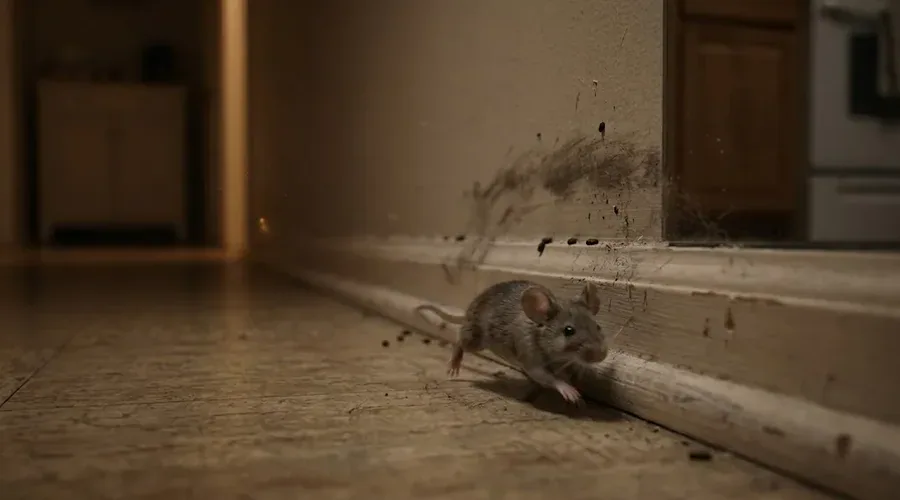
| Fixed travel routes | Mice run along walls and edges between the nest and food | Grease rub marks, tracks in dust, droppings along baseboards |
| Short range | Mice seldom stray far from the nest while food is nearby | Activity concentrated within a small area of a room |
| Nibbling and scattered feeding | Mice eat small amounts from many sources and contaminate more than they eat | Small holes in packaging, scattered seed husks, droppings in food areas |
| Constant gnawing | Mouse teeth keep growing, so mice chew to wear them down | Chewed wiring, boxes, wood and soft plastic |
| Climbing and squeezing | Mice climb well and fit through very small gaps | Entry at roof lines, utility lines and door gaps |
| Curiosity | Mice investigate new objects quickly | Traps and new items draw attention within a day or two |
Why Short Range Matters
A mouse that finds food and shelter in the same area has no reason to travel. That habit works in your favor. If you see droppings behind the stove, the nest almost certainly sits within a few feet of that spot, not in the attic. Start your search at the highest concentration of droppings and work outward.
How Small a Gap Can a Mouse Use?
UC IPM reports that house mice squeeze under gaps about a quarter inch tall and through openings about three-eighths of an inch wide. A pencil fits through a gap that size, and so does a mouse. That is why exclusion work targets the smallest cracks, not just the obvious holes.
Why Daytime Sightings Matter
Mice stay mostly nocturnal, but you can see them during daylight. A mouse that crosses a room at noon may be disturbed from its nest, short of food, or part of a crowded population. Treat a daytime sighting as a reason to inspect, not as a one-off.
How Fast Do Mice Breed Inside a Nest?
The nest is a nursery, and that fact explains why a mouse problem grows so fast. UC sources note that house mice reproduce year-round indoors and that one female can produce as many as 60 young in a single year. You do not need exact numbers to see the pattern: each female starts a litter cycle that overlaps the next one.
| Stage | Approximate timing | What happens in the nest |
|---|---|---|
| Pregnancy | About three weeks | The female gathers extra bedding and shapes a deeper nest cup |
| Birth | Litters of about five to eight | Pups arrive hairless and blind and depend on nest warmth |
| Nursing | First two to three weeks | The mother stays close, and pups open their eyes and grow fur |
| Weaning | Around three weeks | Young mice start exploring and feeding on their own |
| Maturity | Within about two months | Young females begin their own litters and build their own nests |
Important: Trapping adult mice does not end the problem if a nest with pups remains. Find and remove the nest itself, or the next generation will replace the adults you catch. UC IPM gives a typical house mouse lifespan of 9 to 12 months, but breeding starts long before that.
How Mouse Nesting Changes With the Seasons
Mice nest all year inside a warm building, but outdoor conditions change when and why they move in. UC IPM notes that house mice frequently enter homes in autumn. Use the table below to time your inspections.
| Season | What mice do | What to check |
|---|---|---|
| Fall | Mice move indoors as temperatures drop and outdoor food runs short | Exterior gaps, garage doors, firewood piles and stored boxes |
| Winter | Mice settle into insulated, heated spaces and breed | Attics, wall voids, appliance gaps and pantry corners |
| Spring | Litters grow, and mice spread to secondary nest sites | Garages, sheds, crawl spaces and vehicles you start rarely |
| Summer | Some mice move outdoors, while others stay where food remains | Pet food, trash storage, irrigation leaks and overgrown plants on walls |
Mild-winter regions follow the same pattern with less contrast. Mice in warm areas may never leave, so a nest inside the home can stay active through all four seasons. Wildfire smoke, heavy rain and construction nearby can also push mice toward buildings outside the usual fall window.
Signs You Have an Active Mouse Nest
Look for a cluster of signs, not just one. A single dropping may come from a mouse that passed through. A group of signs in the same area means mice live there.
- Fresh droppings. Mouse droppings are small, dark and pointed at the ends. Soft, shiny droppings are recent.
- Shredded material. Torn paper, fabric or insulation in a hidden spot points to a nest.
- Musky odor. A stale, musky smell builds as a population grows.
- Gnaw marks. Fresh marks look pale and sharp. Old marks look dark and smooth.
- Grease rub marks. Dark smears along baseboards and pipes show repeated travel.
- Night noises. Scratching, scurrying or squeaking at night suggests activity in walls or ceilings.
- Pet fixation. Dogs and cats often stare at, sniff or paw at the spot where mice nest.
Use a flashlight held at a low angle to reveal tracks in dust and rub marks that overhead light hides. Check inside lower cabinets, behind appliances and along the edges of garage storage.
Is a Mouse Nest a Health Hazard?
Yes. A nest concentrates urine, droppings and fur in one place, and the nesting material dries into fine dust. UC IPM lists leptospirosis, salmonella and lymphocytic choriomeningitis (LCM) among the diseases house mice can carry. Mice also drag fleas, mites and other parasites into the nest.
Deer mice add a more serious risk. They carry Sin Nombre hantavirus, and people become ill when they inhale dust from contaminated droppings and nests. You cannot tell an infected mouse from a healthy one by sight, and you cannot tell a deer mouse nest from a house mouse nest at a glance. Our deer mice health risk guide explains symptoms, timelines and when to seek medical care.
Important: Never sweep, vacuum or shake out a mouse nest. Those actions launch contaminated dust into the air you breathe. Wet-clean first, every time.
How to Remove a Mouse Nest Safely
Follow this wet-cleaning sequence for any nest, whatever the species. It matches the approach in CDC guidance and keeps dust out of the air.
Step 1: Ventilate First
Open doors and windows and leave the space for at least 30 minutes. Keep children and pets away.
Step 2: Put On Protection
Wear rubber or nitrile gloves, eye protection and a well-fitted respirator rated N95 or better. Add disposable coveralls for large or enclosed nests.
Step 3: Soak the Nest
Spray the nest, droppings and surrounding surfaces with a household disinfectant or a mix of one part bleach to nine parts water. Let it sit for at least five minutes, or follow the label.
Step 4: Lift and Bag
Pick up the wet nest with paper towels. If you find pups, treat them as contaminated material and bag them with the nest. Seal everything in a plastic bag, then place that bag inside a second bag.
Step 5: Disinfect the Area
Mop or wipe every surface the nest touched. Discard porous items such as soiled cardboard, and wash fabrics in hot water.
Step 6: Remove Gear and Wash Up
Disinfect your gloves before you take them off. Then wash your hands with soap and water for at least 20 seconds, and launder your work clothes separately.
When to Hand the Job to a Professional
Call an expert when the nest sits inside a wall void, an attic, a duct or a crawl space, where you cannot wet-clean without disturbing material. Also call when you find multiple nests, heavy droppings, or any sign of deer mice. The deer mice guide lists the cleanup precautions in more detail.
How to Stop Mice From Nesting Again
Removing a nest without fixing the cause invites mice to rebuild within days. Work through these steps in order. Exclusion gives the most lasting result, according to UC IPM.
1. Seal Every Entry Point
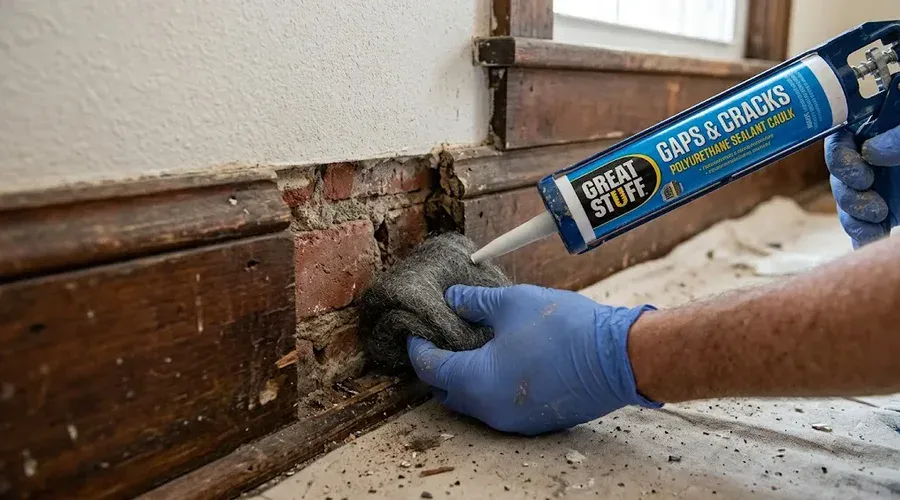
Walk the exterior and look for gaps around utility lines, pipes, vents, garage door bottoms, foundation cracks and roof edges. Seal anything larger than a quarter inch. Use coarse steel wool or copper mesh pressed into the gap and covered with caulk, hardware cloth over vents, and sweeps on exterior doors. Mice chew through foam, plastic and wood, so avoid sealants that mice can eat.
2. Trap Before You Finish Sealing
Set snap traps along walls, behind appliances and near droppings, with the trigger end against the wall. Use several traps rather than one, because mice often avoid a single trap but investigate a new one quickly. Peanut butter works well, and UC IPM suggests varying baits. Check traps daily, wear gloves, and spray each trap and mouse with disinfectant before disposal.
3. Remove Food and Water
- Store pantry food, pet food and birdseed in sealed metal or thick plastic containers.
- Feed pets only what they eat at one sitting, and pick up bowls overnight.
- Fix leaking faucets, pipes and irrigation lines.
- Keep trash in lidded containers, and store bins away from the building.
4. Take Away Shelter
- Replace cardboard storage with sealed plastic bins.
- Lift stored items off the floor and away from walls.
- Stack firewood off the ground and away from the house.
- Trim plants that climb walls or touch the roof, since mice climb well.
5. Skip the Shortcuts
Ultrasonic repellers do not control mice, according to UC IPM. Mothballs and scent products give inconsistent results. Poison baits can send mice into walls, where they die and cause odor, and California restricts the use of certain anticoagulant rodenticides. A licensed professional can advise you on legal and safe options.
Mistakes That Keep Mouse Nests Active
- Removing the nest but not sealing the gaps. New mice find the same entry and rebuild.
- Trapping only adults. Pups left in a hidden nest starve and attract odors and insects.
- Vacuuming nesting material. This spreads contaminated dust through the room.
- Using too few traps. One trap rarely matches the number of active mice.
- Ignoring food storage. Mice stay where food stays available.
- Stopping after one clear week. Keep traps and inspections going until activity stays at zero.
When to Call a Pest Professional
You can handle one small, accessible nest with careful cleaning and a sealing project. Bring in help when the situation goes beyond safe DIY limits:
- You find more than one nest, or you cannot find the nest at all.
- Activity continues after you trap and seal.
- Nests sit inside walls, attics, ducts or crawl spaces.
- You suspect deer mice, or the property sat closed for weeks or months.
- Someone in the household is pregnant, elderly, immunocompromised or has a lung condition.
What a Professional Visit Should Include
- Species identification, so you know whether you face house mice, deer mice or rats.
- A full interior and exterior inspection for nests, travel routes and entry points.
- A written explanation of what the inspector finds and recommends.
- Trap placement and exclusion work that uses durable materials.
- Clear guidance on sanitation and follow-up checks.
PestPunt is a California Service Area Business. We dispatch field representatives directly to your property. We do not operate a walk-in office, so every visit happens where the nest is.
Frequently Asked Questions About Mouse Nesting & Habits
How big is a mouse nest?
Most mouse nests are fist-sized or a little larger. They look like loose, fluffy balls or cups of finely shredded paper, fabric or insulation, with a small opening on the side.
How many mice live in one nest?
A breeding nest usually holds a mother and her litter, which often means five to eight pups. Several related mice can share a nest, and a home can contain more than one nest, so a single nest rarely accounts for the whole population.
Where do mice nest in winter?
Mice seek warm, protected spots in winter. They favor wall voids, attic insulation, spaces behind heat-producing appliances, pantries and stored boxes. They nest wherever warmth, cover and food sit close together.
Do mice come out during the day?
Mice are most active at night, but you can see them during daylight. A daytime sighting can mean a disturbed nest, a food shortage or a crowded population, so inspect the area for nests and droppings.
How far do mice travel from their nest?
Mice seldom travel far from the nest when food and water sit nearby. The densest cluster of droppings, rub marks and gnawed items usually points to a nest within a few feet.
Can mice build nests inside walls and attics?
Yes. Mice climb well and fit through gaps about a quarter inch tall, so they reach wall voids and attics. Insulation gives them nesting material and cover, which makes these spaces common nest sites.
Will mice come back after I remove a nest?
They will come back if you leave the entry points open and the food in place. Seal gaps larger than a quarter inch, store food in sealed containers, remove clutter and keep traps in place until activity stops.
Is it safe to touch or move a mouse nest?
No. Nests contain urine, droppings and parasites, and deer mouse nests can carry hantavirus. Never touch a nest with bare hands, and never sweep or vacuum it. Ventilate the area, wear protection and wet-clean the nest before you remove it.
Key Takeaways
- Mice build fine, fluffy nests from shredded paper, fabric and insulation in warm, hidden spots near food.
- Mice stay close to the nest, so the densest cluster of droppings points to it.
- One nest can multiply fast, and a nest with pups needs removal, not just trapping.
- Never sweep or vacuum a nest. Ventilate, wear protection and wet-clean.
- Seal gaps larger than a quarter inch, use several snap traps, and remove food and clutter.
- Treat any nest near wild land, or in a long-closed space, as a possible deer mouse nest.
- Call a professional for nests in walls, attics, ducts or crawl spaces.
California Statewide Mouse Control
Need Help With Mice at Your Property?
Mouse nests spread contamination and multiply quickly. Contact our team at (888) 217-6759 to schedule a species identification, nest and entry-point survey and tailored exclusion plan.