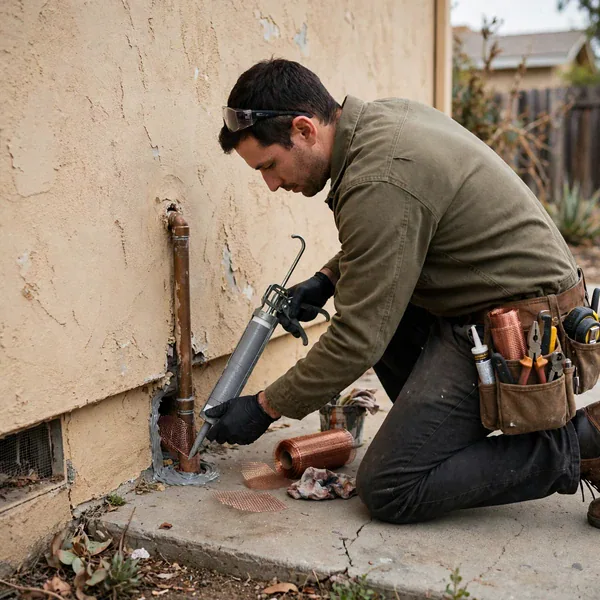
Mouse Entry Point Sealing: Close the Small Gaps That Let Mice Move In
A mouse needs only a quarter inch. That gap hides beside a pipe, under a door, or behind a vent screen. PestPunt field representatives find each one and close it with metal that mice cannot chew. Call (888) 217-6759 to book a visit.
Mouse Entry Point Sealing at a Glance
The key number: Mice can enter openings larger than ¼ inch, so we seal anything near that size.
Where we look: Utility lines, door bottoms, garage corners, vents, siding gaps, and the roofline.
What we use: Hardware cloth, copper mesh, door sweeps, escutcheon plates, and sealant.
How to start: Call (888) 217-6759. A field representative comes to your property.
What Mouse Entry Point Sealing Means
Mouse entry point sealing repairs the small openings that let mice enter a building. Mice do not break in. They walk through gaps that look harmless: a loose pipe collar, a worn door sweep, or a torn vent screen. Because the openings are so small, most homeowners walk past them every day.
The goal is simple. We make the building shell tight enough that a mouse has no way in. Then trapping and cleanup finish the job. Without sealing, new mice replace the ones you remove, often within weeks.
Why Sealing Beats Repeated Trapping
The UC IPM house mouse guidelines describe exclusion as the most successful and permanent form of house mouse control. Traps remove individual animals, but they cannot stop new ones. A sealed home breaks the cycle.
The Quarter-Inch Problem: Why Mice Fit Where You Think They Cannot
Mice have flexible skeletons and a skull that sets their limit. If the head fits, the body follows. UC IPM reports that house mice can squeeze under gaps ¼ inch tall and through openings about ⅜ inch wide. That is smaller than most people imagine.
The Pencil Test
Our field representatives use a simple rule of thumb. A standard pencil is close to ¼ inch thick. If a pencil slides into a gap, a mouse can usually follow. This test works well at door corners, pipe collars, and cabinet backs, and it requires no special tools.
What Mice Can Do Once They Reach Your Wall
UC IPM notes that house mice run along wires and ropes and can jump up to 12 inches onto a flat surface. A mouse that reaches a gap beside a utility line can climb toward a vent or the roofline. This means a gap at the second floor matters as much as one at the foundation.

Where Mice Enter From Outside: A Field Checklist
We work from the outside in, because every interior sign leads back to an exterior gap. The table below shows the points we check on nearly every visit, what we usually see, and the repair we make.
| Location | What we often find | Our repair |
|---|---|---|
| Door bottoms | Worn sweeps and light showing under the door | Metal-backed door sweep |
| Garage door corners | Bent weatherstripping and open side seals | New bottom seal and corner guard |
| Pipe and cable entries | Oversized holes around gas, water, and AC lines | Escutcheon plate or copper mesh, then sealant |
| Foundation vents | Torn screens and bent frames | Quarter-inch hardware cloth |
| Siding and trim joints | Gaps where trim meets stucco or wood | Metal flashing or mesh and sealant |
| Roofline and eaves | Open returns and loose soffits | Sheet metal or mesh closure |
| Dryer and bathroom vents | Missing or crushed damper flaps | Vent cover with mesh guard |
If you want to learn how to find these yourself, read our guide to finding mouse and rat entry points. If you also hear scratching at night, see mouse noises in walls at night.
How to Book Mouse Sealing With PestPunt
PestPunt operates as a mobile Service Area Business, so you never travel to an office. This is how a typical booking runs.
Share the basics
Tell us your home type, garage layout, and whether you have a crawl space or attic.
Get a field representative
A local representative travels to your property at the time we arrange.
Inspect together
We walk the outside and inside. We show you gaps as we find them.
Agree on the scope
We explain which gaps matter, what material each needs, and what falls outside our work.
Schedule the sealing
After you approve, we trap as needed and complete the repairs.
What Our Team Does on Sealing Day
Each repair follows the same logic: remove the route, block it with metal, and verify it holds.
Check for mice inside
We review trap catches and fresh droppings. We seal fully only after activity stops.
Measure and cut
We measure each gap and cut mesh or metal with extra overlap on solid material.
Install the barrier
We set mesh, plates, or sweeps in place. Rigid material goes first, flexible filler second.
Fasten it down
We use screws, staples, or masonry fasteners. A glued patch alone can peel away.
Finish with sealant
Sealant closes drafts and holds mesh edges tight. It supports the metal and never replaces it.
Re-test the gaps
We repeat the pencil test and walk the exterior again to confirm no opening remains.
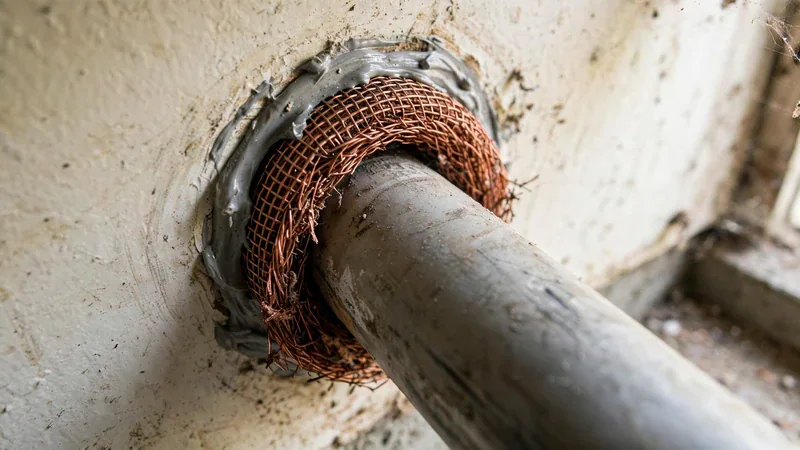
Mouse-Proof Materials: What Holds and What Fails
Mice gnaw constantly because their front teeth never stop growing. A weak material fails fast. We choose from a short list of materials that resist teeth and last outdoors.
- Quarter-inch hardware cloth: We use galvanized mesh over vents and larger holes. Rigid mesh holds its shape and passes airflow.
- Copper mesh: We pack it into pipe gaps. Copper does not rust, and mice find it hard to pull out.
- Sheet metal: We cover wide gaps and damaged trim where mesh cannot span.
- Escutcheon plates: We use them around pipes where they enter walls. They look neat and close the opening.
- Door sweeps and weatherstripping: We choose metal-backed products at exterior doors and garage doors.
- Mortar and concrete patch: We fill foundation cracks and gaps where masonry meets framing.
Where Steel Wool Fits
The CDC seal-up guidance recommends steel wool for small holes, held in place with caulk or foam. UC IPM calls steel wool a good temporary plug, but it may rust over time. We use it only as a stopgap, and we replace it with copper mesh or metal for a lasting repair.
When to Seal for Mice in California
Los Angeles rarely freezes, so mice stay active nearly all year. Still, patterns exist. Cooler, wetter weather in fall and winter pushes more mice toward warm structures. Heavy rain floods burrows and drives rodents to dry attics and garages. Many homeowners notice noise in the first cold snap.
Best Time to Seal
The best time to seal is before activity starts, usually late summer. The second best time is right now. Each week without sealing gives mice time to nest and breed. Mice reach breeding age quickly, so a small problem grows fast. Our page on mouse reproduction and population growth explains how fast numbers can rise.
Signs You Waited Too Long
Fresh droppings, grease marks along baseboards, and gnaw marks on food packaging point to active mice. If you see these signs, call us. We trap first and seal second.
What Changes the Scope of a Mouse Sealing Job
No two buildings need the same amount of work. We explain the scope in plain terms after the inspection, and these factors drive it.
Building Age and Style
Older homes usually have more settling cracks, worn weatherstripping, and loose trim. Newer homes often have fewer gaps, but they still carry open pipe collars and thin garage seals. Multi-unit buildings add shared walls and utility chases, so one unit's gap can feed several apartments.
Roof and Access
Steep roofs, tall two-story walls, and tight crawl spaces take longer to reach. We plan ladders, safety gear, and time around these limits. If a part of the roof is unsafe for our team, we say so and suggest a roofer for that section.
Existing Damage
Mice chew wiring, insulation, and wood. Before we seal, we note any damage that needs a separate trade, such as an electrician. Our guide to identifying rodent chew marks shows what to look for.
Surrounding Conditions
Dense landscaping, stacked storage, and clutter beside the foundation hide gaps and give mice cover. Clearing a two-foot strip along the walls speeds up inspection and makes repairs last longer.
Mouse Sealing Across Los Angeles Neighborhoods
PestPunt sends field representatives to homes across Los Angeles. Housing style, tree cover, and lot layout change what we find, so we plan each visit around the neighborhood. These examples show where homeowners often call us.
Central and Eastside LA
- Eagle Rock (90041): hillside bungalows with older vent screens
- Mid-City (90019): duplexes and courtyard buildings with shared walls
- Boyle Heights (90033): older homes with worn door sweeps
Westside and Beach Areas
- Venice (90291): walk-street homes with tight, shared walls
- Palms (90034): apartment buildings and small lot homes
- Westchester (90045): tract homes with attached garages
San Fernando Valley
- Encino (91316): ranch homes with attached garages
- Northridge (91324): single-story homes with slab gaps
- Van Nuys (91401): older apartments with pipe chases
Los Angeles ZIP codes we dispatch to include 90042, 90041, 90039, 90026, 90027, 90028, 90005, 90019, 90034, 90045, 90049, 90066, 90068, 90291, 91316, 91324, 91401, 91403, 91364, and 91604, plus nearby areas. If your ZIP code is not listed, call and ask. For more local detail, see our mouse proofing in Los Angeles page, our 24/7 Los Angeles rodent control page, and our Highland Park rodent exterminator page. We have no office, so our locations page lists where we dispatch.
Why Mice Find Los Angeles Homes So Easy
Los Angeles has no real winter freeze, so mice do not die back each year. They breed whenever food and shelter exist. Dense housing also helps them. Duplexes, bungalow courts, and apartment blocks share walls, pipe chases, and trash areas. A gap in one unit can feed a mouse into three others.
Stucco and Wood-Sided Homes
Many Los Angeles homes use stucco. Stucco cracks at corners and around windows, and mice follow the cracks to pipe collars and utility lines. Wood-sided homes often have gaps at trim joints and under sills.
Attached Garages
Garages across the Valley and the Westside connect directly to living space. A worn bottom seal or a gap at the garage-to-house door gives mice an easy route. We check both on every visit.
Rain Season Surges
Heavy winter rain pushes mice toward dry spaces. After the first storms, many Los Angeles homeowners notice scratching in cabinets or walls. Sealing in late summer beats sealing in a rush.
DIY Mouse Sealing or Professional Sealing?
You can handle some gaps yourself. Others need a trained eye and the right tools. Use this comparison to decide.
Good for DIY
- Door sweeps and weatherstripping
- Small pipe gaps under sinks
- Quarter-inch mesh over low vents
- Gaps in closets and cabinets
Better for a professional
- Rooflines, eaves, and tall walls
- Attic and crawl space openings
- Large or repeated gaps
- Homes with ongoing activity despite DIY
Homeowners often seal the gaps they can see and miss the ones they cannot. A second look from a field representative catches the rest. If you have tried peppermint oil, read why peppermint oil does not replace sealing, and see whether ultrasonic repellents work.
How to Check That a Mouse Seal Is Working
A repair is only good if mice stop coming. We teach homeowners a simple, three-week check after each job.
Week One
Look at each sealed spot at dusk. Fresh chew marks, scratches, or droppings beside a repair mean a mouse tested it. Photograph the spot and call us.
Weeks Two and Three
Place a few snap traps along walls in the kitchen, garage, and attic. Check them daily. Empty traps and clean droppings suggest the seal holds. A new catch tells us another gap exists.
Keep Food Out of Reach
Sealing works best when food stays hard to reach. Store pantry items in tight containers and fix leaks. Read what attracts mice into a home for a full list of lures to remove.
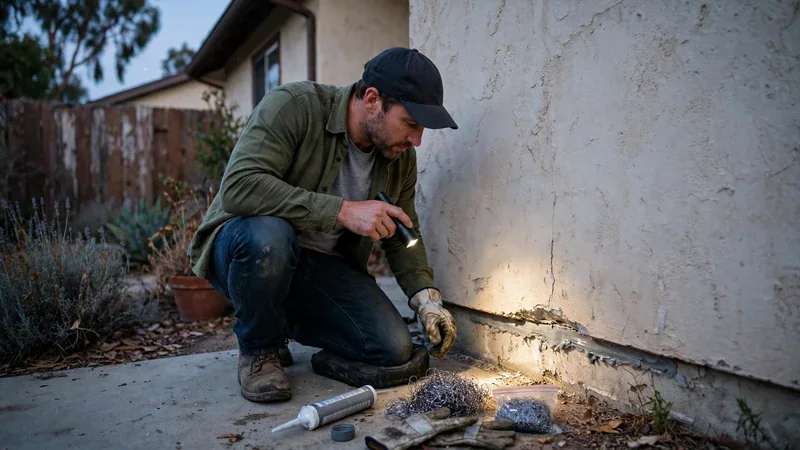
What Mouse Sealing Cannot Do
We tell you what sealing cannot do before you spend money. Sealing does not remove mice already inside. It does not clean droppings or nests. It does not repair rotted wood, cracked stucco, or plumbing leaks. It also cannot guarantee that no mouse ever appears, because a vehicle, a delivered box, or a neighbor's gap can bring one in.
What sealing does is remove the easy routes. That change drops the number of new mice sharply and makes remaining activity easier to catch. For cleanup after an infestation, see our droppings cleanup service and guide to cleaning mouse-contaminated areas.
Six Mistakes That Let Mice Back In
Trusting foam alone
Mice chew foam quickly. Pair it with metal behind it, or choose metal instead.
Ignoring the garage
Garage doors have many gaps, and mice travel from there into the house.
Sealing around live mice
Trapped mice gnaw new openings. Confirm they are gone first.
Skipping the roofline
Mice climb wires and siding. High gaps matter as much as low ones.
Using loose steel wool
It can rust and shift. Replace it with copper mesh for lasting protection.
Stopping at one repair
Mice test nearby gaps. Seal the entire building shell, not one spot.
Related Rodent Proofing Pages
Mice rarely arrive alone, and sealing rarely stops at mice. Use these links to match your next step.
- Rats too? Read about rat entry point sealing.
- Want an inspection first? See our rodent proofing inspection, the next page in this series.
- Curious about the whole house? Visit mouse entry points in the house.
- Need active removal? See mouse removal.
- Browse every PestPunt service.
Frequently Asked Questions About Mouse Entry Point Sealing
A house mouse can enter an opening larger than ¼ inch. UC IPM also reports that mice can squeeze under gaps ¼ inch tall and through holes about ⅜ inch wide. We seal anything near that size to stay safe.
Galvanized quarter-inch hardware cloth, copper mesh, sheet metal, and mortar work best. Steel wool plugs small holes in the short term, but it can rust. Foam and caulk help as a finishing layer, not as the main barrier.
Yes. Trap first and confirm that activity has stopped before the final seal. Mice locked inside will gnaw new routes and may die in walls. We handle both steps so they work together.
You can seal low, reachable gaps with mesh, sweeps, and sealant. Rooflines, attics, and crawl spaces need safe access and the right materials. If activity continues after your repairs, a field representative can find the missed gaps.
Try the pencil test. A standard pencil measures close to ¼ inch. If it slides into the gap, a mouse can likely follow. Treat any such gap as a possible entry point and seal it.
Sealing removes the main routes, and UC IPM calls exclusion the most permanent form of mouse control. No repair lasts forever, because buildings shift and age. Check sealed spots regularly and fix new gaps quickly.
Yes. Mice climb wires, siding, and pipes, and they can jump about 12 inches onto a flat surface. Open eaves and roof vents give them a way in. We check the roofline as part of every inspection.
We send field representatives across Los Angeles, including Highland Park, Eagle Rock, Silver Lake, Echo Park, Hollywood, Koreatown, Sherman Oaks, Studio City, Venice, Brentwood, and Westchester. We work as a Service Area Business and travel to you. Call to confirm your ZIP code.
Final Takeaways
Mouse entry point sealing works because mice need so little room. A gap near ¼ inch is enough, and most homes hold many. We find each one, close it with metal, and check that it holds. We trap first, seal second, and clean third.
If you hear scratching or find droppings, call PestPunt at (888) 217-6759. Our field representatives travel directly to your Los Angeles property. Next, read about the rodent proofing inspection we use to document every gap.
Mobile Rodent Control Services
Close the Quarter-Inch Gaps Before More Mice Arrive
Call (888) 217-6759 any hour. A PestPunt field representative will inspect your doors, pipes, vents, and roofline, and explain the right sealing plan.