
Mouse Proofing Services That Close Pencil-Width Gaps and Keep Mice Out
A mouse needs a gap about as wide as a pencil. Most homes have dozens. PestPunt field representatives travel to your Los Angeles property, find the small openings at doors, pipes, vents, and garages, and seal each one with materials mice cannot chew.
Mouse Proofing Services — At a Glance
What it blocks: House mice that squeeze through tiny gaps and nest in walls, cabinets, garages, and attics.
What it seals: Door bottoms, pipe and cable gaps, vents, AC line sets, garage corners, foundation cracks, and appliance gaps.
Why it matters: Mice breed fast. Pups can reach breeding age in about two months, so early sealing prevents a growing problem.
Next step: Call (888) 217-6759. A field representative comes to you, so you never visit an office.
What Mouse Proofing Services Include
Mouse proofing is rodent exclusion built around the smallest intruder. Mice are small, flexible, and curious. They explore every edge of a building, and they fit through openings that most people never notice.
A mouse proofing visit has three parts. First, a field representative inspects the building for small gaps, from door thresholds to pipe holes. Second, technicians seal each gap with metal and sealant. Third, the team traps any mice still inside and explains how to keep food and clutter from inviting new ones.
This page focuses on mice. If you want the full process, start with our rodent exclusion services overview. For rats, the gaps and routes differ, so see rat proofing services.
How Small a Gap Can a Mouse Use?
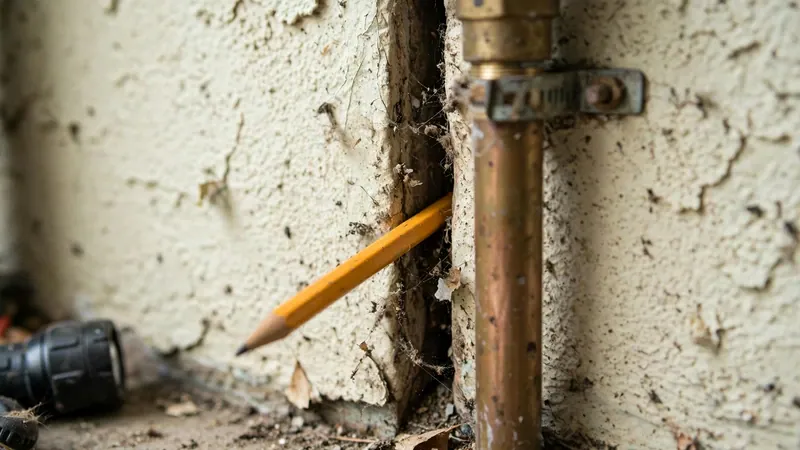
A house mouse can enter through an opening of about ¼ inch. That equals the width of a standard pencil or a dime. Young mice can slip through even smaller gaps than adults expect, because their bodies compress easily.
The CDC tells homeowners to look for gaps and holes inside and outside the home and to seal them, including gaps around attic and crawl space vents and around holes for electrical, plumbing, cable, and gas lines. Los Angeles County Public Health advises sealing exterior openings larger than ¼ inch and installing door sweeps or heavy weather stripping on exterior doors.
The Pencil Test
The simplest test uses a pencil. If a pencil slides into a gap, a mouse can likely slide through. Mark every gap you find with removable tape. A field representative then measures and ranks them.
Where Mice Enter and How Technicians Seal Each Spot
| Entry point | What mice use | Fix |
|---|---|---|
| Door bottoms | Worn sweeps, gaps under thresholds | New door sweeps and threshold seals |
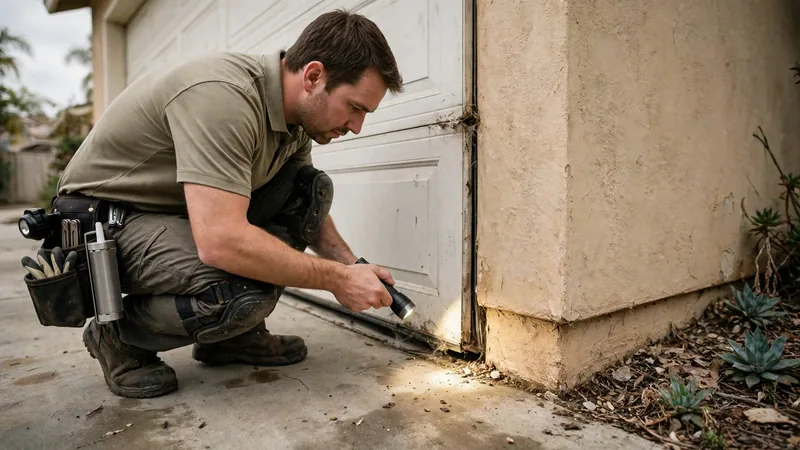
| Garage doors | Bottom seal gaps and corner gaps | Rodent-rated bottom and side seals |
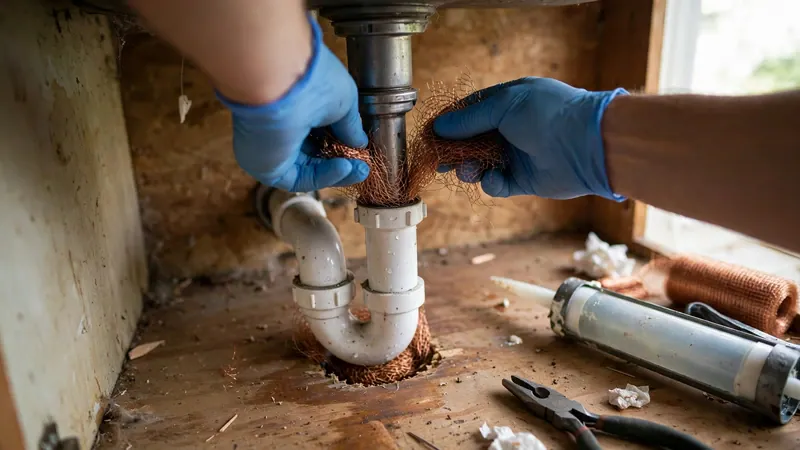
| Pipe and cable gaps | Oversized holes around lines | Copper mesh or steel wool plus sealant |
| AC line sets and dryer vents | Gaps around lines and loose covers | Metal mesh, sealant, and rodent-resistant covers |
| Foundation cracks | Hairline cracks and gaps at slab seams | Mortar or patching compound |
| Vents and louvers | Torn or oversized screens | ¼ inch galvanized hardware cloth |
| Behind appliances | Wall gaps behind stoves and refrigerators | Metal escutcheons and sealed wall gaps |
Our guide to finding mouse and rat entry points shows how to locate these gaps step by step.
Why Mice Are So Hard to Keep Out
Mice behave in ways that defeat casual repairs.
- They explore constantly. A mouse tests every edge and gap it meets. If one gap stays open, it finds it.
- They are active at night. You may never see them, even when many live in the walls. Read more in our guide on mouse activity patterns.
- They breed quickly. A female can carry pups for about three weeks, and pups reach breeding age at roughly two months. See our guide to mouse reproduction and population growth.
- They nest in small spaces. Wall voids, attic insulation, and storage boxes all work. Our guide to mouse nesting habits explains where to look.
Many people ask whether one mouse means an infestation. Our article on one mouse versus an infestation answers that, and our guide to how many mice live in one nest shows why a single sighting deserves attention.
Why Mice Thrive in Los Angeles Buildings
Apartments and Condos
Shared walls, trash rooms, and utility chases let mice move between units. In Koreatown (90020), Hollywood (90038), and East Hollywood (90029), one open gap can serve many homes.
Older Homes
Houses in Jefferson Park (90018), Windsor Square (90020), Baldwin Hills (90056), and Silver Lake (90039) often have worn sweeps, aging pipe penetrations, and settled foundations.
Valley Garages and Storage
Garages in Van Nuys (91405), Panorama City (91402), North Hills (91343), Granada Hills (91344), and Chatsworth (91311) often hold boxes, pet food, and seed that draw mice.
Mild weather also keeps mice active. They do not need a cold snap to look for shelter, and a warm, dry garage works year round. Field representatives commonly find mice using the same few gaps: the garage door corner, the dryer vent, and the hole behind the kitchen sink.
For one neighborhood example, see our Highland Park rodent exterminator page.
The Kitchen, Pantry, and Laundry Hot Spots
Mice go where food and shelter meet. Three interior zones deserve a close look.
Under the Kitchen Sink
Plumbing lines enter the wall through holes that builders often cut wider than needed. Mice use those gaps to reach the wall void. Technicians seal them with copper mesh and sealant, or install metal escutcheons.
Behind Appliances
The stove, refrigerator, and dishwasher sit against walls that hold wires and pipes. Gaps behind them give mice a hidden runway, plus warmth and crumbs. Technicians check and seal these gaps when the appliance can move safely.
Laundry Room and Dryer Vent
A loose dryer vent cover or a gap around the vent pipe lets mice walk right in. Technicians fit a rodent-resistant cover that still lets lint and air escape.
How a Mouse Proofing Visit Works
A mouse proofing visit pays close attention to small details. Here is the sequence a field representative follows.
Call and Share the Signs
Call (888) 217-6759 and describe noises, droppings, or sightings and where they appear.
Inspect Inside and Out
The representative checks door bottoms, pipe gaps, vents, garage corners, and appliance gaps.
Measure and Rank the Gaps
The representative tests suspect gaps with a probe and ranks them by how likely mice are to use them.
Review the Plan
You hear which gaps matter first, which materials will seal them, and how trapping fits in.
Trap and Seal
Technicians trap mice still inside, then seal the gaps from the outside in.
Verify and Follow Up
A final check confirms the repairs. The representative explains how to monitor the property.
A Six-Step Weekend Plan for Sealing Small Gaps
You can handle many small interior gaps yourself. This plan needs steel wool or copper mesh, caulk, gloves, a flashlight, and a pencil.
Check for Activity First
Look for fresh droppings and listen for noises at night. If mice are active, trap before you seal.
Gear Up
Wear gloves and a fitted respirator when you work near droppings. Wet any dust before you touch it.
Walk Every Room
Use the pencil test around pipes, cabinets, doors, and floor edges. Mark each gap with tape.
Pack the Gap With Metal
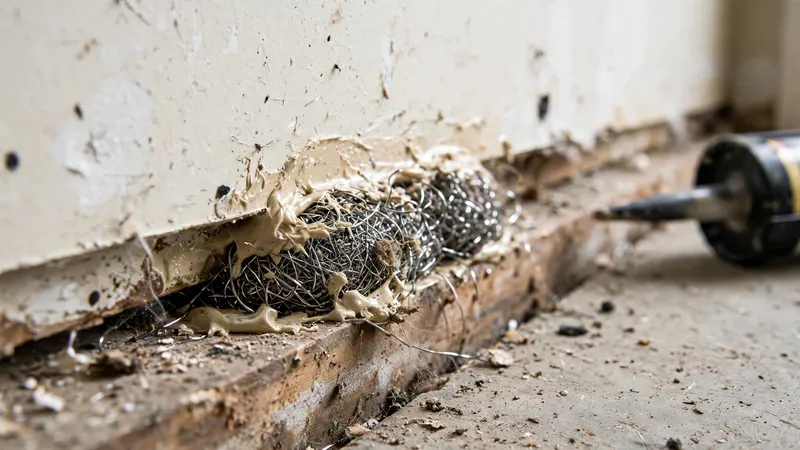
Push steel wool or copper mesh deep into each gap so no channel stays open.
Seal Over the Metal
Press caulk around the mesh to hold it. Use patching compound for wider cracks.
Recheck in a Week
Look for new droppings or gnawing. If you see them, call for a professional inspection.
Signs Mice Are Already Inside
Mouse signs appear early if you know where to look.
- Noises: Light scratching and scurrying in walls or ceilings at night. Our guides on mouse noises in walls at night and mouse noises in the house explain the sounds.
- Droppings: Small, dark, pointed grains about ¼ inch long near baseboards, drawers, and appliances.
- Gnaw marks: Small, rough holes in packaging, wood, and wire coating.
- Nests: Shredded paper, fabric, or insulation tucked into hidden corners.
- Odor: A stale, musky smell in closed spaces.
If you notice these signs, trap first and seal second. Our same-day mouse removal page explains the removal side of the process.
Mouse Proofing Versus Rat Proofing
Mouse Proofing Focus
- Gaps near ¼ inch
- Door sweeps, pipes, dryer vents, and garage corners
- Interior gaps behind appliances and cabinets
- Small-gap materials such as copper mesh and sealant
Rat Proofing Focus
- Gaps near ½ inch
- Rooflines, eaves, wires, and tree bridges
- Burrows, foundations, and drains
- Heavy-gauge mesh, flashing, and mortar
Many buildings need both approaches, because a rat-proof home can still leak mice through smaller gaps. If you are unsure which animal you have, read our guide on the difference between a Norway rat and a house mouse or the comparison of a house mouse and a baby rat.
Mouse Proofing in Apartments, Condos, and Rentals
Shared buildings add a layer of difficulty. Mice move through walls, ceilings, and utility chases, so a sealed unit can still receive visitors from next door. Three steps help.
- Start with your own unit. Seal pipe gaps under sinks, behind the stove, around the dryer vent, and at the front door. These spots sit within your control.
- Tell property management. Common areas, trash rooms, and the building exterior need sealing too. Share your photos and notes so management can act.
- Coordinate with neighbors. Mice cross unit lines. When several households act at once, the problem shrinks faster.
Renters should check their lease and ask permission before making permanent changes. Metal mesh and caulk usually count as minor repairs, but a manager may prefer to handle exterior and common-area work. A PestPunt field representative can explain which gaps fall under your responsibility and which need building-level action.
Seasonal Habits Worth Keeping
Check your seals after heavy rain, after any repair work on the building, and when you move boxes in or out of storage. Put pet food away at night, wipe crumbs from counters, and keep trash lids tight. These simple habits remove the food that makes small gaps worth the trip for a mouse.
Why Sealing Matters More Under California Rules
California has prohibited most residential use of anticoagulant rodenticides since January 1, 2025. UC Agriculture and Natural Resources explains the earlier limits on second-generation products. For mice, that means traps, sealing, and sanitation carry the work.
This approach also avoids a common problem. Poisoned mice can die inside walls and cause odor. Sealing and trapping reduce that risk and keep pets and children safer.
Los Angeles Neighborhoods and ZIP Codes We Serve
PestPunt dispatches field representatives across Los Angeles. The list below shows common areas, and the representative confirms your address on the call.
- Hollywood and Mid-City: Hollywood (90038), East Hollywood (90029), Koreatown (90020), Windsor Square (90020), Jefferson Park (90018), Baldwin Hills (90056).
- Eastside and Northeast: Silver Lake (90039), Atwater Village (90039), Eagle Rock (90041), Highland Park (90042).
- Westside: Westwood (90024), Palms (90034), Mar Vista (90066), Playa Vista (90094).
- San Fernando Valley: Van Nuys (91405), Panorama City (91402), North Hills (91343), Granada Hills (91344), Chatsworth (91311), Porter Ranch (91326), Winnetka (91306).
- Harbor Area: San Pedro (90731), Wilmington (90744).
Browse our locations page or the rapid rodent control page for Los Angeles for more.
When to Handle It Yourself and When to Call
You Can Handle It When
- You see signs in one room.
- You can reach and see the gap.
- Only one or two mice appear.
- You are comfortable with traps and metal fillers.
Call a Professional When
- You hear activity in walls, ceilings, or the attic.
- Droppings appear in many rooms.
- You share walls with other units.
- Mice return after you sealed gaps.
What to Ask Before You Hire a Mouse Proofing Provider
Mouse proofing demands patience, because small gaps hide everywhere. Ask these questions to find a careful provider.
- Will you inspect inside the home, not only outside?
- How will you seal small gaps so mice cannot pull the filler out?
- How will you trap mice that are already inside?
- How will you handle droppings and nesting material?
- What will you check at the follow-up visit?
Learn more about our approach on our about page or see all PestPunt services.
Six Mouse Proofing Mistakes to Avoid
1. Using Foam Alone
Mice chew through foam quickly. Pack metal into the gap first, then seal over it.
2. Missing Tiny Gaps
Mice fit through pencil-width gaps. Test each gap instead of judging by eye.
3. Sealing With Mice Inside
Trapped mice chew new holes or die in walls. Trap before you seal.
4. Leaving Food Out
Pet food, crumbs, and open boxes keep mice nearby. Store food in sealed containers.
5. Ignoring the Garage
Garage corners and bottom seals often stay open. Check them with the door closed.
6. Skipping the Recheck
New gaps form as buildings age. Look again after a week and twice a year.
Frequently Asked Questions About Mouse Proofing Services
Mouse proofing services seal the small openings that mice use to enter a building. Technicians close gaps at door bottoms, pipes, vents, dryer lines, garage corners, and foundation cracks, then trap mice that remain inside and explain how to limit food and clutter.
A house mouse can enter through a gap of about ¼ inch, roughly the width of a pencil or a dime. Public health guidance recommends sealing exterior openings larger than ¼ inch with durable materials.
Copper mesh and steel wool backed by caulk, galvanized hardware cloth, cement mortar, and metal escutcheons all resist gnawing. Foam, plastic, and soft caulk alone fail, because mice chew through them.
No. Proofing blocks entry. Trapping removes mice that are already inside, and cleanup handles droppings and nesting material. A good plan combines all three and confirms the building is clear before the final seal.
Mice return when gaps stay open and food stays available. They explore constantly and breed quickly. Sealing every small gap and storing food in sealed containers breaks the cycle.
California has prohibited most residential use of anticoagulant rodenticides since January 2025. Poison can also cause mice to die inside walls. Trapping and sealing give safer, more reliable control for most homes.
Yes. Shared walls, trash rooms, and utility chases let mice move between units. A good plan checks common areas, coordinates with neighbors or management, and seals gaps in each affected unit.
Call (888) 217-6759 at any hour. Share your address, building type, and the signs you noticed. PestPunt is a mobile service area business, so a field representative comes to your property.
Final Takeaways
Mouse proofing works when you seal every gap near ¼ inch with metal and sealant, trap the mice inside, and keep food in sealed containers. Pay special attention to door bottoms, pipes, dryer vents, garage corners, and gaps behind appliances. To see the full process from the start, review our rodent exclusion services.
If you hear noises, find droppings, or spot damage, call PestPunt at (888) 217-6759. Our field representatives travel directly to your property anywhere in California.
Mobile Rodent Control Services
Close the Small Gaps Before the Mice Multiply
Call (888) 217-6759 to schedule on-site mouse proofing for your Los Angeles home, apartment, or business.