
10 Early Signs of Rodent Infestation in Your California Home (And What to Do)
Rats and mice hide by day and leave clues at night. This guide shows you the signs of rodent infestation to check first, how to tell mice from rats, and the exact steps to take in the first 48 hours. When the signs keep coming, our field representatives travel to your property anywhere in California.
Signs of Rodent Infestation — At a Glance
What to look for: Dark droppings, scratching at night, gnaw marks, rub marks, nests, odor, food damage, tracks, outdoor burrows, and live sightings.
Where to look: Behind appliances, under sinks, in garages, along attic joists and eaves, in crawl spaces, and around fruit trees and utility lines.
Safety first: Air out the space, wear gloves, spray droppings until wet, and never sweep or vacuum them dry.
Key takeaway: Count the signs and the locations. A pattern means act now, before one nest becomes several.
What Counts as an Early Sign of Rodent Infestation?
An early sign of rodent infestation is any fresh evidence that rats or mice live, feed, or nest inside your property. You do not need to see an animal. Rodents hide by day, move at night, and leave clues long before one runs across your kitchen floor.
Most California homeowners find the first clue by accident. They hear a faint scratch above a ceiling, spot a few dark droppings behind the toaster, or notice a chewed corner on a cereal box. One clue alone can mislead you. Several clues together tell a clear story. This guide teaches you to read that story, confirm it, and act on it.
One Sign vs. a Pattern
A single dropping may mean one mouse slipped in last night. Droppings in three rooms, plus night noise and a chewed bag, point to an established problem. Our guide on one mouse vs. an infestation explains this difference in depth. Use a simple rule: count the signs, then count the locations. Two or more signs in two or more places mean you should act today, not next week.
Strong, Moderate, and Weak Clues
- Strong clues: fresh droppings, a nest, gnaw marks with pale clean edges, and a live rodent.
- Moderate clues: night noises, rub marks, a musky smell, and torn packaging.
- Weak clues on their own: a pet that stares at a wall, one old dropping, or one unexplained smell.
No single clue tells you how many rodents live in your home. A technician confirms the scale by inspecting the whole structure, not by reading one sign. If your signs already look worse than this, read our page on signs a mouse infestation is getting worse.
Signs 1–5: Evidence You Can See and Hear First
These five signs show up first in most homes. You can check each one in a single evening with a flashlight and a pair of disposable gloves.
1. Droppings
Droppings give you the fastest confirmation. House mouse droppings look like dark grains of rice with pointed ends, about 1/8 to 1/4 inch long. Rat droppings run larger. Fresh droppings look dark and moist. Old droppings turn gray and crumble. Do not touch them with bare hands.
Check baseboards, the backs of cabinets under sinks, the space behind the refrigerator, attic joists, and the area around pet food bowls. UC IPM rat guidance lists droppings near pet food and storage areas as a classic rat sign. Mice drop pellets where they feed, so scattered droppings near food mark their feeding route. For help with size and shape, see our guide on roof rat droppings.

2. Scratching, Scurrying, and Squeaking at Night
Mice stay mostly active at night, according to UC IPM, so the first clue often arrives after the lights go off. Listen for light scratching inside a wall, quick scurrying above a ceiling, or faint squeaks near a pantry. Rats make heavier sounds, and UC IPM lists noises from attics and drop ceilings as a rat warning.
Location helps you narrow the species. Sounds overhead often point to roof rats. Sounds low in a wall or behind a kitchen appliance often point to mice. Sit quietly for 30 minutes after dark and note the time and place of each sound. Our guide to mouse noises in the house and our page on when mice are active explain what each sound means.
3. Gnaw Marks and Chewed Items
Rodent teeth never stop growing, so rodents gnaw constantly. They chew wood, cardboard, plastic, soap, and wire insulation. Fresh gnaw marks look pale and clean. Old marks look dark and smooth. UC IPM notes that rats leave tooth marks about 1/6 inch wide, while mouse marks look scratchy and measure about 1/12 inch.
Treat chewed wires as an urgent hazard. UC IPM reports that many fires of unknown origin may trace back to rodents gnawing on wiring. Our page on why rats chew through wires and wood covers the risk in detail. Check your car's engine bay too, because rodents like to chew vehicle wiring.
4. Rub Marks and Grease Smudges
Rodents follow the same routes every night. Their fur carries body oil and dirt, so it leaves dark smudges where they brush against surfaces. Look along baseboards, pipes, beams, rafters, and the edges of entry holes. UC IPM lists smudge marks on beams, rafters, pipes, and walls as a standard rat sign.
A smudge works like a map. It shows you where the animals travel, so it also shows you where to place traps and where to look for the entry gap. Fresh smudges feel slightly greasy. Old smudges look dusty.
5. Nests and Shredded Material
Mice build nests from finely shredded paper, fabric, insulation, and other fibrous material. UC IPM advises you to search behind boxes, in drawers, in garages, and around woodpiles. Roof rats favor attics, wall voids, ceiling voids, and cabinets. Norway rats dig burrows along foundations and under debris.
Do not tear a nest apart. You will scatter the animals and spread contaminated dust. Photograph it, mark the spot, and read our guides on rodent nest identification and how to find a mouse nest in walls or attic.
Signs 6–10: Odors, Tracks, Food Damage, and Outdoor Clues
The next five signs take a little more detective work. They also tell you how long the problem has lasted and where the animals live.
6. A Musky or Ammonia-Like Odor
Mice leave a characteristic musky smell. UC IPM says this odor is common in large or long-term infestations. That detail matters in two ways. A strong smell suggests the problem has lasted a while. No smell does not mean you are safe, because a young infestation may not smell at all.
A sharp, rotting smell is different. It usually means a rodent died in a wall, attic, or crawl space. Our page on dead rodent removal in California explains how professionals locate and remove the source.
7. Tracks, Runways, and Urine Stains
Rodents leave footprints and tail drags in dust, especially in attics, garages, and behind appliances. Shine a flashlight at a low angle across a dusty surface and the trails will stand out. Look for narrow, repeated paths along walls. Dark urine stains may appear on cardboard, insulation, and stored fabric. A UV flashlight can highlight urine, but many household substances glow too, so use it as a hint, not proof.
8. Chewed Food Packaging and Hoarded Food
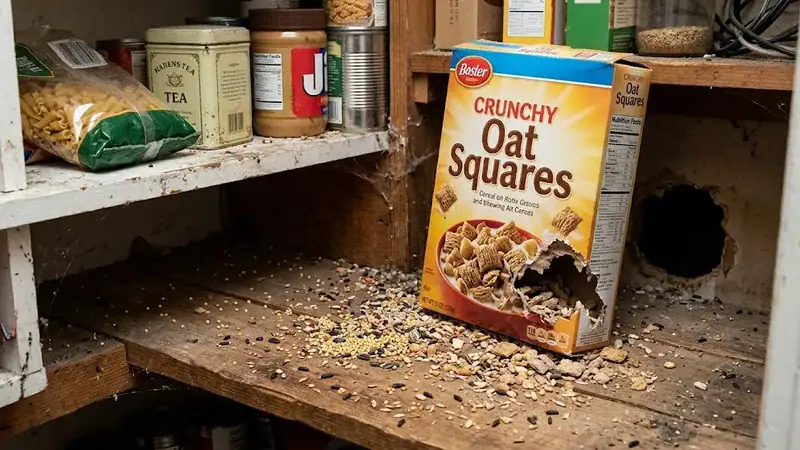
Open your pantry and check the bottom shelf first. Look for torn cereal boxes, chewed grain bags, holes in pet food sacks, and small piles of seeds or kibble tucked into drawers, shoes, or corners. UC IPM reports that a house mouse eats about 20 percent of its body weight each day, spread across roughly 200 small meals a night. Those habits leave a lot of evidence behind.
Throw away any food that a rodent touched. Droppings and urine contaminate it, even when the food looks fine.
9. Outdoor Signs: Burrows, Damaged Fruit, and Rats on Wires
Indoor signs often start outside. UC IPM lists several outdoor clues that California homeowners should check:
- Burrows beneath garbage cans, compost piles, sheds, and garden plants
- Gnawed fruit or nuts on trees and on the ground, including hollowed-out citrus rinds and chewed avocados
- Rats that run along utility lines or fence tops at dusk
- Nests in woodpiles or behind boxes in the garage
- Droppings in recycling bins
If you find burrows, read our guide on how to destroy rat burrows in your yard. Roof rats can travel 300 feet or more for food, so a neighbor's fruit tree can feed a rat that nests in your attic.
10. Live Sightings and Pet Reactions
Seeing a live rodent is a strong sign, but the timing matters. UC IPM says mice mostly move at night but sometimes appear in daylight. It also says people rarely see rats unless the area has a serious infestation. If you spot a rat in daylight, treat it as urgent.
Dogs and cats often detect rodents before you do. A pet that stares at a wall, paws at a cabinet, or sniffs one spot over and over gives you a place to start looking. A pet cannot confirm an infestation by itself. Keep pets away from droppings, dead rodents, and bait, because rodent poisons can harm them.
Mouse, Roof Rat, or Norway Rat? Read the Clues
The species decides the strategy. A mouse trap will not stop a rat, and a rat nest in the attic needs a different plan than a mouse nest behind the stove. UC IPM stresses that you should know which species you have before you choose control methods. Use the table below as a field guide.
| Clue | House Mouse | Roof Rat | Norway Rat |
|---|---|---|---|
| Droppings (typical) | About 1/8–1/4 inch, pointed ends | About 1/2 inch, pointed ends | Larger, often blunt ends |
| Weight (adult) | About 1/2 ounce | 5 to 10 ounces | 7 to 18 ounces |
| Tail | Nearly hairless, about as long as head and body | Longer than head and body | Shorter than head and body |
| Gnaw marks | Scratchy, about 1/12 inch | Larger tooth marks, about 1/6 inch | Larger tooth marks, about 1/6 inch |
| Where it lives indoors | Kitchens, garages, behind boxes, wall voids | Attics, wall voids, ceiling voids, cabinets | Basements and ground floors |
| Nest style | Finely shredded fibrous material | Elevated, enclosed spaces; trees and dense vegetation outdoors | Burrows along foundations and under debris |
| Smallest gap used | About 1/4 inch | Rats squeeze under doors with about 1/2-inch gaps | Rats squeeze under doors with about 1/2-inch gaps |
Roof rats dominate many coastal and warm California neighborhoods, especially where ivy, palms, and fruit trees surround the house. Our guides on the roof rat and Norway rat and the Norway rat and house mouse add photos and measurements.
One more species deserves a mention. Deer mice live throughout California and can carry hantavirus, according to the California Department of Public Health. They look different from house mice, with a white belly and a furred tail. Read our page on deer mice dangers and health risks if you find signs in a cabin, shed, or rural property.
Where to Look: A Room-by-Room Inspection Checklist
Rodents choose spots that give them food, warmth, and cover within a short walk. UC IPM reports that house mice rarely wander more than 30 feet from their nest and food, so a sign in one spot usually means a nest sits nearby. Take a flashlight and work through these zones in order.
Kitchen and Pantry
- Look behind and under the refrigerator, stove, and dishwasher.
- Check the pipe holes under sinks, where gaps often hide.
- Open lower cabinets and inspect the back panels for gnaw holes.
- Check the bottom shelf of the pantry for torn packaging.
Garage and Storage
- Open cardboard boxes and check for shredded paper or fabric.
- Look under the garage door seal for light or chewed edges.
- Check pet food and birdseed containers.
- Raise the hood of any parked car and check the engine bay.
Attic and Eaves
- Scan the insulation for tunnels and flattened trails.
- Check the eaves, soffit vents, and roof edges for gaps.
- Look around ducts, chimney chases, and wall tops.
- Step only on joists and wear a respirator in dusty attics.
Crawl Space and Exterior
- Walk the foundation and look for burrows and gnawed vents.
- Check where pipes, cables, and AC lines enter the wall.
- Inspect fruit trees, ivy, and branches that touch the roof.
- Look at the compost bin, wood pile, and trash can area.

How to Record What You Find
Take a clear photo of every sign. Add a coin or a ruler for scale. Write the date and the room on a sticky note or in your phone. These notes help a technician identify the species fast, and they show you whether signs spread or shrink over the next week. For deeper hiding-spot detail, see our page on where mice hide during the day.
Why California Homes Face Rodent Pressure in Autumn
California gives rodents a long season. Rats and mice stay active all year, and several local conditions raise the risk.
Cooler Nights Push Mice Indoors
UC IPM reports that house mice frequently enter homes in autumn, when nighttime temperatures drop. Late October falls right inside that window, so this is a smart time for a full inspection of your attic, garage, and exterior.
Roof Rats Love Mature Landscaping
According to UC IPM, roof rats prefer warm climates and coastal areas. They nest in shrubs, trees, ivy, and dense vegetation, then enter attics through gaps in the roofline. They eat citrus, avocados, nuts, and berries, so a backyard fruit tree can feed a colony. Overhanging branches give them a bridge to your roof.
Norway Rats Thrive Near Waste and Waterways
Norway rats live throughout California cities. They dig burrows along foundations and under trash, compost, and wood piles. Open dumpsters, spilled pet food, and cracked slabs help them settle in.
Deer Mice Add a Health Concern
The California Department of Public Health reports that deer mice carry Sin Nombre hantavirus and live throughout the state. California records about three infections per year, so the risk stays low. The illness can turn severe, though, so you should always use safe cleanup methods.
To learn which household conditions attract rodents, read our page on what attracts mice into a home.
What to Do in the First 48 Hours: A Six-Step Plan
You found a sign. Now act in the right order. These six steps protect your health, preserve the evidence, and keep the rodents from spreading.
Leave Nests Alone and Stay Calm
Do not pull out a nest or chase an animal. You will scatter the rodents into new areas and stir up contaminated dust. Photograph the nest and mark its location with tape.
Photograph and Map Every Sign
Take photos of droppings, gnaw marks, smudges, and damage. Note the date, room, and amount. A simple sketch of your floor plan with dots for each sign shows you the travel routes.
Air Out, Then Wet-Clean Droppings
Open doors and windows for 30 minutes. Put on gloves. Spray droppings with disinfectant or a fresh bleach solution until very wet, wait at least 5 minutes, then wipe with paper towels. Bag the waste and wash your hands. The CDPH hantavirus guidance gives the full method.
Seal Food and Pet Food
Move pantry food into glass, metal, or thick plastic containers. Feed pets only what they finish in one sitting. Seal garbage containers. Less food makes your traps work better.
Set Snap Traps Along Walls
UC IPM recommends snap traps for most homes. Place them behind objects and in dark corners, with the trigger end next to the wall. Space mouse traps about 10 feet apart, use pairs along busy routes, and add only a pea-sized dab of bait. Keep traps away from children and pets.
Seal Gaps Larger Than ¼ Inch
Mice squeeze through gaps about the width of a pencil. Plug small holes with steel wool as a temporary fix, then close them permanently with metal or concrete. Check that no rodent remains inside before you seal a hole, so nothing dies in the wall.
How to Confirm an Active Infestation in One Week
Old droppings can fool you. This seven-day check separates a past visit from an active problem, and it gives you clear facts before you decide what to do next.
Clean One Test Zone
Wet-clean a small area, such as a 3-foot strip along one baseboard, using the safe method above. Mark the date on masking tape. Fresh droppings the next morning prove that rodents still use that route.
Keep a Night Noise Log
Write down the time, room, and type of each sound for three nights. Repeated sounds at the same spot suggest a nest or a main travel route. Random, one-time sounds may come from pipes or settling wood.
Check Trap Results Daily
Look at your traps each morning. Caught animals confirm activity. Bait that disappears without a snap means the trigger needs to be more sensitive or the bait portion smaller. Rats often avoid new objects for several days, so patience matters.
Watch With a Night Camera
Point a phone or a small trail camera at a suspected route for one night. The footage shows the species, the travel time, and the entry point. It also helps a technician plan the visit.
Inspect at Dusk Outside
Walk your yard 30 minutes after sunset. Watch utility lines, fence tops, and tree limbs for rats. Check fruit trees for hollowed rinds. Look for fresh soil near foundations and sheds.
Compare Day 1 and Day 7
Review your photos and notes. New signs after a week of trapping and sealing mean activity continues. That result tells you the nest or entry point still needs professional attention.

Six Mistakes That Let Rodent Problems Grow
1. Waiting to See a Rodent
Rodents avoid people. By the time you see one in daylight, the nest may already hold several animals. Act on droppings, noise, and gnaw marks.
2. Sweeping or Vacuuming Droppings
Dry cleaning launches dust into the air. Public health agencies, including CDPH, tell you to wet the area first and wipe it up with disposable towels.
3. Plugging Holes With Foam or Plastic
UC IPM warns that rodents chew through expanding foam, plastic, rubber, vinyl, and wood. Use metal, concrete, or hardware cloth instead.
4. Trusting Ultrasonic Devices
UC IPM finds little evidence that sound, magnetic, or vibration devices drive established rats or mice out of a building. Rodents quickly get used to repeated noises.
5. Using Poison First
Poison can send rodents to die in your walls and can harm pets and wildlife. Traps and exclusion give you control without those risks.
6. Setting One Trap in One Room
UC IPM advises using enough traps to keep the trapping period short. Place several traps along each route, and inspect the whole property, including the attic and the yard.
Health Risks of Rodent Droppings, Urine, and Nests
Rodent signs are more than a nuisance. UC IPM reports that house mice carry diseases such as leptospirosis, salmonella, and lymphocytic choriomeningitis (LCM). UC IPM lists typhus, leptospirosis, foodborne illness, and rat bite fever among the diseases rats can spread. Understanding the risk helps you clean safely and decide when to call for help.
Main Risks to Know
- Hantavirus: deer mice spread it when people breathe dust from dried urine, droppings, or saliva.
- LCM: UC IPM estimates that about 5 percent of house mice in the U.S. carry the virus.
- Salmonella and other bacteria: rodents contaminate food and surfaces.
- Allergens: mouse urine proteins have been linked to asthma in sensitive children.
When to See a Doctor
- You have a fever, headache, muscle aches, or trouble breathing after rodent exposure.
- CDPH says hantavirus symptoms usually appear 1 to 6 weeks after exposure.
- Tell your provider about the rodent contact, especially deer mice.
- Early medical care improves the outlook for serious cases.
PestPunt offers rodent cleanup and decontamination services for heavy contamination, and you can follow our step-by-step page on how to clean areas contaminated by mice for small jobs. Los Angeles homeowners can also read about our rodent droppings cleanup service in LA.
DIY or Professional? How to Decide
You can handle a small, early problem yourself. Some situations need a trained technician, because the cause sits where you cannot see it. Use these lists to decide.
DIY Can Work When
- You find a few droppings in one room.
- Traps catch an animal within a day or two and new signs stop.
- You can see and reach every entry gap.
- No one in the home has a weakened immune system or asthma.
Call a Professional When
- You see signs in several rooms or on several floors.
- You hear noise in walls or the attic and cannot find the source.
- New signs appear after a week of trapping.
- You suspect roof rats, chewed wiring, or a dead animal in a wall.
- You find heavy droppings, soaked insulation, or strong odor.
- The attic or crawl space feels unsafe to enter.
What a Professional Inspection Covers
A proper visit checks the whole structure, not only the room where you saw the problem. Your technician looks at the roofline, vents, foundation, attic, crawl space, and utility entries. They identify the species, trace the travel routes, find the nest sites, and map every entry point. Then they explain which control steps fit your property and which cleanup tasks need protective equipment.
Attic problems deserve special attention. Learn more about our California attic rodent solutions, or read about fast mouse removal and professional rat removal across California.
What Happens When You Call PestPunt
PestPunt is a California Service Area Business. We do not run a walk-in office. Instead, we send a field representative to your home or business and do the work on site. Here is what to expect from the first call to the finished job.
Before the Visit
- You call the 24/7 dispatch line.
- We ask what you saw, where, and for how long.
- We ask about pets, children, and attic or crawl space access.
- We schedule the earliest available visit for your area.
During the Visit
- Our representative inspects the interior and exterior.
- They identify the rodent species.
- They locate nests, routes, and entry points.
- They explain the recommended control and sealing steps.
After the Visit
- You get clear next steps for sanitation and prevention.
- You can add cleanup or decontamination if needed.
- You learn which signs to watch for in the coming weeks.
- You can call again if new signs appear.
What to Tell Us When You Call
- Your city and property type (house, apartment, shop, or restaurant)
- Which signs you found and where you found them
- When you first noticed each sign
- Whether you saw a rodent and what it looked like
- Whether you have used traps, poison, or sealing materials
- Any photos you took, plus attic and crawl space access details
How to Choose Any Rodent Control Provider
Ask every company the same questions before you book. Strong providers inspect the whole property, explain how they will close entry points, and describe their cleanup options. Ask for the company's license number and verify it with the state. Be careful with anyone who promises results without an inspection, relies only on poison, or ignores the gaps that let rodents in.
Prevention Checklist: Keep Rodents From Coming Back
Prevention costs less than treatment. UC IPM calls exclusion the most successful and permanent form of house mouse control, and it ranks structural exclusion first for rats as well. Use this checklist each autumn and spring.
Exterior
- Seal every gap larger than 1/4 inch around pipes, vents, cables, and foundation edges.
- Cover vents and openings with hardware cloth or metal. Avoid foam, plastic, rubber, and wood.
- Install tight door sweeps, including on the garage door.
- Prune tree limbs back from the roof. UC IPM suggests clearing limbs within 3 to 6 feet.
- Thin ivy, star jasmine, and dense shrubs near the house.
- Pick up fallen fruit and keep woodpiles off the ground and away from walls.
Interior
- Store dry food, pet food, and birdseed in rodent-proof containers.
- Switch from cardboard to sealed plastic bins in garages and attics.
- Clean behind appliances twice a year and check for new signs.
- Fix leaks and remove standing water.
- Keep clutter low so rodents have fewer places to nest.
Yard and Seasonal Habits
Close trash lids tightly and keep compost in a sturdy bin with a secure lid. Feed pets only what they finish. Walk the attic and the foundation each autumn, before cold nights push mice indoors, and again in early spring. To understand how fast an overlooked problem grows, read our guides on mouse reproduction and population growth and how many mice live in one nest.

Rodent Control Across California
PestPunt dispatches field representatives statewide. The right strategy changes with the region, because coastal neighborhoods, inland valleys, and dense cities attract different rodents. Choose your area below for local detail, or browse our full list of service locations and rodent services.
- Los Angeles: fast rodent control in Los Angeles and rapid rodent control in LA
- San Francisco Bay Area: rodent pest control in San Francisco, 24/7 rodent removal in San Francisco, and rodent exterminators in San Jose
- San Diego: emergency rodent removal in San Diego
- Central Valley and Capital Region: Fresno rodent exterminator and rodent pest control in Sacramento
- Long Beach: fast rodent control in Long Beach
Do not see your city? Call anyway. We serve homes and businesses across California.
Frequently Asked Questions About Signs of Rodent Infestation
The first signs usually include dark droppings, scratching or scurrying at night, gnaw marks, grease smudges along walls, shredded nesting material, and chewed food packaging. Check baseboards, cabinets under sinks, garages, and attic edges first. Two or more signs in different places often point to an active problem.
Check droppings, gnaw marks, and location. Mouse droppings measure about 1/8 to 1/4 inch and gnaw marks look scratchy. Rat droppings run larger and tooth marks measure about 1/6 inch. Sounds in the attic or ceiling often point to roof rats, while basement and ground-floor activity often points to Norway rats or mice.
Yes, they can be. Droppings, urine, and nesting material can carry bacteria and viruses, including hantavirus from deer mice. Never sweep or vacuum them dry. Air out the room, wear gloves, spray the area until very wet, wait at least 5 minutes, and wipe it up with paper towels.
No fixed number exists, and no single sign proves how many rodents live in your home. Look at the pattern instead. Signs in two or more rooms, fresh droppings after you clean, repeated night noise, or a nest usually point to an active infestation that deserves a professional inspection.
Yes. A small or new infestation may stay quiet, and thick insulation can muffle sound. Droppings, grease smudges, gnaw marks, and food damage can appear before you hear anything. Rely on several types of evidence, and do not treat silence as proof that your home is clear.
Mice leave a musky, ammonia-like odor that grows stronger in large or long-term infestations. A sharp rotting smell usually means a rodent died in a wall, attic, or crawl space. A missing smell does not prove you are safe, because early problems may not smell at all.
Start with snap traps, sanitation, and sealing entry points. UC IPM recommends trapping for most home situations. Poison can kill rodents inside your walls, causing odor, and it can harm pets, children, and wildlife. California also restricts many rodenticides, so ask a licensed professional before you use any bait.
Call when you find signs in several rooms, hear noise in walls or the attic, see a rat in daylight, suspect chewed wiring, or notice new signs after a week of trapping. Also call for heavy contamination or a strong odor. PestPunt dispatches field representatives statewide on a 24/7 line.
Final Takeaways
The key signs of rodent infestation are droppings, night noises, gnaw marks, rub marks, nests, odors, tracks, food damage, outdoor burrows, and live sightings. Count both the signs and the places you find them, because a pattern tells you more than a single clue. Identify the species, wet-clean safely, set snap traps along walls, and seal every gap larger than 1/4 inch with metal or concrete. Avoid sweeping, foam plugs, ultrasonic gadgets, and DIY poison.
If signs spread, return after a week of trapping, or appear in the attic or walls, call PestPunt at (888) 217-6759. Our field representatives travel directly to your property anywhere in California.
Mobile Rodent Control Services
Stop Rodents Before One Nest Becomes Several
Early action saves time, money, and stress. Call (888) 217-6759 to describe your signs and book a full property inspection with a PestPunt field representative.